
Exploring the Meaning of Thauma in Greek
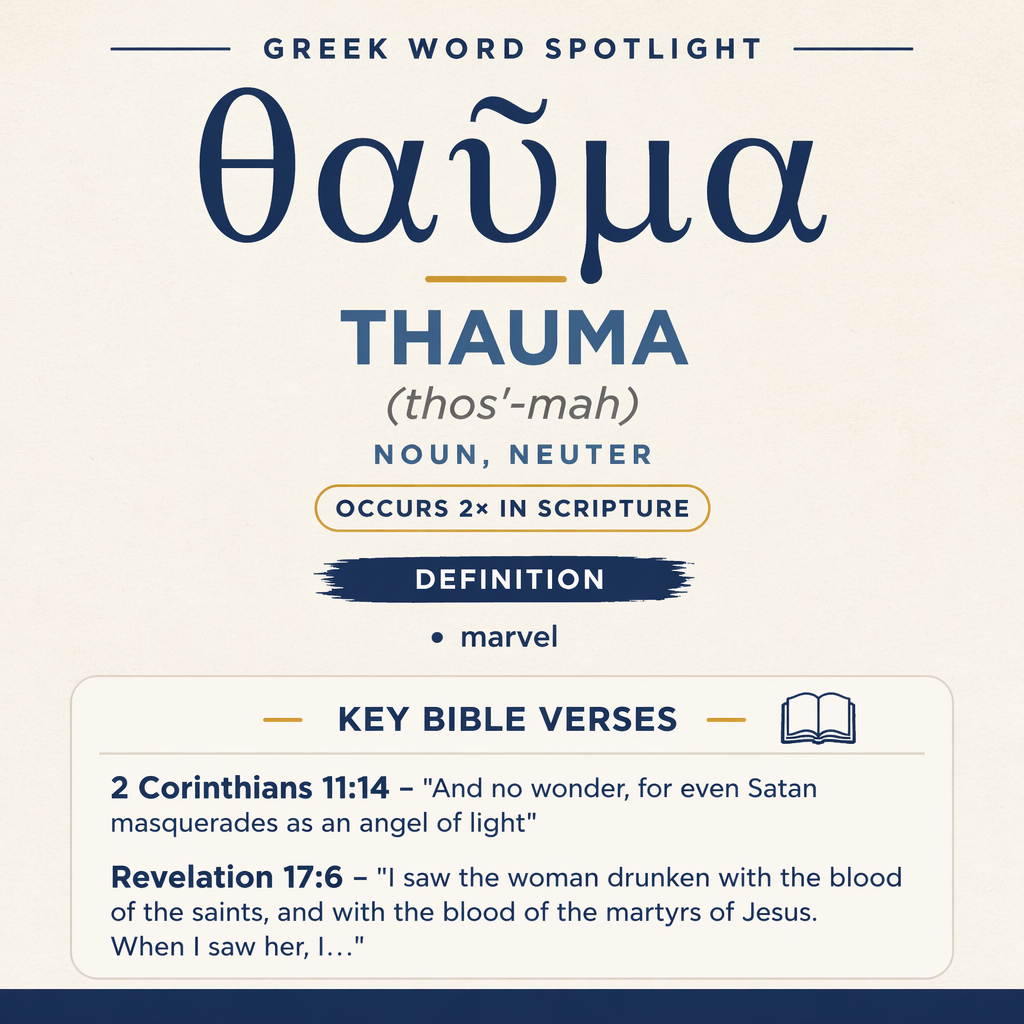
θαῦμα (Thauma) means “marvel” and appears twice in Scripture, in 2 Corinthians 11:14 and Revelation 17:6.
Scripture Occurrences
It occurs 2 times in Scripture: 2 Corinthians 11:14 and Revelation 17:6.
Learn More →Context Examples
In 2 Corinthians 11:14 it appears in “And no wonder.” In Revelation 17:6 it appears in “When I saw her, I wond…”.
Learn More →θαῦμα means “marvel.” It appears in two New Testament contexts: a brief aside in Paul’s argument about deception and disguise, and John’s reaction of astonishment when he sees the bloodstained woman in his vision.
Root and Related Words
θαῦμα is related to the verb theaomai (θεάομαι), “to look at” (Strong’s G2300). The connection places the word in the orbit of what is seen and the reaction that follows from looking.
Occurrences
“And no wonder, for even Satan masquerades as an angel of light.” (2 Corinthians 11:14)
Here the term frames Paul’s point as something that should not surprise his readers. The sentence is concise and emphatic: “And no wonder,” followed immediately by the reason—“for even Satan masquerades as an angel of light.” The marvel is not treated as an admirable response but as an expectation of surprise that is deliberately removed. By introducing the claim with a negated sense of astonishment (“no wonder”), the wording guides the audience to treat disguise as consistent with the nature of the deceiver described in the sentence. The effect is rhetorical: the reader is steered away from being impressed or caught off guard by appearances, because the example is set at the most extreme level (“even Satan”) and yet is presented as fitting. In this setting, the word contributes to the logic of the argument by marking what counts as predictable rather than astonishing when one considers the capacity for masquerade.
“I saw the woman drunken with the blood of the saints, and with the blood of the martyrs of Jesus. When I saw her, I wondered with great amazement.” (Revelation 17:6)
In Revelation the term appears in a visionary description, and it is explicitly tied to sight: “I saw… When I saw her….” The scene is visually intense: the woman is depicted as “drunken with the blood of the saints, and with the blood of the martyrs of Jesus.” Against that background, the response is immediate and personal—“I wondered”—and it is intensified by the accompanying phrase “with great amazement.” The marvel here is not an abstract idea; it is a reaction provoked by what is perceived. The structure of the verse links the act of seeing to the surge of astonishment, making the marvel the natural psychological and narrative consequence of the vision’s horror and excess. The wording also shows that this marvel is not mild curiosity: it is marked as “great,” suggesting a strong impact on the seer that corresponds to the extremity of what he has just described. Within the flow of the verse, the term signals a moment where the vision pauses in a human response before any further interpretation or action.
Sense and Usage
Across its two uses, θαῦμα operates as a marker of astonishment—either expected and therefore dismissed, or intense and therefore highlighted. In 2 Corinthians 11:14, the marvel is invoked only to be denied: the phrase “no wonder” functions as a verbal brake on surprise. It trains the reader’s judgment about appearances by making masquerade something that should not create astonishment. The marvel in that line is not celebrated; it is treated as an inappropriate reaction in light of what is being explained. The sentence’s force depends on how quickly it moves from “no wonder” to its causal explanation (“for even Satan masquerades…”): the marvel is replaced by an informed expectation.
In Revelation 17:6, by contrast, marvel is foregrounded and intensified. The verse provides both stimulus and reaction in close sequence—seeing, then wondering—so that the term describes a response that is integral to the narrative experience of the vision. The addition “with great amazement” pushes the word toward maximal astonishment, portraying marvel as something that overwhelms. In this use, marvel is not corrected or canceled; it is reported as the seer’s immediate state in the face of the woman’s bloody intoxication.
Taken together, these passages show how the same word can serve opposite rhetorical aims without changing its core idea. In one context it helps communicate that a phenomenon is not astonishing once its nature is understood; in the other it conveys that what is seen is so striking that astonishment is the fitting response. The two scenes also share an implicit connection between marvel and perception: 2 Corinthians speaks of a “masquerade” (a matter of appearance), and Revelation explicitly ties marvel to what is “saw.” In both, θαῦμα lives in the space where what appears before the eyes (or presents itself as light) meets the mind’s reaction of surprise.
Imagery
The word’s imagery in these verses is shaped by contrast. In 2 Corinthians 11:14, marvel is restrained at the threshold of appearance: an “angel of light” is precisely the sort of sight that could elicit astonishment, yet the sentence refuses that response and interprets the appearance as disguise. In Revelation 17:6, marvel erupts after a sight that is not alluring but appalling—blood, drunkenness, and the deaths of “saints” and “martyrs of Jesus.” In both passages, θαῦμα stands at a moment of confrontation with what is presented to view, whether that presentation is deceptive brightness or shocking violence.
Sources: Lexical data from Strong’s Exhaustive Concordance and the Translators Brief Lexicon of Extended Strongs for Greek (STEPBible, CC BY). Occurrence data from the Translators Amalgamated Greek New Testament (STEPBible, CC BY). Scripture quotations from the World English Bible (public domain).




