Exploring the Meaning of Echos in Greek
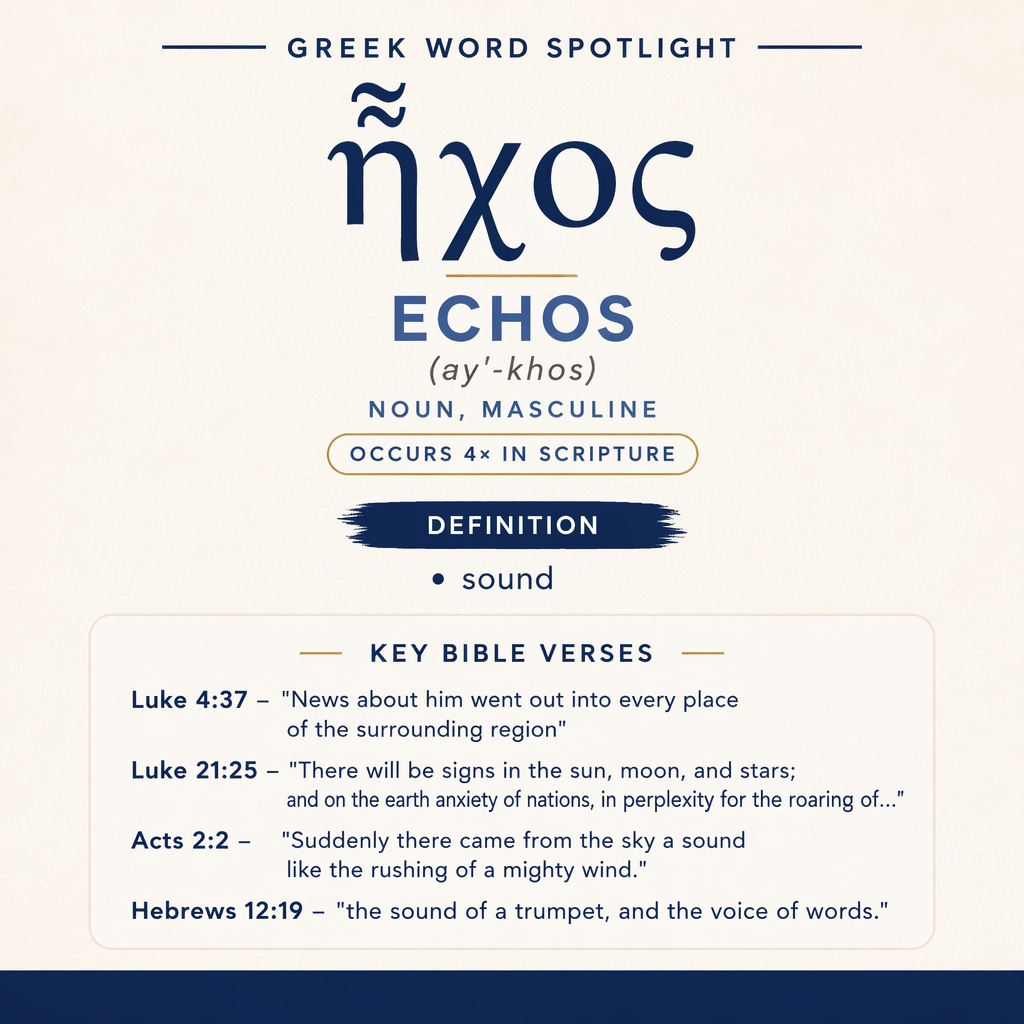
ἦχος (Echos) means “sound” and appears four times in Scripture: Luke 4:37; Luke 21:25; Acts 2:2; Hebrews 12:19.
Scripture Occurrences
It occurs 4 times: Luke 4:37; Luke 21:25; Acts 2:2; Hebrews 12:19.
Learn More →Usage Examples
In Acts 2:2 it describes a sound like a rushing mighty wind. In Hebrews 12:19 it refers to the sound of a trumpet.
Learn More →ἦχος means “sound,” and it appears in scenes that range from public report, to the sea’s roar, to a house filled with a windlike noise, to the terrifying blast of a trumpet. In these passages it marks what is heard and how what is heard spreads, swells, or presses upon those who listen.
Occurrences
Luke 4:37: “News about him went out into every place of the surrounding region.”
Here ἦχος belongs to the sphere of circulating report. The verse pictures the outward movement of what people are saying and repeating, so that what began locally becomes audible “into every place of the surrounding region.” Even without describing the content of the news, the sentence emphasizes its propagation: it “went out,” as though it had a momentum of its own. ἦχος, in this setting, contributes the idea of an audible report that travels through a wider area by being spoken, repeated, and carried from place to place.
Luke 21:25: “There will be signs in the sun, moon, and stars; and on the earth anxiety of nations, in perplexity for the roaring of the sea and the waves;”
In this saying, ἦχος stands within a description of public distress, where “anxiety of nations” and “perplexity” are linked to a particular kind of sound: “the roaring of the sea and the waves.” The “roaring” is not a mere background detail; it is one of the pressures that drives the nations into confusion. ἦχος thus highlights the sea’s audible force—something heard on the earth, overwhelming enough to be paired with broad, communal fear. The sound is portrayed as a sign that affects human perception and emotion, not simply as a natural noise.
Acts 2:2: “Suddenly there came from the sky a sound like the rushing of a mighty wind, and it filled all the house where they were sitting.”
In Acts, ἦχος is described with striking intensity and direction. The sound “came from the sky,” arriving abruptly (“Suddenly”) and being compared to “the rushing of a mighty wind.” The comparison underscores the character of what was heard—powerful, forceful, and sweeping—yet the verse speaks first about sound, not about wind itself. The result is spatial: it “filled all the house where they were sitting.” ἦχος here is not only audible but also pervasive; it occupies the entire interior space, surrounding those present. The word therefore contributes to the scene’s physical realism: a noise that arrives, resembles a wind’s rush, and saturates the room.
Hebrews 12:19: “the sound of a trumpet, and the voice of words; which those who heard it begged that not one more word should be spoken to them,”
In Hebrews, ἦχος is joined to a second auditory element, “the voice of words.” The verse distinguishes between the trumpet’s sound and articulated speech, showing that ἦχος can denote a powerful noise that does not itself carry verbal content. The effect on the hearers is immediate and intense: they “begged that not one more word should be spoken to them.” Within that reaction, the trumpet sound functions as part of an overwhelming auditory encounter that provokes dread and retreat. ἦχος contributes the sharp, arresting element of what is heard—an acoustic signal that heightens the fearfulness of the moment alongside the “voice of words.”

Sense and Usage
Across these four passages, ἦχος consistently operates as an audible phenomenon, but the scenes show that “sound” can be experienced in different ways depending on its source, scale, and effect. In Luke 4:37 it is social in character: something people pass along until it reaches “every place of the surrounding region.” The focus there falls on spread and reach—sound as public report that travels through speech.
In Luke 21:25 the term is anchored in the physical world, yet it presses into the human world: the sea’s “roaring” becomes a factor in “anxiety of nations.” The sound is large enough to be felt as a sign, not because it is merely loud, but because it is bound up with a context of ominous “signs” and shared perplexity. ἦχος, then, can mark an environmental sound whose impact is not confined to the senses but spills into collective fear.
Acts 2:2 concentrates on immediacy and enclosure. The sound arrives “from the sky,” and the narrative underscores its sudden onset and its power by likening it to a “mighty wind.” Yet the detail that it “filled all the house” portrays sound as something that can occupy space thoroughly, surrounding listeners and defining their environment for that moment. ἦχος in this verse is experienced as an event—something that happens to a room and to those in it.
Hebrews 12:19 shows another feature: ἦχος can be set alongside “the voice of words” to differentiate nonverbal sound from spoken language. The trumpet blast is an auditory reality that stands on its own, and it helps frame the hearers’ response: they plead for an end to further speech. The pairing of trumpet-sound and voiced words portrays an overwhelming auditory encounter with multiple layers—signal and speech—both pressing upon those who hear. In that context, ἦχος is the component that communicates intensity and alarm through sound itself, without being described as verbal.
Taken together, these uses show ἦχος ranging from what is carried by human mouths (news that “went out”) to what surges from creation (sea and waves) to what arrives from above and fills a dwelling (a windlike sound) to what blasts forth as an instrument’s note (a trumpet). In each case it is not an abstract idea but an experienced auditory reality: it travels, it roars, it fills, it strikes—and it consistently shapes the scene by drawing attention to what is heard and how hearers are affected.
Imagery
The word’s imagery in these passages is strongly spatial and communal. Sound moves outward through a “surrounding region” (Luke 4:37), rises as a roar associated with sea and waves amid worldwide anxiety (Luke 21:25), pours into a house until it is full (Acts 2:2), and pierces the listeners with a trumpet blast bound up with a fearful hearing of words (Hebrews 12:19). ἦχος, in these scenes, frames hearing as a decisive kind of encounter—public, environmental, immersive, and sometimes unbearable.
Sources: Lexical data from Strong’s Exhaustive Concordance and the Translators Brief Lexicon of Extended Strongs for Greek (STEPBible, CC BY). Occurrence data from the Translators Amalgamated Greek New Testament (STEPBible, CC BY). Scripture quotations from the World English Bible (public domain).