
Exploring the Meaning of Hesuchazo in Greek
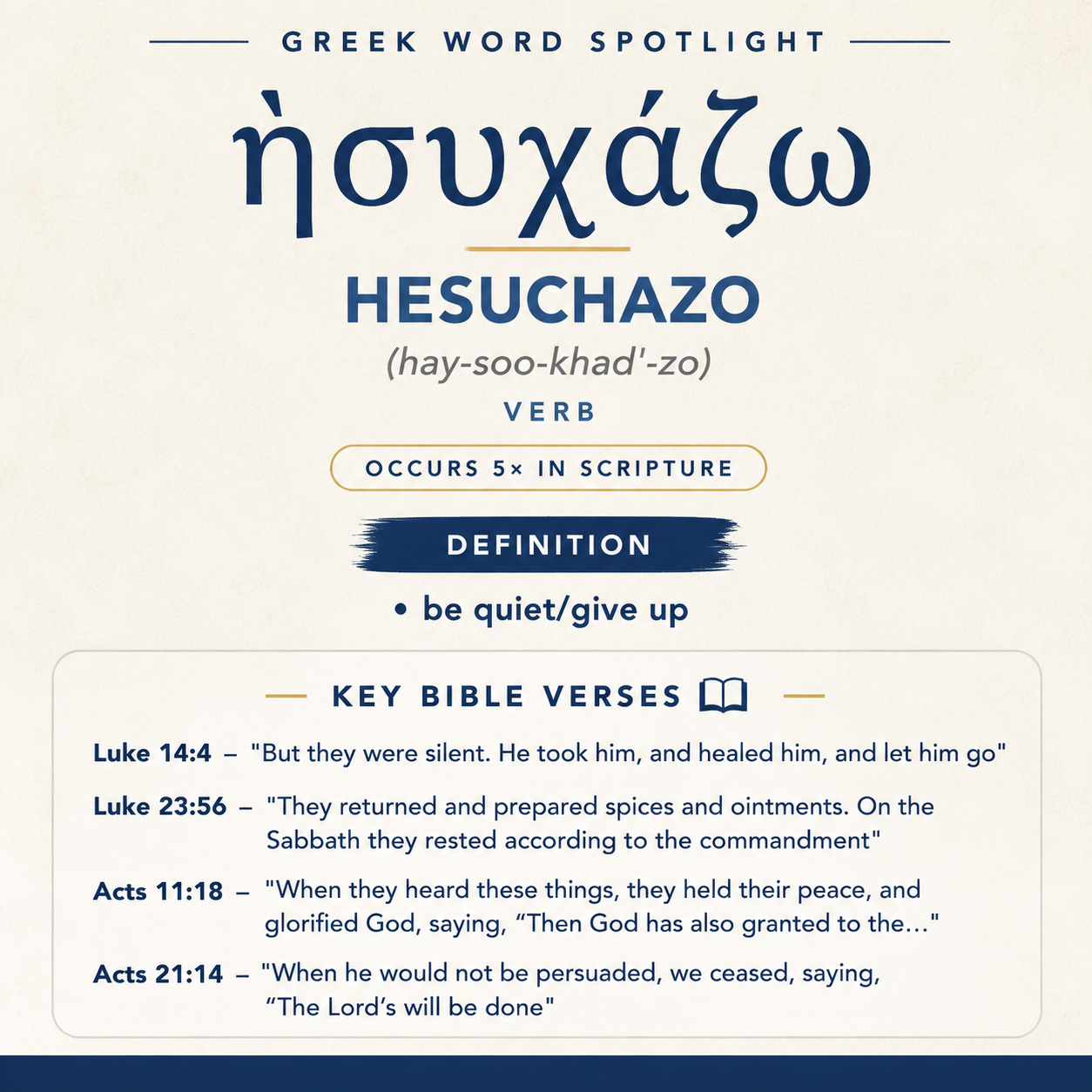
ἡσυχάζω means “be quiet/give up” and appears five times in Luke 14:4; Luke 23:56; Acts 11:18; Acts 21:14; and 1 Thessalonians 4:11.
Core Meaning
ἡσυχάζω means “be quiet/give up.” In its passages, it describes silence, resting, holding peace, ceasing, and living quietly.
Learn More →Narrative Moments
In Luke 14:4 it describes people being silent, and in Luke 23:56 it describes resting on the Sabbath. In Acts 11:18 it marks holding peace, and in Acts 21:14 it marks ceasing persuasion.
Learn More →Quiet Life
In 1 Thessalonians 4:11 it is used for leading a quiet life. The verse links quiet living with minding one’s own business and working with one’s hands.
Learn More →ἡσυχάζω expresses being quiet or giving up, appearing in scenes of silence, rest, and the settling of a dispute. In its five New Testament occurrences, it describes people falling silent under questioning, resting on the Sabbath, holding their peace as God is praised, ceasing persuasion in the face of resolve, and aiming for a quiet life.
Root and Related Words
ἡσυχάζω is related to the adjective hesychios (ἡσύχιος), “quiet” (Strong’s G2272), from which it derives.

Occurrences
“But they were silent. He took him, and healed him, and let him go.” (Luke 14:4)
Here the word marks a charged pause in a public encounter. Jesus’ question meets no verbal response—those present become quiet—so the narrative moves directly to action: “He took him, and healed him, and let him go.” The quietness functions as more than background mood; it is the immediate social context in which Jesus acts without further debate. Their silence leaves the healing standing on its own, unopposed in speech, and the scene’s momentum shifts from argument to deed.
“They returned and prepared spices and ointments. On the Sabbath they rested according to the commandment.” (Luke 23:56)
In this setting the word depicts a deliberate cessation of activity. The women “returned and prepared spices and ointments,” but the next sentence draws a clear boundary: “On the Sabbath they rested according to the commandment.” The quietness is expressed as stopping—giving up ongoing tasks for a time—so that the rhythm of preparation yields to commanded rest. The verse places this rest alongside purposeful preparation, highlighting a controlled restraint: work is done, then work is set aside.
“When they heard these things, they held their peace, and glorified God, saying, “Then God has also granted to the Gentiles repentance to life!”” (Acts 11:18)
Here the word describes a shift in a communal conversation. After hearing an account (“When they heard these things”), the group “held their peace,” and the atmosphere changes from potential contention to worship: “and glorified God.” Their quietness is not emptiness but a settled acceptance that clears space for a confession of God’s work: “Then God has also granted to the Gentiles repentance to life!” The stilling of voices functions as a turning point where argument is given up and praise takes its place.
“When he would not be persuaded, we ceased, saying, “The Lord’s will be done.”” (Acts 21:14)
In this episode the word conveys stopping an effort in response to someone’s steadfast resolve. “When he would not be persuaded” indicates a sustained attempt to influence him; “we ceased” signals that the speakers relinquish that attempt. The quietness is practical and relational: they give up pressing their case and instead voice a brief, weighty acknowledgment—“The Lord’s will be done.” The cessation here is not mere silence but the end of persuasion, a quieting of insistence that recognizes limits.
“and that you make it your ambition to lead a quiet life, and to do your own business, and to work with your own hands, even as we instructed you;” (1 Thessalonians 4:11)
In this instruction the word is set within a pattern of ordinary, steady conduct. The community is urged to “make it your ambition to lead a quiet life,” and that quietness is framed alongside concrete habits: “to do your own business” and “to work with your own hands.” The quiet life envisioned is not passive withdrawal but a way of living in which noise, disruption, or needless interference is given up in favor of settled responsibility. The verse binds quietness to personal industry and focused attention to one’s affairs.
Sense and Usage
Across these passages, the word’s range is shown by how quietness and giving up can be expressed in different kinds of settings: public dispute, ritual rest, communal deliberation, interpersonal persuasion, and daily ethics. In Luke 14:4, being quiet is a response under scrutiny; silence emerges when questions are posed and no rebuttal is offered. That quietness intensifies the significance of what follows, because the scene moves from unspoken resistance to unchallenged action.
In Luke 23:56, the idea leans toward stopping—quietness as rest—where activity is paused in obedience. The sequence matters: preparation occurs, then a clear cessation occurs “according to the commandment.” Quietness here is measured and timed, showing restraint that is chosen for a reason, not forced by inability.
In Acts, the word repeatedly functions as a marker of resolution. In Acts 11:18 the group’s quietness comes after understanding; they hear, then they hold their peace, and praise follows. Quietness here is the giving up of contention and the settling of a matter through recognition of God’s action. In Acts 21:14 the giving up is more personal and immediate: persuasion fails, so the persuaders stop. The stillness is the end of pressure and the acceptance of an outcome expressed in a short spoken surrender: “The Lord’s will be done.”
In 1 Thessalonians 4:11, quietness is presented as a deliberate aim. It is not a momentary hush but a sustained orientation—something to be pursued with “ambition.” The verse anchors that ambition in concrete behaviors: minding one’s own business and working with one’s hands. Quietness, in this usage, is compatible with active labor; what is given up is not work but the kind of life that disrupts others or disperses attention.
Taken together, these scenes show quietness as a social and moral posture with visible outcomes: silence that yields to healing, rest that interrupts preparation, peace that turns into glorifying God, cessation that ends argument, and a quiet life that accompanies steady work. The word can therefore describe both the absence of speech and the termination of an effort, and it can name a temporary state (a moment of silence or a day of rest) as well as a settled pattern of living.
Imagery
The passages attach quietness to tangible moments: a room that falls silent while a man is healed, a household that stops its preparations for Sabbath rest, a gathered group that quiets down and then speaks praise, companions who stop urging and accept what will be, and a community urged toward an untroubled routine of work. In each case, quietness is portrayed not as emptiness but as a decisive restraint that shapes what happens next.
Sources: Lexical data from Strong’s Exhaustive Concordance and the Translators Brief Lexicon of Extended Strongs for Greek (STEPBible, CC BY). Occurrence data from the Translators Amalgamated Greek New Testament (STEPBible, CC BY). Scripture quotations from the World English Bible (public domain).




