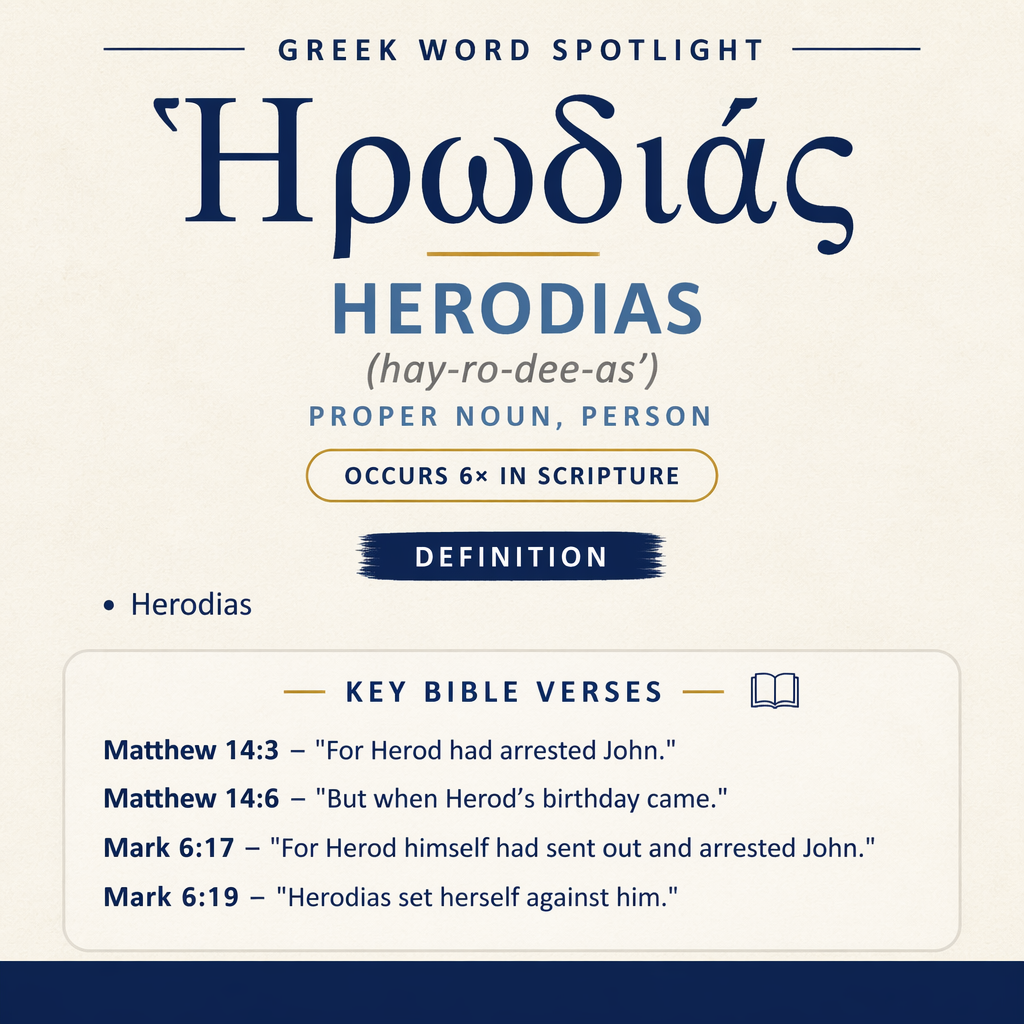
In Matthew 14:3 and Mark 6:17, John is imprisoned for the sake of Herodias, his brother Philip’s wife. Mark 6:19 records Herodias opposing him and desiring to kill him.
Ἡρωδιάς refers to Herodias. The name appears in the Gospel narratives where the imprisonment of John and the events around Herod’s banquet are told, and where Herod is publicly reproved in connection with her.
Occurrences
“For Herod had arrested John, and bound him, and put him in prison for the sake of Herodias, his brother Philip’s wife.” (Matthew 14:3)
Here Ἡρωδιάς identifies the personal relationship at the center of the action: John’s imprisonment is described as being “for the sake of Herodias.” The verse sets her in close association with Herod’s decision to arrest, bind, and imprison John, and it characterizes her by her connection to “his brother Philip” as “wife,” framing the situation as a family matter with political consequences.
“But when Herod’s birthday came, the daughter of Herodias danced among them and pleased Herod.” (Matthew 14:6)
In this banquet setting, Ἡρωδιάς functions as a marker of identity within the court: the dancer is named indirectly as “the daughter of Herodias.” The name links the scene to the earlier imprisonment episode by keeping Herodias in view through her family, and it places her household within a public celebration where Herod is surrounded by others (“among them”) and responds with pleasure.
“For Herod himself had sent out and arrested John, and bound him in prison for the sake of Herodias, his brother Philip’s wife, for he had married her.” (Mark 6:17)
This account intensifies the causal framing around Ἡρωδιάς. John’s arrest and imprisonment again occur “for the sake of Herodias,” but the verse adds a direct statement of Herod’s marital action: “for he had married her.” Ἡρωδιάς therefore anchors the explanation for Herod’s initiative (“Herod himself had sent out”) and ties the confinement of John to a contested household arrangement identified through the phrase “his brother Philip’s wife.”
“Herodias set herself against him, and desired to kill him, but she couldn’t,” (Mark 6:19)
Ἡρωδιάς is the acting subject here. The name points to personal agency and sustained hostility: she “set herself against him” and held a lethal intention (“desired to kill him”). Yet the sentence ends with frustration—“but she couldn’t”—which keeps her desire distinct from the power to carry it out. The use of her personal name makes the opposition explicit and individual rather than merely an impersonal circumstance surrounding Herod.
“When the daughter of Herodias herself came in and danced, she pleased Herod and those sitting with him. The king said to the young lady, “Ask me whatever you want, and I will give it to you.”” (Mark 6:22)
Again Ἡρωδιάς appears through the identification of her daughter, now with emphasis (“herself”). The verse highlights the public nature of the moment: the dancing pleases not only Herod but also “those sitting with him,” and the king’s response turns pleasure into an open-ended promise. By naming Herodias in the daughter’s description, the narrative keeps the familial line of influence in view, placing Herodias’ household at the center of a scene where royal words (“Ask me whatever you want”) are spoken in front of an audience.
“but Herod the tetrarch, being reproved by him for Herodias, his brother’s wife, and for all the evil things which Herod had done,” (Luke 3:19)
In Luke’s phrasing, Ἡρωδιάς is part of the stated content of John’s reproof. Herod is “reproved … for Herodias, his brother’s wife,” which presents her as a focal point of prophetic confrontation, set alongside “all the evil things which Herod had done.” The name is paired with a familial descriptor (“his brother’s wife”), and the construction makes the reproof about concrete matters associated with Herod’s behavior, with Herodias singled out as one of the reasons.
Sense and Usage
Across these passages, Ἡρωδιάς operates as a proper name that carries narrative weight by tying together imprisonment, public celebration, and moral reproof into a single thread. The name is not used as a title or office; it is consistently personal, and its force comes from how it locates characters within a charged network of relations: Herod acts “for the sake of Herodias” (Matthew 14:3; Mark 6:17), a daughter is identified by reference to her (Matthew 14:6; Mark 6:22), and a ruler is reproved “for Herodias” (Luke 3:19). In each case, the name functions as a hinge between private household connections and public consequences—prison, banquet, and confrontation.
The repeated explanatory phrase “for the sake of Herodias” presents her as more than a background figure; her name becomes a stated reason attached to decisive actions taken by Herod. Mark’s addition, “for he had married her,” narrates the relational reality that stands behind the imprisonment, while still keeping the name as the narrative shorthand by which the situation is recalled. Luke’s use shows that the same name can stand within a formal charge: a reproof that includes her and extends to “all the evil things” connected with Herod. Thus, Ἡρωδιάς can be used both in explanation of political action and in the content of moral indictment.
When the name appears through the expression “the daughter of Herodias,” it serves a different but complementary function. It identifies the young dancer by family association, placing her actions within Herodias’ sphere. In Matthew 14:6 the daughter “danced among them and pleased Herod,” and in Mark 6:22 the pleasure spreads to “those sitting with him,” prompting the king’s extravagant offer. In these scenes, the name Herodias does not describe the daughter directly; it situates her socially—she is recognizable through her mother—and it keeps Herodias present in the narrative even when she is not the immediate actor.
Mark 6:19 is the one place where Ἡρωδιάς stands alone as subject without additional relational description in the same sentence. There the name is linked to intentional hostility: she positions herself “against him” and desires his death. This makes her the personal embodiment of opposition to John within Mark’s account, complementing the earlier “for the sake of Herodias” that connected Herod’s action to her. The name, then, can mark the person for whom actions are taken, the person whose household is placed at the center of courtly scenes, and the person whose animosity becomes narratively explicit.
Imagery in Context
The occurrences of Ἡρωδιάς evoke a sequence of vivid settings: a prison holding a bound prophet (Matthew 14:3; Mark 6:17), a birthday feast where dancing draws royal pleasure (Matthew 14:6; Mark 6:22), and a public reproof of a tetrarch that names Herodias among the causes (Luke 3:19). The name threads these scenes together so that domestic relations, festive display, and the language of indictment are not separate stories but interconnected moments revolving around the same person.
Sources:
Lexical data from Strong’s Exhaustive Concordance and the Translators Brief Lexicon of Extended Strongs for Greek (STEPBible, CC BY). Occurrence data from the Translators Amalgamated Greek New Testament (STEPBible, CC BY). Scripture quotations from the World English Bible (public domain).