Exploring the Meaning of Herodes in Greek
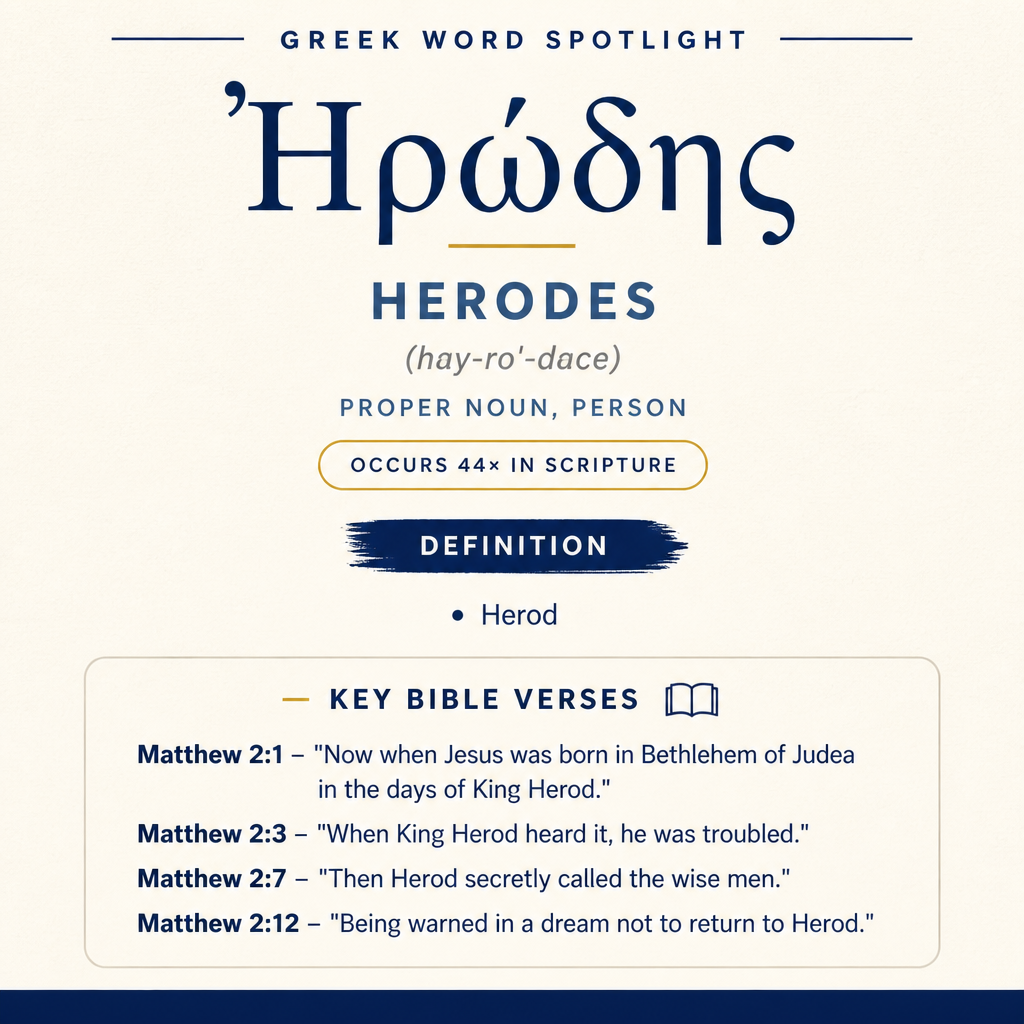
Ἡρώδης (Herodes) means “Herod” and appears 44 times in Scripture, including in Matthew 2:1–19 describing events around Jesus’ birth.
Matthew 2 Context
In Matthew 2:1–19, Herod hears of Jesus’ birth in Bethlehem and is troubled. He questions the wise men and is later avoided after a dream warning.
Learn More →Narrative Role
Matthew records Herod’s anger when the wise men do not return to him. The passage also notes Joseph’s flight and return in connection with Herod’s death.
Learn More →Ἡρώδης refers to “Herod,” a personal name that appears in narratives surrounding Jesus’ birth and early life and, later, in the setting of John the Baptist’s imprisonment and a ruler’s response to reports about Jesus. In these passages the name functions as a marker of political authority and as a point of reference for fear, secrecy, and violence.
Occurrences
Matthew 2:1: “Now when Jesus was born in Bethlehem of Judea in the days of King Herod, behold, wise men from the east came to Jerusalem, saying,”
Here Ἡρώδης anchors the time frame (“in the days of King Herod”) and identifies the reigning authority over Judea as the birth narrative opens. The name situates Jesus’ birth within an established kingship and sets up Jerusalem as the political center to which the wise men come.

Matthew 2:3: “When King Herod heard it, he was troubled, and all Jerusalem with him.”
Ἡρώδης is the hearer whose reaction shapes the city’s mood: the king is “troubled,” and the disturbance spreads to “all Jerusalem.” The name in this verse functions as the focal point for the collective anxiety, linking the ruler’s internal response to public unrest.
Matthew 2:7: “Then Herod secretly called the wise men, and learned from them exactly what time the star appeared.”
With Ἡρώδης the narrative highlights a ruler acting “secretly,” drawing the wise men into a private inquiry. The name marks the agent who seeks precise information (“exactly what time”), emphasizing calculated investigation rather than open consultation.
Matthew 2:12: “Being warned in a dream not to return to Herod, they went back to their own country another way.”
Ἡρώδης becomes the person to be avoided: the dream-warning is framed as a warning “not to return to Herod.” The name thus defines the danger point in the travel narrative, motivating a change of route and separating the wise men’s obedience to the warning from the king’s intentions.
Matthew 2:13: “Now when they had departed, behold, an angel of the Lord appeared to Joseph in a dream, saying, “Arise and take the young child and his mother, and flee into Egypt, and stay there until I tell you, for Herod will seek the young child to destroy him.””
In this dream message Ἡρώδης is explicitly presented as the pursuer: “Herod will seek the young child to destroy him.” The name concentrates the threat in a single figure whose search necessitates flight, and it gives the reason for leaving and remaining away “until I tell you.”
Matthew 2:15: “and was there until the death of Herod; that it might be fulfilled which was spoken by the Lord through the prophet, saying, “Out of Egypt I called my son.””
Ἡρώδης marks the endpoint of the family’s exile: they remain “until the death of Herod.” The name here functions as a boundary in the story’s movement—danger persists while Herod lives, and the transition in circumstances is keyed to his death.
Matthew 2:16: “Then Herod, when he saw that he was mocked by the wise men, was exceedingly angry, and sent out, and killed all the male children who were in Bethlehem and in all the surrounding countryside, from two years old and under, according to the exact time which he had learned from the wise men.”
Here Ἡρώδης is the subject of escalating action: perception (“when he saw”), emotion (“was exceedingly angry”), decision (“sent out”), and a sweeping act of violence (“killed all the male children”). The name binds together the earlier secrecy about timing (linked to “the exact time”) with the later execution of policy, showing how information gathered becomes the basis for harm.
Matthew 2:19: “But when Herod was dead, behold, an angel of the Lord appeared in a dream to Joseph in Egypt, saying,”
Ἡρώδης again serves as a narrative hinge, now stated plainly: “when Herod was dead.” His death signals a change in the story’s setting—Joseph is still “in Egypt,” and the dream appearance follows upon this altered political reality.
Matthew 2:22: “But when he heard that Archelaus was reigning over Judea in the place of his father, Herod, he was afraid to go there. Being warned in a dream, he withdrew into the region of Galilee,”
In this verse Ἡρώδης identifies a father in a succession: Archelaus reigns “in the place of his father, Herod.” The name functions as the reference point for continuity of rule, and it frames Joseph’s fear (“he was afraid to go there”) in relation to the new ruler’s connection to Herod.
Matthew 14:1: “At that time, Herod the tetrarch heard the report concerning Jesus,”
Ἡρώδης appears with an added political description (“the tetrarch”) and is again characterized as a hearer, now receiving “the report concerning Jesus.” The name introduces a governing figure into the public spread of Jesus’ fame, connecting political leadership with the circulation of information.
Matthew 14:3: “For Herod had arrested John, and bound him, and put him in prison for the sake of Herodias, his brother Philip’s wife.”
Here Ἡρώδης is the authority who takes coercive action: he “arrested John,” “bound him,” and “put him in prison.” The verse also places this exercise of power within relational entanglements (“for the sake of Herodias”), so the name signals not only rule but the personal motives and household dynamics that accompany the imprisonment.
Matthew 14:6: “But when Herod’s birthday came, the daughter of Herodias danced among them and pleased Herod.”
In this setting Ἡρώδης is linked to courtly celebration (“Herod’s birthday”) and to the immediate social environment (“among them”). The name identifies the person pleased by the dance, highlighting how a ruler’s pleasure in a banquet context becomes narratively significant within the same sequence that has already mentioned John’s imprisonment.

Sense and Usage
Across these passages Ἡρώδης operates as a proper name that repeatedly concentrates narrative tension around a ruler and his court. In Matthew 2 the name is introduced with explicit royal status (“King Herod”) and is used to structure time (“in the days of King Herod”), cause-and-effect (his being “troubled” and Jerusalem’s shared distress), and plot movement (secret inquiry, the wise men’s refusal to return, the family’s flight, and the return only after his death). The name thereby functions as more than a label: it identifies the human center of a threat that drives geography and decision-making—Jerusalem, Bethlehem, Egypt, and later a withdrawal toward Galilee are all presented in relation to what Herod does, intends, or no longer can do once dead.
Within Matthew 2, Ἡρώδης is consistently associated with information control and reaction. He “heard,” he “secretly called,” he “learned… exactly what time,” he perceived being “mocked,” and he responded with “exceedingly angry” violence that is narrated on a large scale. Even when Herod is not acting directly, the name remains operative as a point of avoidance (“not to return to Herod”) and as a temporal boundary (“until the death of Herod”). The story’s dream-warnings are framed around him: Joseph’s and the wise men’s decisions are shaped by the danger attached to the name.
When the name reappears in Matthew 14, it belongs to another scene of governance, now titled “Herod the tetrarch.” The narrative emphasis still aligns the name with hearing reports and exercising power over others: this Herod hears about Jesus and is already known for having arrested and imprisoned John. The sequence then places him in a festive environment (“Herod’s birthday”), showing the ruler not only as an administrator of detention but also as a figure whose pleasure at a social event is highlighted. In this way the name Ἡρώδης in these occurrences connects political authority with personal reactions—trouble, secrecy, anger, and pleasure—and shows how those reactions reverberate outward, affecting cities, travelers, and prisoners.
Imagery
The passages pair Ἡρώδης with vivid scenes of court and crisis: a king in Jerusalem disturbed by news, a secret meeting to pin down “exactly what time,” a family fleeing by night to Egypt, and later a ruler whose household celebration forms the backdrop to actions already taken against John. The name thus carries the imagery of a powerful seat of rule—capable of troubling a city, directing violent orders, and shaping the movements of others—set against the vulnerability of children, travelers, and an imprisoned prophet.
Sources: Lexical data from Strong’s Exhaustive Concordance and the Translators Brief Lexicon of Extended Strongs for Greek (STEPBible, CC BY). Occurrence data from the Translators Amalgamated Greek New Testament (STEPBible, CC BY). Scripture quotations from the World English Bible (public domain).