
Exploring the Meaning of Hegemon in Greek
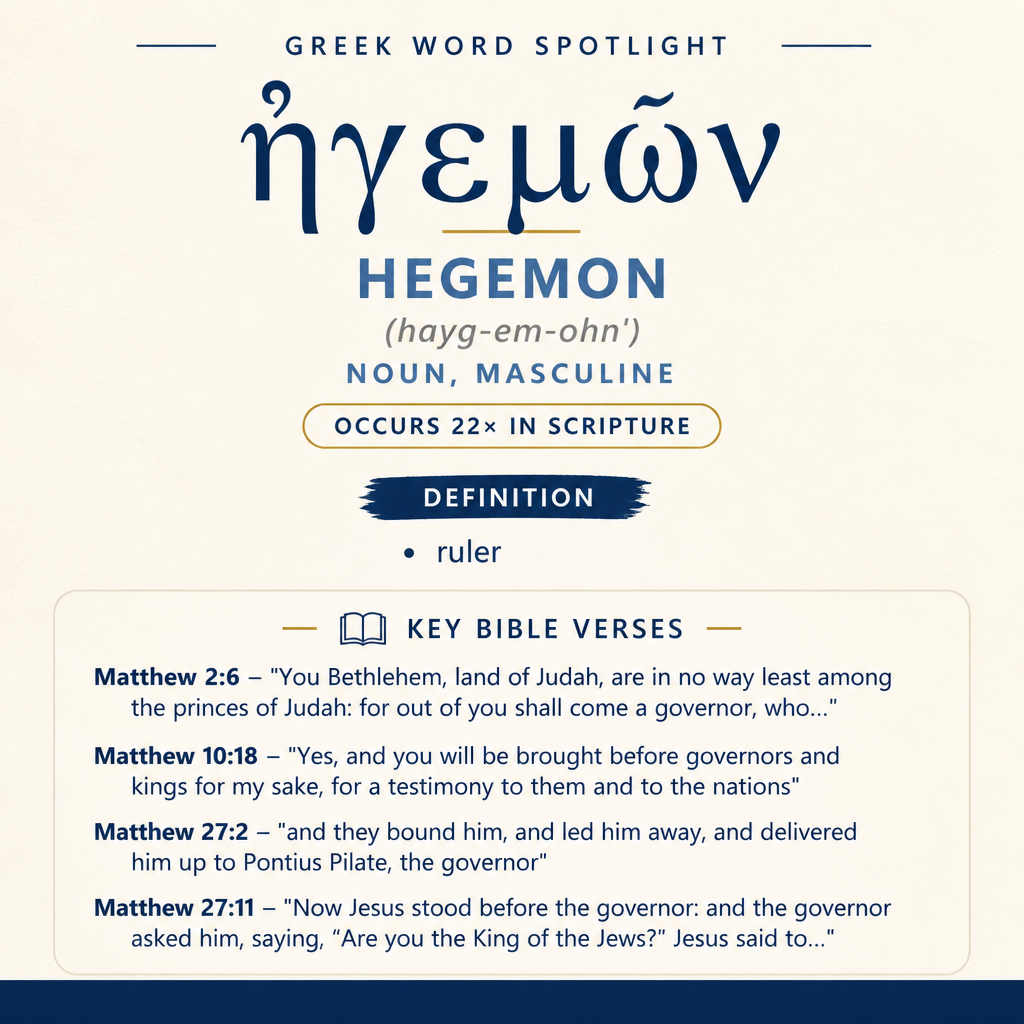
ἡγεμών means “ruler” and appears 22 times in Scripture, including Matthew 2:6; 10:18; and repeatedly in Matthew 27:2, 11, 14, 15, 21, 23.
Core Meaning
ἡγεμών is defined as “ruler.” In Matthew it is rendered “governor” in multiple verses.
Learn More →Matthew Usage
In Matthew 2:6, the term refers to a “governor” coming from Bethlehem. In Matthew 10:18, disciples are brought before “governors and kings.”
Learn More →Trial Narrative
Matthew 27 repeatedly uses ἡγεμών for Pontius Pilate, “the governor” (Matthew 27:2). Jesus stands before the governor, who questions Him and makes release decisions (Matthew 27:11, 15, 21).
Learn More →ἡγεμών means “ruler.” In the passages where it appears, it names figures who exercise public authority—from the promised leader associated with Bethlehem to the officials before whom Jesus and his followers are brought.
Occurrences
Matthew 2:6: ‘You Bethlehem, land of Judah, are in no way least among the princes of Judah: for out of you shall come a governor, who shall shepherd my people, Israel.’ ”
Here ἡγεμών is rendered “governor” and placed in a forward-looking statement about Bethlehem. The ruler who “shall shepherd my people, Israel” is described not merely as holding rank among “the princes of Judah,” but as one who will exercise leadership in a way characterized by guidance and care in relation to “my people, Israel.” The term therefore functions as a title of rule within Israel’s own framework, tied to origin (“out of you”) and to the responsibility implied by shepherding.

Matthew 10:18: Yes, and you will be brought before governors and kings for my sake, for a testimony to them and to the nations.
In this saying, “governors and kings” are paired as representative authorities before whom disciples may be hauled. ἡγεμών contributes the idea of official rulers as judicial or administrative figures capable of receiving a case (“you will be brought before…”) and, in that setting, becoming an audience for “a testimony.” The word places the disciples’ experience in the sphere of formal power rather than private dispute.
Matthew 27:2: and they bound him, and led him away, and delivered him up to Pontius Pilate, the governor.
At the start of the trial narrative, ἡγεμών designates Pontius Pilate’s role as the ruler to whom Jesus is “delivered up.” The term marks a transfer of custody and responsibility: Jesus is bound, led away, and handed over to a figure whose office carries the authority to proceed with the case.
Matthew 27:11: Now Jesus stood before the governor: and the governor asked him, saying, “Are you the King of the Jews?” Jesus said to him, “So you say.”
Twice repeated, “the governor” frames the interrogation as an encounter with ruling authority. ἡγεμών signals that the question “Are you the King of the Jews?” is asked from the standpoint of a ruler assessing a politically charged claim. The scene’s tension depends on this: the one questioned stands “before” the ruler, and the ruler initiates the formal inquiry.
Matthew 27:14: He gave him no answer, not even one word, so that the governor marveled greatly.
Here ἡγεμών identifies the person whose reaction is highlighted. The ruler’s amazement (“marveled greatly”) underscores the unusual nature of the silence in a setting where a governor would normally expect answers. The word keeps the focus on an official accustomed to being addressed and obeyed, now confronted by a striking refusal to speak.
Matthew 27:15: Now at the feast the governor was accustomed to release to the multitude one prisoner, whom they desired.
ἡγεμών marks the ruler as the one who holds discretionary power to “release… one prisoner.” The term anchors the custom in the governor’s authority: the crowd may “desire” a release, but the act itself belongs to the ruler’s established practice at “the feast.”
Matthew 27:21: But the governor answered them, “Which of the two do you want me to release to you?” They said, “Barabbas!”
In this exchange the ruler functions as the one who poses the decisive question and carries out the release. ἡγεμών contributes the procedural tone—an official asking a choice that will determine an outcome. The governor addresses “them,” and the crowd responds, but the governor is the one with power to execute the requested decision.
Matthew 27:23: But the governor said, “Why? What evil has he done?” But they cried out exceedingly, saying, “Let him be crucified!”
Here ἡγεμών marks the ruler’s attempt to exercise judgment. The questions “Why?” and “What evil has he done?” fit a ruler’s role in weighing charges and evaluating wrongdoing. The crowd’s escalating demand (“Let him be crucified!”) is set against the governor’s inquiry, keeping the tension between public clamor and the ruler’s responsibility to adjudicate.
Matthew 27:27: Then the governor’s soldiers took Jesus into the Praetorium, and gathered the whole garrison together against him.
In this verse ἡγεμών appears in a possessive relationship: “the governor’s soldiers.” The word identifies whose forces these are, linking military personnel and a “garrison” to the ruler’s command structure. The action—taking Jesus into “the Praetorium” and assembling the troops “against him”—is framed as occurring under the governor’s jurisdiction.
Matthew 28:14: If this comes to the governor’s ears, we will persuade him and make you free of worry.”
ἡγεμών again appears possessively, describing a ruler whose awareness matters: “If this comes to the governor’s ears.” The term signals a figure with authority sufficient to create “worry” if he hears the report, and also someone who can be “persuade[d].” The verse portrays the governor as both powerful and accessible to influence, at least through intermediaries confident they can manage his response.
Mark 13:9: But watch yourselves, for they will deliver you up to councils. You will be beaten in synagogues. You will stand before rulers and kings for my sake, for a testimony to them.
In Mark’s parallel warning, ἡγεμών is translated “rulers” and again paired with “kings.” The sequence moves from local bodies (“councils”) and communal spaces (“synagogues”) to the presence of high authority (“stand before rulers and kings”). The word positions the disciples’ witness as occurring in formal, exposed settings where rulers function as the hearing audience.
Luke 20:20: They watched him and sent out spies, who pretended to be righteous, that they might trap him in something he said, so as to deliver him up to the power and authority of the governor.
Here ἡγεμών is integrated into the phrase “the power and authority of the governor.” The ruler is not merely a person but the locus of “power and authority” to which opponents aim to hand Jesus over. The plotted goal is to secure a statement that can be used to transfer the matter from debate and surveillance (“They watched him… sent out spies”) to the governor’s jurisdiction, where authority can act decisively.

Sense and Usage
Across these occurrences, ἡγεμών consistently identifies a ruler in contexts where authority is exercised publicly and consequentially. In Matthew 27 the term is concentrated around a single figure—Pontius Pilate—whose rulership is shown through multiple facets: receiving prisoners, questioning a defendant, responding to public pressure, and commanding soldiers. The repeated references to “the governor” in close succession create a tightly bounded arena of authority: Jesus is “delivered… to” the ruler (Matthew 27:2), stands “before” him (Matthew 27:11), and is handled by forces explicitly belonging to him (Matthew 27:27). Even customary acts of clemency are framed as governor-centered (“the governor was accustomed to release… one prisoner,” Matthew 27:15), so that the crowd’s choice is meaningful precisely because the ruler has the capacity to carry it out (Matthew 27:21).
In the sayings about future persecution (Matthew 10:18; Mark 13:9), ἡγεμών functions more generally. The word evokes the class of authorities before whom disciples may be forced to appear. In both places it is paired with “kings,” broadening the range of official power without changing the central picture: rulers are the ones before whom testimony is given. The term therefore contributes not only the idea of rank but also the courtroom-like or audience-like setting implied by being “brought before” or “stand before” such figures.
Luke 20:20 highlights the governor as a conduit of “power and authority,” the destination of an attempted entrapment. The emphasis falls on jurisdiction: the opponents’ goal is not merely to refute Jesus but to move him into the sphere where a ruler’s authority can act. In Matthew 28:14, the governor’s potential knowledge (“If this comes to the governor’s ears”) is treated as a decisive factor in how events will unfold, again portraying ἡγεμών as a person whose authority shapes outcomes even without direct on-scene action.
Matthew 2:6 stands out by placing ἡγεμών in a promise-like description: “out of you shall come a governor, who shall shepherd my people, Israel.” Here rulership is linked to origin and to the wellbeing of a people, expressed through the language of shepherding. In the later narratives, governors appear as officials who adjudicate, command, and react to reports. Taken together, the passages show ἡγεμών spanning both the expectation of a people’s leader and the concrete realities of political and judicial authority.
Imagery
The word’s imagery in these texts is strongly spatial: people are “brought before” or “stand before” rulers (Matthew 10:18; Mark 13:9), and cases are “deliver[ed]… up to” the governor’s authority (Matthew 27:2; Luke 20:20). The governor’s sphere includes a place of official business (“the Praetorium,” Matthew 27:27) and an environment where decisions can shift rapidly under pressure—questions about guilt (Matthew 27:23), customs of release (Matthew 27:15), and the weight of what may reach a ruler’s hearing (Matthew 28:14). ἡγεμών, in these scenes, is the human face of public authority: the one whose presence defines the setting and whose decision-making power sets the stakes.
Sources: Lexical data from Strong’s Exhaustive Concordance and the Translators Brief Lexicon of Extended Strongs for Greek (STEPBible, CC BY). Occurrence data from the Translators Amalgamated Greek New Testament (STEPBible, CC BY). Scripture quotations from the World English Bible (public domain).




