
Exploring the Meaning of Zugos in Greek
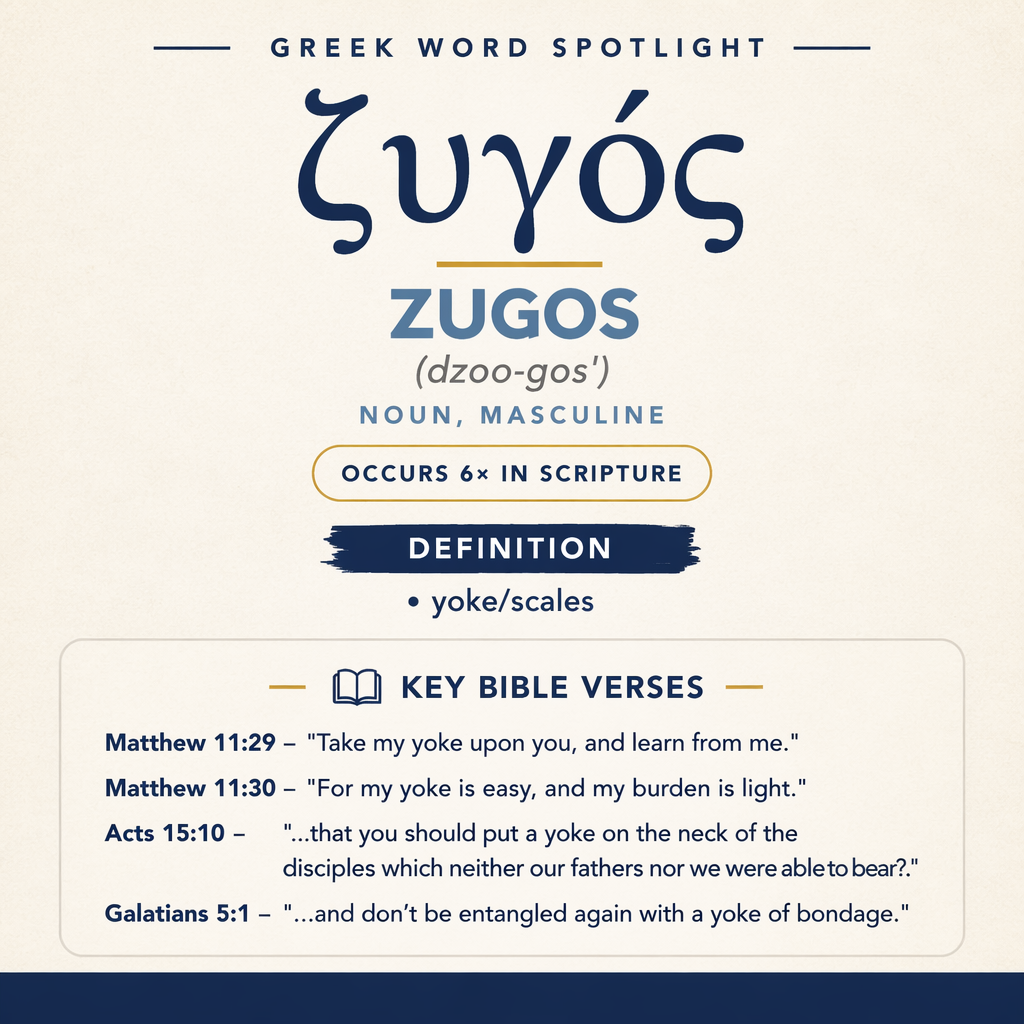
ζυγός (Zugos) means “yoke/scales” and occurs 6 times in Scripture: Matthew 11:29–30, Acts 15:10, Galatians 5:1, 1 Timothy 6:1, Revelation 6:5.
Key Occurrences
In Matthew 11:29–30, Jesus calls disciples to take His yoke, describing it as easy and light.
Learn More →Other Uses
Acts 15:10 warns against placing a yoke on disciples, and Galatians 5:1 speaks of a yoke of bondage.
Learn More →ζυγός carries the paired ideas of a yoke and of scales, imagery that ranges from constraint placed on people to weighing used in a scene of judgment and scarcity. In the New Testament it appears both in Jesus’ invitation to take his yoke and in later passages where a yoke is something imposed, borne, or escaped, and where scales are held in the hand.
Occurrences
Matthew 11:29 — “Take my yoke upon you, and learn from me, for I am gentle and humble in heart; and you will find rest for your souls.”
Here ζυγός names what is taken up in response to Jesus’ call. The action is voluntary (“Take”), and it is paired with instruction (“learn from me”), so the yoke functions as a concrete image for entering a relationship of guided learning under a teacher described as “gentle and humble in heart.” The promise attached to taking this yoke is not exhaustion but “rest for your souls,” so the word contributes an image of an ordered, borne load that leads to relief rather than collapse.

Matthew 11:30 — “For my yoke is easy, and my burden is light.”
This statement tightens the image by setting ζυγός alongside “burden,” keeping the focus on what is carried. The yoke is qualified as “easy,” and the burden as “light,” so the yoke is not presented as the mere fact of obligation but as a kind of obligation characterized by fit and manageability. Within these two lines, ζυγός helps Jesus speak of discipleship as real carrying, yet carried in a way that contrasts with heavy, crushing weight.
Acts 15:10 — “Now therefore why do you tempt God, that you should put a yoke on the neck of the disciples which neither our fathers nor we were able to bear?”
In this dispute, ζυγός is something placed “on the neck of the disciples,” an explicitly physical location that evokes constraint and forced burden. The key verbs are “put” and “bear,” making the yoke an imposed demand tested by human capacity: it is a load “neither our fathers nor we were able to bear.” The word therefore serves the argument by turning an abstract requirement into a vivid image of pressure on the neck, and by framing the proposed action as testing God (“tempt God”) through adding an unbearable weight.
Galatians 5:1 — “Stand firm therefore in the liberty by which Christ has made us free, and don’t be entangled again with a yoke of bondage.”
ζυγός here belongs to the sphere of “bondage,” set against “liberty” and being “made… free.” The yoke is something that can entangle a person again, so it is pictured not only as weight but as an ensnaring condition that compromises freedom. The imperative “Stand firm” implies pressure toward reversal, and the yoke-image names that reversal: returning to bondage is like putting oneself back under a constraining apparatus.
1 Timothy 6:1 — “Let as many as are bondservants under the yoke count their own masters worthy of all honor, that the name of God and the doctrine not be blasphemed.”
In this instruction, ζυγός marks an existing social condition: some are “bondservants under the yoke.” The phrase does not argue for or against the condition in this sentence; it locates the audience within it and then directs their conduct: they are to “count their own masters worthy of all honor,” with a stated concern for public perception—“that the name of God and the doctrine not be blasphemed.” ζυgός thus supplies a concrete descriptor for subjection that frames the ethical exhortation: behavior is addressed within the constraints of being under a yoke.
Revelation 6:5 — “When he opened the third seal, I heard the third living creature saying, “Come and see!” And behold, a black horse, and he who sat on it had a balance in his hand.”
In this apocalyptic scene, ζυγός appears as “a balance,” shifting from the yoke-image to the image of scales. The object is held “in his hand,” prominent as a symbol-like implement within the vision of “a black horse.” The balance contributes the idea of weighing—an instrument used to measure—so within the scene it functions as a visible marker of assessment and regulated measure, fitting the solemn tone of a seal being opened and a summoned spectacle (“Come and see!”).

Sense and Usage
Across these passages ζυγός gathers two related images—something borne and something that weighs—used to speak about the experience of constraint, guidance, and measured assessment. In the sayings of Jesus (Matthew 11:29–30), the yoke is personally owned (“my yoke”) and offered to be taken, not forced onto unwilling shoulders. It is also described by its effect: it leads to “rest” and is paired with a “burden” that is “light.” The word therefore supports a paradoxical picture: a yoke can be genuinely binding and still be a context for relief, because its character matches the gentleness of the one who gives it.
In Acts and Galatians the yoke-image serves polemical and pastoral aims by making religious and social pressures tangible. Acts 15:10 uses the neck-location and the verb “bear” to express weight that crushes and exceeds communal endurance, and it frames the act of laying such weight as a provocation against God. Galatians 5:1 speaks of the yoke as “bondage” and warns against being “entangled again,” so the yoke is not only a load but a condition that traps and reverses freedom. In both, ζυγός is not merely descriptive; it is evaluative by the surrounding language: unbearable on the neck, entangling, opposed to liberty.
1 Timothy 6:1 shows the yoke-image applied to a lived status—being a bondservant “under the yoke.” The instruction that follows is shaped by that status: the conduct urged is meant to protect “the name of God and the doctrine” from being “blasphemed.” Here ζυγός functions as a sober realism about constraint: it names a setting in which honor and public witness are to be pursued.
Revelation 6:5 introduces the other side of the definition—scales—by presenting ζυγός as a “balance.” The image is not about what is worn on the body but about an instrument held and displayed. Even without additional explanation in the quoted verse, the balance naturally conveys the act of weighing and measuring. In this way, ζυγός can move from the burden that presses a neck to the apparatus that measures out weight, keeping the shared conceptual thread of load and measurement while shifting the scene’s focus from endurance to assessment.
Imagery
The passages cluster ζυγός around the human experience of what is placed upon someone and what must be carried, resisted, or accepted. Matthew portrays a yoke that is taken up in trust and learning and is characterized as “easy,” tied to promised “rest.” Acts and Galatians highlight the opposite: the yoke that is put on disciples’ necks and the yoke that re-entangles into bondage, both pictured as threats to endurance and freedom. Revelation’s balance extends the word’s imagery into the visual language of weighing, placing ζυγός in the hand of a rider as part of a stark, watchful scene.
Sources: Lexical data from Strong’s Exhaustive Concordance and the Translators Brief Lexicon of Extended Strongs for Greek (STEPBible, CC BY). Occurrence data from the Translators Amalgamated Greek New Testament (STEPBible, CC BY). Scripture quotations from the World English Bible (public domain).




