Exploring the Meaning of Zophos in Greek
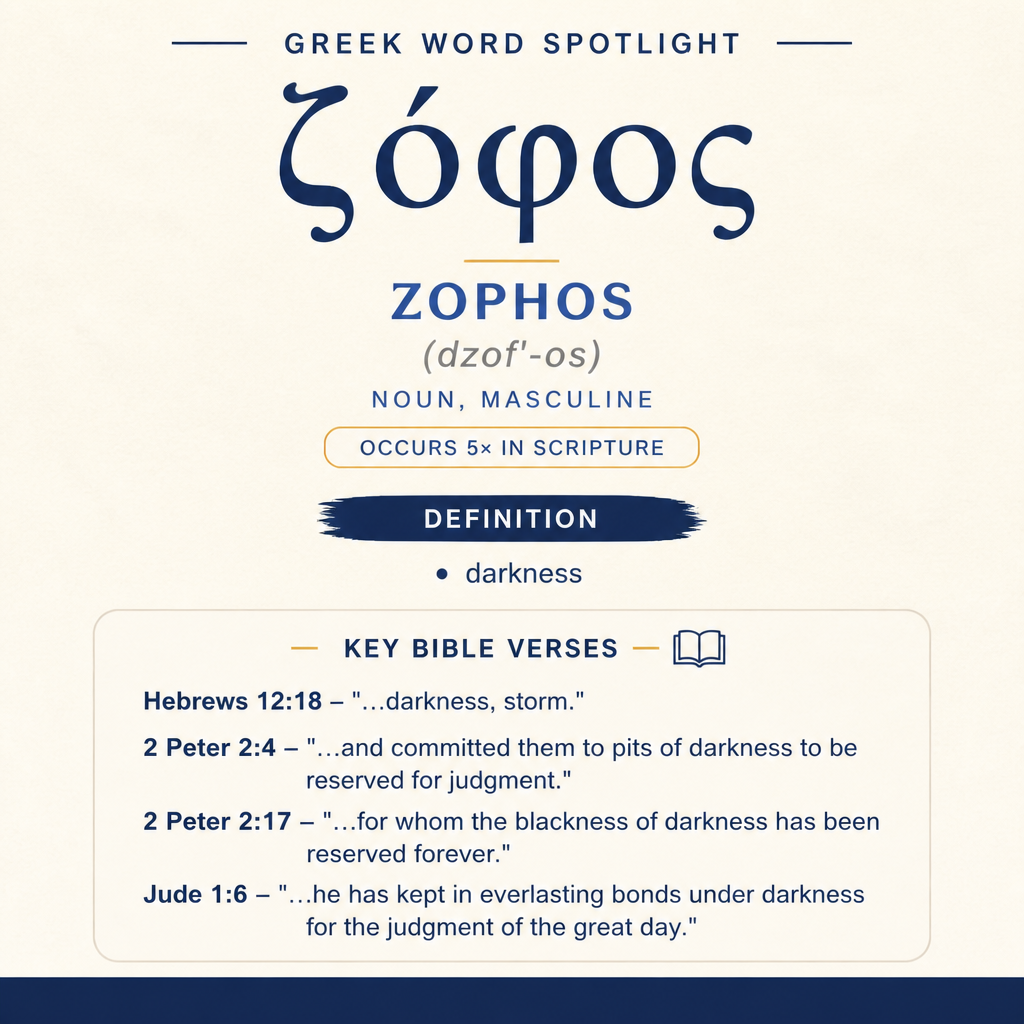
ζόφος means “darkness” and appears five times in Scripture: Hebrews 12:18; 2 Peter 2:4, 2:17; Jude 1:6, 1:13.
Where It Appears
It occurs five times: Hebrews 12:18; 2 Peter 2:4 and 2:17; Jude 1:6 and 1:13.
Learn More →Context Of Use
In these passages it is associated with blackness and darkness, and with angels committed to pits of darkness.
Learn More →ζόφος appears in the New Testament with the sense of “darkness,” clustered in scenes of awe, judgment, and reserved punishment. The word is used both in a historical recollection of a terrifying approach and in warnings that speak of a kept, awaiting darkness.
Root and Related Words
ζόφος is connected with νεφός (nephos, “cloud”; Strong’s G3509).

Occurrences
“For you have not come to a mountain that might be touched, and that burned with fire, and to blackness, darkness, storm,” (Hebrews 12:18)
Here ζόφος stands among a sequence of sensory terms: a touchable mountain, fire, “blackness,” “darkness,” and “storm.” In this piling up of sights and conditions, the word contributes to an atmosphere where visibility and clarity are swallowed up by threatening phenomena. Darkness is not presented as a neutral absence of light but as part of an overwhelming environment that discourages casual approach; it belongs with fire and storm as features that make the scene forbidding.
“For if God didn’t spare angels when they sinned, but cast them down to Tartarus, and committed them to pits of darkness to be reserved for judgment;” (2 Peter 2:4)
In this warning example, ζόφος is spatial and custodial: “pits of darkness” are described as the place of commitment for angels who sinned, and this confinement has a purpose—“to be reserved for judgment.” Darkness, in this sentence, functions like a condition that marks the pits as unwelcoming and restrictive, matching the verbs “cast… down” and “committed.” The phrase makes darkness part of the restraint itself, fitting the picture of a holding place where the occupants are kept until a future judicial moment.
“These are wells without water, clouds driven by a storm; for whom the blackness of darkness has been reserved forever.” (2 Peter 2:17)
ζόφος is used to describe what is “reserved” for “these”—people likened to “wells without water” and “clouds driven by a storm.” The metaphors depict promise without fulfillment and instability under force. Against that backdrop, “the blackness of darkness” is presented as their appointed outcome, something stored up and awaiting them. Darkness here is intensified by its pairing with “blackness,” yielding a concentrated image: not merely dimness, but a thick, engulfing darkness that matches the severity of the warning and the emptiness suggested by the preceding comparisons.
“Angels who didn’t keep their first domain, but deserted their own dwelling place, he has kept in everlasting bonds under darkness for the judgment of the great day.” (Jude 1:6)
This occurrence again places ζόφος in a context of confinement and waiting. The angels are described in terms of abandoned responsibility and forsaken “dwelling place,” and the response is that “he has kept” them “in everlasting bonds under darkness.” Darkness is joined to “bonds,” reinforcing the idea of restraint; it is the surrounding condition under which the keeping happens. The clause “for the judgment of the great day” frames darkness not as the final point of the narrative but as the present condition of custody oriented toward judgment.
“wild waves of the sea, foaming out their own shame; wandering stars, for whom the blackness of darkness has been reserved forever.” (Jude 1:13)
In Jude’s vivid string of images, ζόφος again appears as “the blackness of darkness,” reserved “forever.” The immediate metaphors—“wild waves of the sea” and “wandering stars”—stress restless motion, disorder, and aimlessness. Against that movement, the reserved darkness is static and sure: it is not drifting, but set aside. The phrase connects the moral imagery (“foaming out their own shame”) with an outcome portrayed as an enveloping darkness that awaits them with certainty and permanence.
Sense and Usage
Across these five texts, ζόφος operates in two closely related ways: as part of a fearsome environment and as a condition associated with restraint awaiting judgment. In Hebrews 12:18, the word is embedded in a cluster of phenomena that evoke dread and inaccessibility—darkness is one element among several that together portray an encounter that would overwhelm ordinary perception and confidence. The force comes not from darkness in isolation but from its coordination with “fire,” “blackness,” and “storm,” so that darkness contributes to an overall scene of threat and disorientation.
In 2 Peter and Jude, the usage tightens into a judicial register. Darkness becomes something that can be spoken of in relation to custody (“committed… to pits of darkness”; “kept in everlasting bonds under darkness”) and in relation to allocation (“has been reserved forever”). In those warnings, darkness is not merely atmospheric; it is attached to verbs of keeping and reserving that imply control, certainty, and an appointed future. The repeated language of reservation emphasizes that darkness is not accidental or temporary in these contexts: it is held ready, as it were, as the fitting environment for those being described.
The collocation “blackness of darkness” in 2 Peter 2:17 and Jude 1:13 heightens the imagery by stacking terms that both depict a lack of light. Within the rhetoric of those passages, this doubling strengthens the picture of darkness as dense and decisive. The surrounding metaphors—empty wells, storm-driven clouds, wild waves, wandering stars—carry the sense of instability and false promise; set against them, “blackness of darkness” is portrayed as a fixed destiny, “reserved forever.”
Even where the subjects differ (a remembered mountain scene in Hebrews, angels under restraint in 2 Peter and Jude, and human teachers or agitators compared to natural phenomena), the word’s consistent role is to render the scene or outcome grim and uninviting. Darkness marks the boundary of safe approach in Hebrews, and it marks the place and portion of those destined for judgment in the Petrine and Judean warnings.
Imagery
The passages tie ζόφος to images that are concrete and heavy: storm, pits, bonds, sea-waves, and the sky’s wandering lights. Darkness in these scenes is never merely a backdrop; it is a felt condition—something one is “under,” something one is committed into, something reserved with finality. Whether it surrounds a mountain aflame or encloses beings kept for judgment, the word helps the writers paint darkness as an experienced reality that corresponds to dread, restraint, and an awaiting reckoning.
Sources: Lexical data from Strong’s Exhaustive Concordance and the Translators Brief Lexicon of Extended Strongs for Greek (STEPBible, CC BY). Occurrence data from the Translators Amalgamated Greek New Testament (STEPBible, CC BY). Scripture quotations from the World English Bible (public domain).