Exploring the Meaning of Ephemeria in Greek
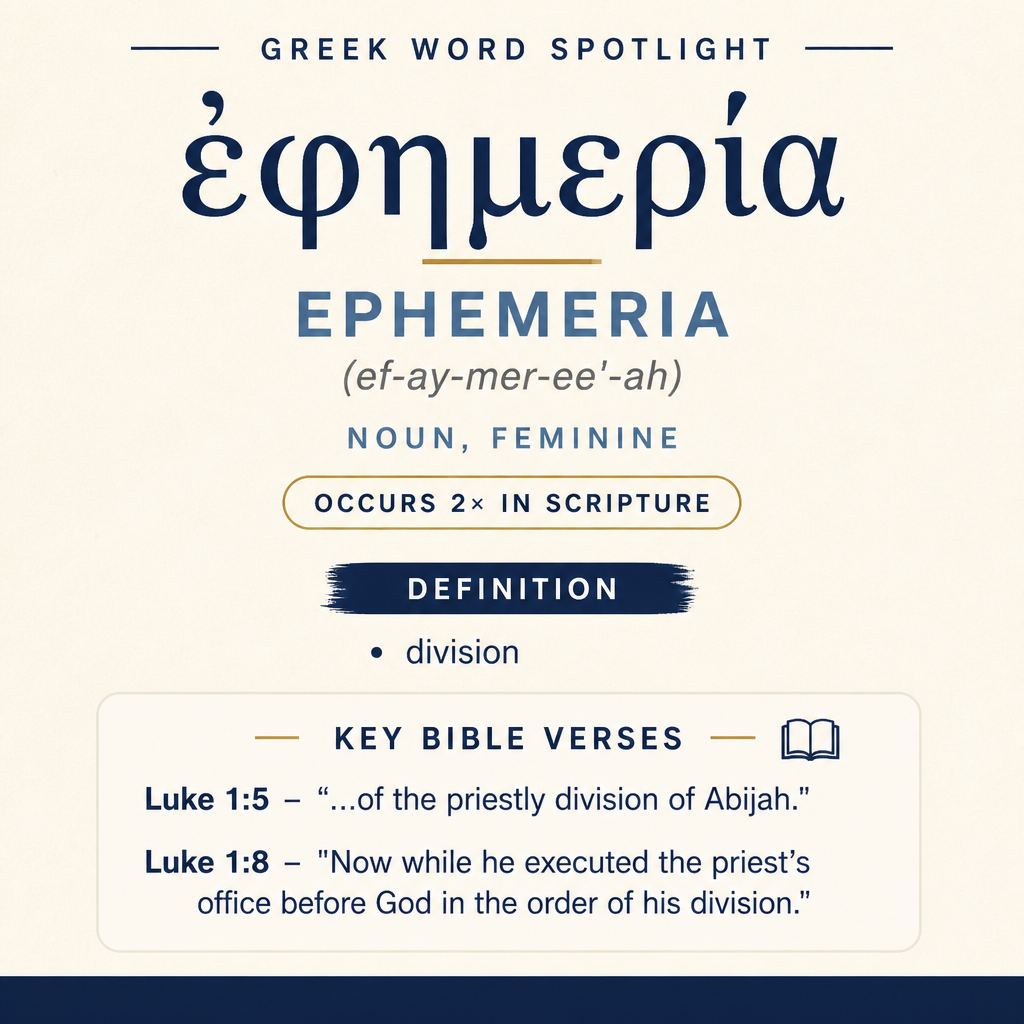
ἐφημερία (Ephemeria) means “division” and appears twice in Luke 1:5 and 1:8 regarding Zacharias’ priestly service.
Luke Occurrences
It occurs in Luke 1:5 and Luke 1:8. Both references describe priestly service within an assigned division.
Learn More →Immediate Context
In Luke 1:5, Zacharias is identified with the priestly division of Abijah. In Luke 1:8, he serves before God in the order of his division.
Learn More →ἐφημερία refers to a “division,” and in the New Testament it appears in Luke’s opening narrative about the priest Zacharias. In both places it frames priestly service as ordered by an established division with a named identity and a recognized sequence.
Root and Related Words
ἐφημερία is connected with the adjective ephemeros (ἐφήμερος), “daily” (Strong’s G2184). In Luke’s setting, that relationship naturally sits beside the idea of priestly work carried out within an organized rhythm of service.

Occurrences
“There was in the days of Herod, the king of Judea, a certain priest named Zacharias, of the priestly division of Abijah. He had a wife of the daughters of Aaron, and her name was Elizabeth.” (Luke 1:5)
Here ἐφημερία anchors Zacharias in a defined priestly structure: he is “of the priestly division of Abijah.” The narrative does not introduce him merely as “a certain priest,” but locates him within a particular division that bears a name. This does two things in the scene. First, it places Zacharias within a recognized priestly order inside Judea under Herod (“in the days of Herod, the king of Judea”), showing that his identity is not only personal (his name) and familial (his wife is “of the daughters of Aaron”), but also corporate and administrative: he belongs to a division. Second, it prepares the reader to understand subsequent temple service as something assigned and scheduled rather than improvised. The word “division” functions like a marker of official standing: Zacharias is presented as someone who serves as part of an arrangement larger than himself, connected to a specific unit within the priesthood.
Luke also pairs the division-language with lineage-language in the same verse: Zacharias is tied to “the priestly division of Abijah,” while Elizabeth is tied to “the daughters of Aaron.” The effect is that ἐφημερία sits alongside genealogical descriptors without becoming a genealogy itself. It signals an organizational grouping within the priestly world, a way of speaking about where someone belongs when temple duties are distributed. By giving the name “Abijah,” Luke treats the division as a concrete, identifiable body, not an abstract category. In this opening line, ἐφημερία therefore contributes clarity and specificity: the priesthood is not a monolithic mass, and Zacharias is introduced through the particular division to which he is attached.
“Now while he executed the priest’s office before God in the order of his division” (Luke 1:8)
In this second occurrence, ἐφημερία shapes the action itself. Zacharias “executed the priest’s office before God,” and Luke adds that he did so “in the order of his division.” The phrase “before God” places the work in a sacred setting, but “in the order” places it in an arranged sequence. The “division” is not only a label attached to Zacharias (as in Luke 1:5); it is the organizing principle that governs when and how he performs his priestly office. The word thus functions as an explanation of timing and authorization: his service is happening within a defined order associated with his division.
The verse presents priestly activity as both devotional (“before God”) and regulated (“in the order of his division”). ἐφημερία supports this dual perspective. It does not replace the religious purpose of the work, but it explains the practical framework in which the work occurs. Zacharias is not acting independently; rather, his priestly execution takes place as part of his division’s turn or arrangement. The division provides a structure that can be “ordered,” implying recognizable sequencing within which individual priests carry out their office. In this scene, ἐφημερία contributes a sense of orderly service: priestly work is performed as a duty assigned within an organized division.
Sense and Usage
Across Luke 1:5 and 1:8, ἐφημερία consistently points to an ordered grouping within the priesthood—something that can be named (“of Abijah”) and something that can have an “order” in which duties are carried out. The word’s force in these contexts lies in its ability to express how the priesthood is divided into parts that function as units. In Luke 1:5, that unit identifies Zacharias: the division answers the question, “Which priestly grouping is he associated with?” In Luke 1:8, the same unit explains his activity: the division answers the question, “Under what arrangement is he serving at this time?”
The two occurrences also show how a “division” can operate on more than one level. It is a descriptor of belonging (Zacharias is of a particular division), and it is a descriptor of procedure (there is an order connected to that division). Luke’s phrasing brings out the practical implications of a division without needing to detail the mechanics: the division is sufficiently real that it can be referred to as “his division,” and sufficiently structured that it can have an “order.” This makes ἐφημερία a word of social and liturgical organization in Luke’s opening sentences. It indicates that the priest’s role is embedded in a larger system that allocates service by divisions and that recognizes the divisions as stable, identifiable groups.
Because Luke introduces ἐφημερία alongside personal names (Zacharias, Elizabeth), royal context (Herod, king of Judea), and priestly lineage (“daughters of Aaron”), the word also contributes to the narrative’s sense of public, verifiable setting. The story begins within a world where offices, relationships, and duties have recognizable forms. A “division” is one of those forms: it frames priestly life as structured membership rather than mere occupation. Luke 1:8 then shows that this structure is not only background detail; it affects when Zacharias performs his priestly service. In this way, ἐφημερία supports Luke’s emphasis on ordered events unfolding within established institutions.
Imagery in Luke
In these verses, ἐφημερία carries imagery of ordered temple service: a priest executing his office “before God” within the “order” associated with his division (Luke 1:8). Luke pairs the sacred setting with an organized framework, so the picture is neither chaotic nor purely private. The “priestly division of Abijah” (Luke 1:5) evokes a named company within the priesthood, and “the order of his division” (Luke 1:8) evokes a sequence in which that company’s service proceeds.
Sources: Lexical data from Strong’s Exhaustive Concordance and the Translators Brief Lexicon of Extended Strongs for Greek (STEPBible, CC BY). Occurrence data from the Translators Amalgamated Greek New Testament (STEPBible, CC BY). Scripture quotations from the World English Bible (public domain).