Exploring the Meaning of Eumetadotos in Greek
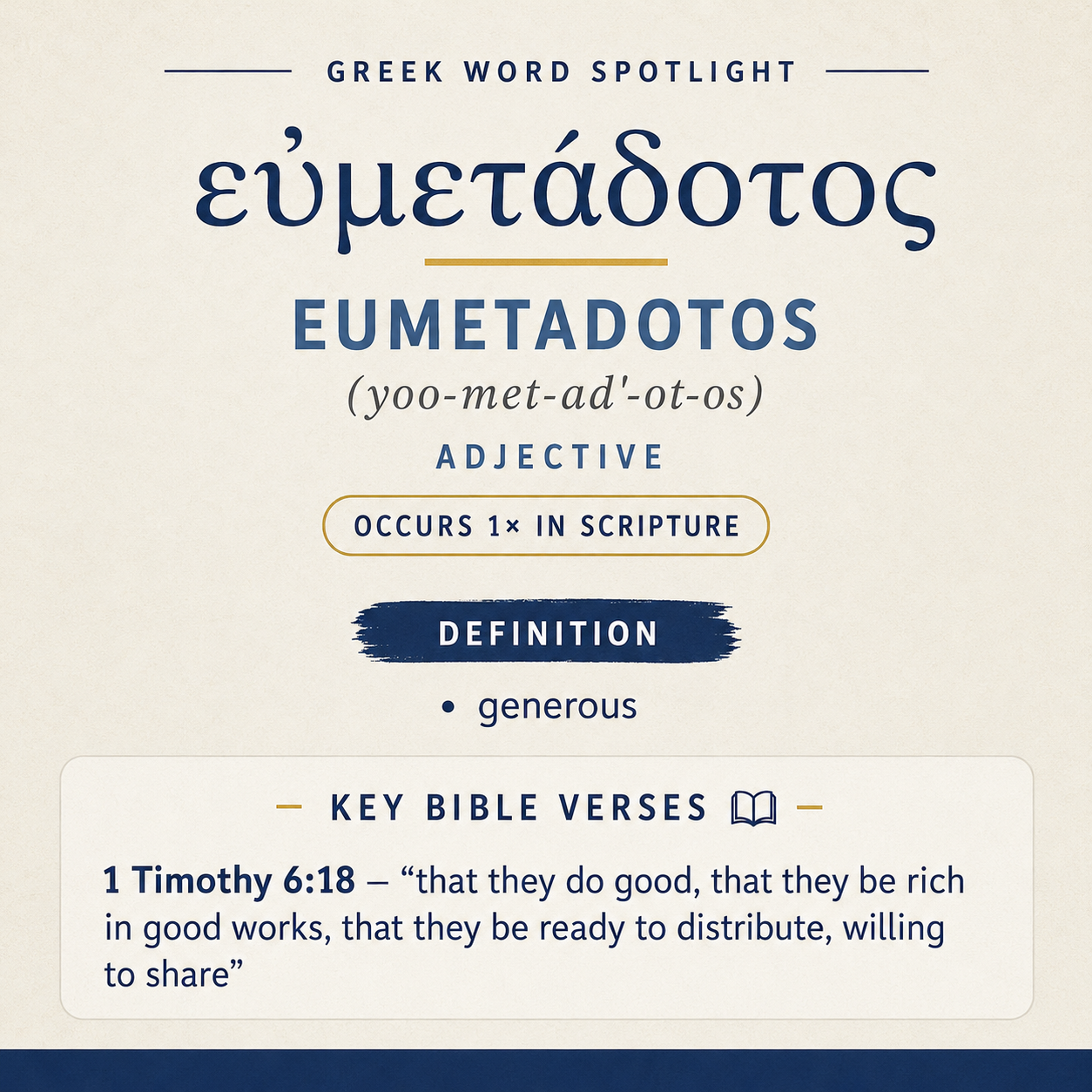
εὐμετάδοτος means “generous” and appears once in Scripture, in 1 Timothy 6:18.
Scripture Occurrence
This word occurs 1 time in Scripture. Its only occurrence is in 1 Timothy 6:18.
Learn More →Verse Context
In 1 Timothy 6:18 it appears in the call to do good and be rich in good works. The verse includes being ready to distribute and willing to share.
Learn More →εὐμετάδοτος expresses the quality of being “generous.” It appears once, in Paul’s instructions about practical conduct for those who have wealth (1 Timothy 6:18).
Root and Related Words
εὐμετάδοτος is connected with the element eu (εὖ), “well/well done!” (Strong’s G2095), and with the verb metadidōmi (μεταδίδωμι), “to share” (Strong’s G3330). Together these related words point toward generosity as a form of “good” sharing—sharing that is done in a fitting, commendable way.

Occurrences
“that they do good, that they be rich in good works, that they be ready to distribute, willing to share;” (1 Timothy 6:18)
In 1 Timothy 6:18, εὐμετάδοτος belongs to a tightly linked set of exhortations that describe what wealth should look like when it is put into motion. The verse stacks short clauses that move from broad moral direction (“do good”) to a kind of wealth redefined in ethical terms (“rich in good works”), and then to concrete outward action (“ready to distribute, willing to share”). Within this sequence, εὐμετάδοτος characterizes a posture toward one’s resources: generosity is not treated as a sporadic act, but as a settled readiness that expresses itself in distribution and sharing. The wording keeps the focus on action that benefits others; generosity is shown as something embodied through deeds and open-handed decisions rather than merely claimed as an attitude.
The immediate neighbors of the term in the verse provide its texture. “Ready to distribute” frames generosity as preparedness—an availability to give when a need comes into view. “Willing to share” frames it as voluntary—generosity that is not coerced but chosen. εὐμετάδοτος sits naturally with both: it is the quality that makes a person both prepared and willing, so that good intentions take shape as tangible sharing. In this line, generosity functions as a moral descriptor that aligns a person’s wealth with “good works,” so that what one has becomes an avenue for doing good rather than a private possession held back.
Sense and Usage
The sense “generous” in εὐμετάδοτος, as used in 1 Timothy 6:18, is defined by its practical direction. It is not presented as a detached virtue floating above daily life; it is interwoven with actions that can be observed: doing good, being rich in good works, distributing, sharing. The verse treats generosity as a quality that turns resources outward. That outward orientation is important for how the adjective lands: it is not merely about quantity given, but about a consistent disposition that makes giving and sharing a normal and ready response.
Because εὐμετάδοτος is paired with language of readiness and willingness, the generosity it denotes has an active and responsive character. “Ready” speaks to preparedness: generosity that has already decided, before any specific request arises, that possessions are available for good. “Willing” speaks to desire: generosity that shares without reluctance. Together they portray generosity as both prompt and free, a habit of life that expresses itself without delay and without compulsion.
The connection with metadidōmi (“to share”) also helps the reader hear the kind of behavior being urged: generosity is not described as abstract benevolence but as sharing—making what one has available to others. In the verse, this sharing is not separated from “good works”; rather, it is one of the ways such works become concrete. Thus εὐμετάδοτος functions as a bridge between the moral category of “doing good” and the specific practices of distributing and sharing.
In this setting, εὐμετάδοτος also serves a clarifying role: it frames how wealth is to be handled within the community addressed by the letter. The verse does not merely command isolated acts of giving; it sketches a pattern in which generosity marks the wealthy person’s conduct and reputation. The repeated “that they…” clauses portray generosity as part of a broader identity shaped by good works, implying consistency over time rather than a single moment of charity.
Imagery
The imagery implied by εὐμετάδοτος in 1 Timothy 6:18 is ordinary and concrete: hands that are prepared to distribute, and a household or person who shares without hesitation. The verse invites the reader to picture wealth not as stored-up goods kept behind closed doors, but as resources already poised to move outward in practical ways through good works.
Sources: Lexical data from Strong’s Exhaustive Concordance and the Translators Brief Lexicon of Extended Strongs for Greek (STEPBible, CC BY). Occurrence data from the Translators Amalgamated Greek New Testament (STEPBible, CC BY). Scripture quotations from the World English Bible (public domain).