
Exploring the Meaning of Eulogetos in Greek
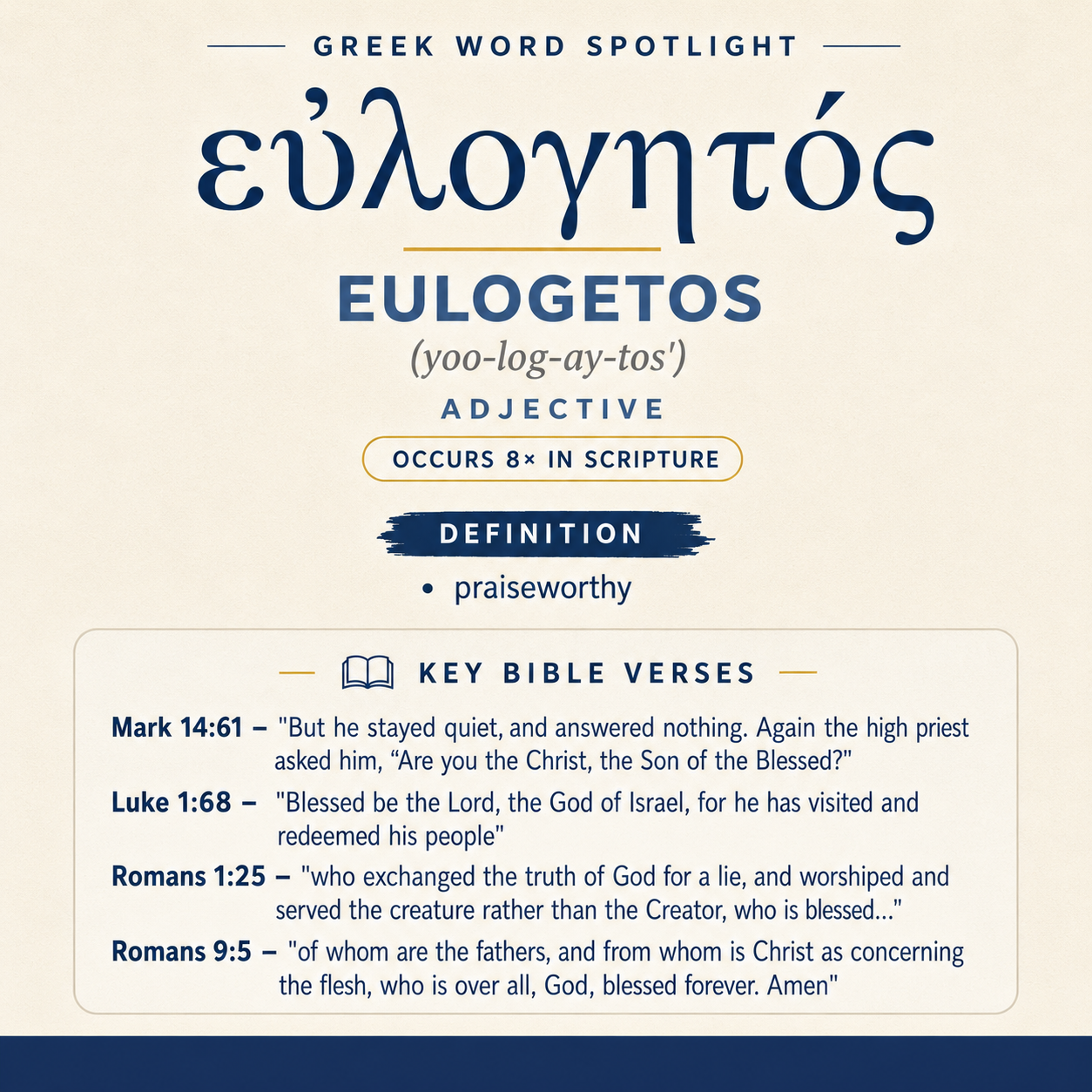
εὐλογητός (Eulogetos) means “praiseworthy” and occurs 8 times in Scripture, including Mark 14:61, Luke 1:68, Romans, Corinthians, Ephesians, and 1 Peter.
Core Meaning
εὐλογητός is defined as “praiseworthy.” It is used as a term of blessing and praise.
Learn More →Where It Appears
It occurs 8 times: Mark 14:61; Luke 1:68; Romans 1:25; Romans 9:5; 2 Corinthians 1:3; 2 Corinthians 11:31; Ephesians 1:3; 1 Peter 1:3.
Learn More →How It’s Used
It describes God as “blessed,” including “blessed forever” in Romans 9:5 and 2 Corinthians 11:31. It also appears in doxological openings such as Luke 1:68 and Ephesians 1:3.
Learn More →εὐλογητός describes someone as “praiseworthy,” and in Scripture it appears as a fixed word of acclaim directed to God and, in one setting, as a revered title. The passages where it occurs place the word on the lips of worshipers, witnesses, and interrogators as they speak about the identity and worthiness of the Lord.
Occurrences
Mark 14:61 — “But he stayed quiet, and answered nothing. Again the high priest asked him, “Are you the Christ, the Son of the Blessed?””
Here εὐλογητός is used as a title: “the Blessed.” The high priest’s question frames the trial scene by coupling two claims—“the Christ” and “the Son of the Blessed”—so that praiseworthiness functions as a way of speaking about God with reverence and weight. In this setting the word does not introduce a spoken blessing but serves as a recognized designation, one that gives the question a solemn, theological focus.
Luke 1:68 — ““Blessed be the Lord, the God of Israel, for he has visited and redeemed his people;”
In Luke the word appears in a direct acclamation: “Blessed be the Lord.” The praiseworthiness of the Lord is immediately anchored in what is celebrated in the sentence that follows: “for he has visited and redeemed his people.” The word therefore marks the opening of a praise-saying that points to God’s action toward his people as the ground for proclaiming him praiseworthy.
Romans 1:25 — “who exchanged the truth of God for a lie, and worshiped and served the creature rather than the Creator, who is blessed forever. Amen.”
Paul uses εὐλογητός as a contrasting verdict on God’s worthiness in a context describing misdirected worship. The sentence speaks of exchanging “the truth of God for a lie” and shifting worship from “the Creator” to “the creature,” but then it halts on the Creator’s enduring status: “who is blessed forever.” The word functions as a corrective confession: regardless of human distortion, the Creator remains praiseworthy, and the “Amen” seals that confession as a settled affirmation.
Romans 9:5 — “of whom are the fathers, and from whom is Christ as concerning the flesh, who is over all, God, blessed forever. Amen.”
In this densely packed statement εὐλογητός stands at the summit of a description that moves from ancestry (“the fathers”) to the Messiah’s human lineage (“from whom is Christ as concerning the flesh”) and then to a culminating doxological claim: “who is over all, God, blessed forever.” The word here functions as praise-language attached to the one described as “over all,” giving the sentence not only an identifying claim but also a posture of worship. Again, “Amen” frames the praiseworthiness as a confession meant to be received and affirmed.
2 Corinthians 1:3 — “Blessed be the God and Father of our Lord Jesus Christ, the Father of mercies and God of all comfort;”
Here εὐλογητός introduces a formal blessing-saying directed to “the God and Father of our Lord Jesus Christ.” The phrase “the Father of mercies and God of all comfort” elaborates why he is spoken of as praiseworthy: his character is expressed in mercy and comfort. In this scene the word sets a worshipful tone for what follows, locating praise not in vague admiration but in naming the God who relates to believers with mercy and comfort.
2 Corinthians 11:31 — “The God and Father of the Lord Jesus Christ, he who is blessed forever more, knows that I don’t lie.”
Paul invokes εὐλογητός within an oath-like appeal to divine knowledge: God “knows that I don’t lie.” Calling God “he who is blessed forever more” frames the appeal to God’s omniscience with worshipful reverence. The word strengthens the gravity of the claim by linking the truthfulness of the speaker’s testimony to the praiseworthy God who can verify it; the confession of God’s enduring praiseworthiness stands as the moral and spiritual backdrop to the assertion of honesty.
Ephesians 1:3 — “Blessed be the God and Father of our Lord Jesus Christ, who has blessed us with every spiritual blessing in the heavenly places in Christ,”
In Ephesians, εὐλογητός is again the opening acclamation directed to “the God and Father of our Lord Jesus Christ,” but here it immediately connects divine praiseworthiness with benefaction: God “has blessed us with every spiritual blessing.” The word functions as the response of worship to God’s giving. The scene is expansive—“in the heavenly places in Christ”—and the word signals that such a sweeping description of God’s work is properly met with speech that declares him praiseworthy.
1 Peter 1:3 — “Blessed be the God and Father of our Lord Jesus Christ, who according to his great mercy caused us to be born again to a living hope through the resurrection of Jesus Christ from the dead,”
Peter uses εὐλογητός to launch praise that is explicitly grounded in mercy and new life. The praiseworthiness of “the God and Father of our Lord Jesus Christ” is tied to what he has done “according to his great mercy”: he “caused us to be born again to a living hope.” The phrase “through the resurrection of Jesus Christ from the dead” specifies the means by which that hope is given. In this setting the word marks the proper verbal stance toward God’s saving mercy—praise that rises from the reality of new birth and hope.

Sense and Usage
Across these passages εὐλογητός operates as a distinctive adjective of acclaim, applied to God in settings that are overtly worshipful and confessional. It does not function here as a general compliment to human virtue but as a weighty ascription that belongs to “the Lord,” “the Creator,” and “the God and Father of our Lord Jesus Christ.” When the word appears, it signals that the speaker is not merely describing God but honoring him—placing God in the position of being publicly recognized as worthy of praise.
Several occurrences show a doxological pattern: the word stands at the front of a sentence (“Blessed be the Lord…,” “Blessed be the God and Father…”) and then a reason is given. In Luke, the reason is redemption: “for he has visited and redeemed his people.” In 2 Corinthians 1, the reason is who God is for his people: “the Father of mercies and God of all comfort.” In Ephesians, the reason is God’s generosity toward believers: he “has blessed us with every spiritual blessing in the heavenly places in Christ.” In 1 Peter, the reason is God’s merciful act that generates new life and hope: “according to his great mercy caused us to be born again to a living hope through the resurrection of Jesus Christ from the dead.” In each case, εὐλογητός marks the response of praise, while the remainder of the clause supplies the concrete grounds that display why God is to be recognized as praiseworthy.
Other occurrences show the word placed after a description of God, as an enduring qualifier: “who is blessed forever” (Romans 1:25), “God, blessed forever” (Romans 9:5), and “he who is blessed forever more” (2 Corinthians 11:31). In these lines the word functions almost like a concluding seal attached to the name of God. The temporal phrases “forever” and “forever more” reinforce the stability of the ascription: the praiseworthiness confessed is not momentary or dependent on circumstances but is spoken of as lasting. The repeated “Amen” in Romans 1:25 and Romans 9:5 also marks these as confessional statements, meant to be affirmed as true and fitting.
Mark 14:61 uses the word differently: “the Son of the Blessed.” The term appears as a reverent designation for God that can be used in a legal-religious interrogation without turning the scene into a hymn. Even there, εὐλογητός carries the weight of worship language; calling God “the Blessed” presents him as the one recognized as praiseworthy, and the question tests Jesus’ relationship to that praiseworthy God. The adjective therefore serves both liturgical praise (ascriptions directed to God) and solemn reference (a title that evokes honor) within narrative and epistolary contexts.
Imagery and Tone
Although εὐλογητός is a compact word, these passages surround it with a consistent atmosphere: worship shaped by God’s acts and character. The Lord is praised for visiting and redeeming his people (Luke 1:68), the Creator is confessed as worthy even when creatures are wrongly worshiped (Romans 1:25), and the God and Father of the Lord Jesus Christ is honored as the source of mercies, comfort, spiritual blessing, new birth, and living hope (2 Corinthians 1:3; Ephesians 1:3; 1 Peter 1:3). Even when invoked to underscore truthfulness (“knows that I don’t lie,” 2 Corinthians 11:31) or employed as a reverent title in a trial question (Mark 14:61), the word keeps the discourse oriented toward the acknowledged worthiness of God.
Sources: Lexical data from Strong’s Exhaustive Concordance and the Translators Brief Lexicon of Extended Strongs for Greek (STEPBible, CC BY). Occurrence data from the Translators Amalgamated Greek New Testament (STEPBible, CC BY). Scripture quotations from the World English Bible (public domain).





