Exploring the Meaning of Eulogeo in Greek
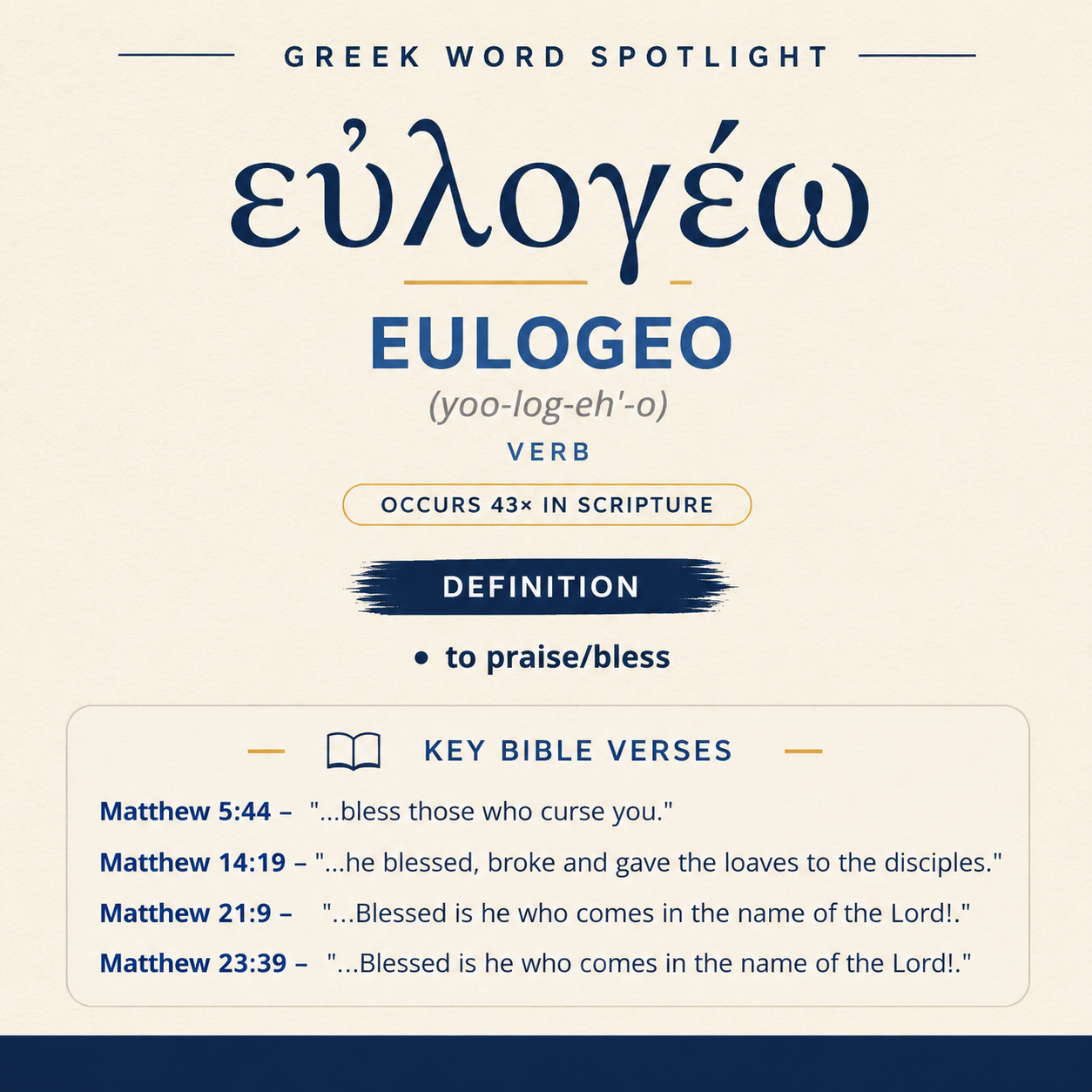
εὐλογέω means “to praise/bless” and occurs 43 times in Scripture, including Matthew and Mark.
Where It Appears
εὐλογέω occurs 43 times in Scripture. The listed occurrences include multiple verses in Matthew and Mark.
Learn More →Usage Examples
In Matthew 5:44, it is used in the command to “bless those who curse you.” In Mark 6:41, Jesus “blessed” the loaves and fish.
Learn More →εὐλογέω means “to praise/bless,” and in these passages it appears in teachings about how to treat others, in scenes where Jesus blesses food or bread, in public cries of blessing at his arrival, and in words of blessing spoken over particular people.
Occurrences
Matthew 5:44: “But I tell you, love your enemies, bless those who curse you, do good to those who hate you, and pray for those who mistreat you and persecute you,”
Here εὐλογέω stands as an active response to hostility. The command pairs “bless” with “love,” “do good,” and “pray,” placing blessing in the sphere of deliberate action toward people who are openly opposed (“enemies,” “those who curse you”). Blessing is not framed as a private feeling but as an outward stance taken toward the offender, set against the verbal harm of cursing.

Matthew 14:19: “He commanded the multitudes to sit down on the grass; and he took the five loaves and the two fish, and looking up to heaven, he blessed, broke and gave the loaves to the disciples, and the disciples gave to the multitudes.”
In this feeding scene, εὐλογέω is performed over tangible food (“five loaves and the two fish”) in a structured sequence: he “took,” “looking up to heaven,” “he blessed,” then “broke and gave.” The direction of gaze anchors the act in reverence toward heaven, and the blessing functions as the verbal or liturgical act that precedes distribution. It is the hinge between taking what is present and breaking and giving it for the crowd’s need.
Matthew 21:9: “The multitudes who went in front of him, and those who followed, kept shouting, “Hosanna to the son of David! Blessed is he who comes in the name of the Lord! Hosanna in the highest!””
Here the language of blessing is shouted by crowds “in front” and “followed,” giving εὐλογέω a public, acclamatory setting. The blessing is attached to “he who comes in the name of the Lord,” so it is directed toward a person’s arrival and identity rather than toward an object. The repeated cries (“kept shouting”) show blessing as collective praise voiced aloud in celebration.
Matthew 23:39: “For I tell you, you will not see me from now on, until you say, ‘Blessed is he who comes in the name of the Lord!’ ”
In this saying, blessing becomes a future confession: “until you say.” εὐλογέω is framed as spoken words that mark recognition—what must be said before “you will…see me.” The same blessing formula as the triumphal shouting is now presented as a threshold utterance, highlighting blessing as explicit, verbal acknowledgment.
Matthew 25:34: “Then the King will tell those on his right hand, ‘Come, blessed of my Father, inherit the Kingdom prepared for you from the foundation of the world;”
εὐλογέω functions here as a designation placed on people: “blessed of my Father.” The word marks identity and standing in the King’s summons (“Come”) and is bound to an invitation to “inherit the Kingdom.” Blessing is not merely something spoken over a moment; in this courtroom-like scene it describes those welcomed and authorizes their inclusion in what is “prepared for you.”
Matthew 26:26: “As they were eating, Jesus took bread, gave thanks for it, and broke it. He gave to the disciples, and said, “Take, eat; this is my body.””
In this meal setting, the act associated with εὐλογέω appears as “gave thanks for it” in the same place where other passages describe blessing over bread. The sequence “took…gave thanks…broke…gave” parallels the feeding narratives’ movement from taking and blessing to breaking and distributing. In this context the action over bread is immediately followed by interpretive speech (“this is my body”), so the blessing/thanksgiving action helps frame the giving of the bread as a significant act within the meal.
Mark 6:41: “He took the five loaves and the two fish, and looking up to heaven, he blessed and broke the loaves, and he gave to his disciples to set before them, and he divided the two fish among them all.”
This parallels Matthew’s feeding but emphasizes the coordinated actions: “he blessed and broke the loaves.” εὐλογέω is joined tightly to the breaking, presenting blessing as the consecrating or praising act that accompanies provision. The blessing is again linked to “looking up to heaven,” and it sits within a chain that results in the disciples’ service (“to set before them”) and the inclusive distribution (“among them all”).
Mark 8:7: “They had a few small fish. Having blessed them, he said to serve these also.”
Here εὐλογέω is applied specifically to “a few small fish,” and the participial phrasing (“Having blessed them”) makes it preparatory for the instruction, “serve these also.” Blessing stands as the brief but decisive act that transitions the fish from being counted (“they had”) to being shared. The “also” suggests a setting of provision where blessing legitimizes serving what is available, even when it is small.
Mark 11:9: “Those who went in front, and those who followed, cried out, “Hosanna! Blessed is he who comes in the name of the Lord!”
In this acclamation, εὐλογέω again appears as a crowd’s cry. The blessed one is “he who comes in the name of the Lord,” tying blessing to the arrival of a figure welcomed in God’s name. The scene places blessing in the mouth of the procession, functioning as praise that accompanies movement and public attention.
Mark 11:10: “Blessed is the kingdom of our father David that is coming in the name of the Lord! Hosanna in the highest!”
Here the blessing is directed not only to a person but to “the kingdom…that is coming.” εὐλογέω thus extends to the anticipated reign or realm associated with David, and it is praised as it “is coming in the name of the Lord.” Blessing functions as public approval and praise for what is arriving, linking hope to the language of blessing.
Mark 14:22: “As they were eating, Jesus took bread, and when he had blessed, he broke it, and gave to them, and said, “Take, eat. This is my body.””
This explicitly uses εὐλογέω for Jesus’ action over bread at the meal: “when he had blessed, he broke it, and gave.” Blessing is positioned between taking and breaking, and it introduces the giving accompanied by interpretive speech. The sequence presents blessing as the purposeful act that frames the breaking and sharing of bread with the words “This is my body.”
Luke 1:28: “Having come in, the angel said to her, “Rejoice, you highly favored one! The Lord is with you. Blessed are you among women!””
In this announcement, εὐλογέω expresses a spoken blessing directed to Mary in the context of divine favor and presence: “The Lord is with you.” The blessing is personal (“Blessed are you”) and comparative (“among women”), and it sits within a greeting that includes joy (“Rejoice”) and affirmation. Blessing here functions as praise and honor spoken over a person in a moment of revelation.

Sense and Usage
Across these passages, εὐλογέω moves in two main directions while staying within “to praise/bless.” In several scenes it is a spoken or shouted act of praise directed toward a person or what is coming: the crowds cry “Blessed is he who comes in the name of the Lord!” (Matthew 21:9; Mark 11:9), Jesus speaks of a time “until you say” that same blessing (Matthew 23:39), the coming kingdom is hailed as “Blessed” (Mark 11:10), and the angel’s greeting includes “Blessed are you among women!” (Luke 1:28). In these, blessing is explicitly verbal and public-facing—either the loud voice of a crowd or the direct address of an angel or the required words of acknowledgment.
In the meal and feeding narratives, εὐλογέω is bound to actions done over food as part of giving: bread and fish are taken, heaven is acknowledged (“looking up to heaven”), and then blessing precedes breaking and serving (Matthew 14:19; Mark 6:41; Mark 8:7; Mark 14:22). The word’s force is seen in its placement: blessing is the transition from possession to provision. Even when the English wording uses “gave thanks” (Matthew 26:26), the narrative role matches the same liturgical moment before bread is broken and handed out, showing how blessing can function as praise directed Godward within a meal while still shaping what is given to others.
Matthew 5:44 sets εὐλογέω in ethical instruction rather than ritual or celebration. Blessing is commanded toward those who actively harm (“curse,” “mistreat,” “persecute”), placing praise/blessing in direct contrast to cursing. The imperative “bless those who curse you” portrays blessing as a disciplined speech-act and posture that refuses to mirror hostility. In Matthew 25:34 the term becomes a description of people welcomed by the King—“blessed of my Father”—so blessing is not only something done but also something that names a status associated with inheritance and welcome.
Imagery
These occurrences repeatedly place εὐλογέω on lips—of crowds shouting, of an angel greeting, of a king summoning, of disciples hearing—and on hands at table—bread taken, blessed, broken, and given. The word’s imagery ranges from the noise of public acclaim (“kept shouting”) to the quiet order of a meal where a blessing marks the moment before food is shared, and from a command to bless enemies to a courtroom-like invitation, “Come, blessed of my Father.”
Sources: Lexical data from Strong’s Exhaustive Concordance and the Translators Brief Lexicon of Extended Strongs for Greek (STEPBible, CC BY). Occurrence data from the Translators Amalgamated Greek New Testament (STEPBible, CC BY). Scripture quotations from the World English Bible (public domain).