
Exploring the Meaning of Eulabeomai in Greek
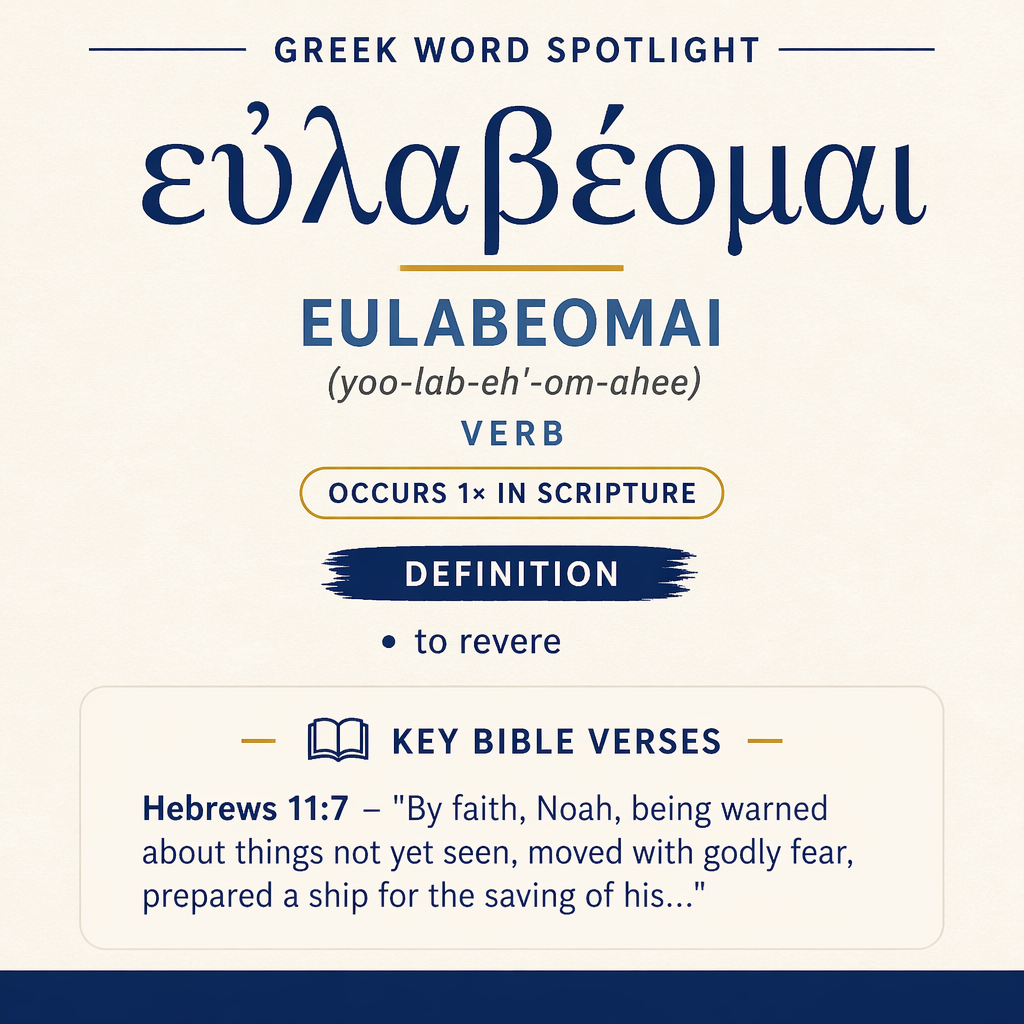
εὐλαβέομαι means “to revere” and appears once in Scripture in Hebrews 11:7.
Hebrews Context
In Hebrews 11:7, Noah responds by faith when warned about unseen things. He is described as moved with godly fear as he prepared a ship.
Learn More →Eulabeomai means “to revere.” It appears once in the New Testament, in Hebrews 11:7, where it characterizes Noah’s response to a divine warning and frames his faithful action as reverent fear before God.
Root and Related Words
Eulabeomai is derived from the adjective eulabēs (εὐλαβής), “devout” (Strong’s G2126). The relationship between the two forms places the verb in a word-family that describes a posture of careful, devout regard.

Occurrences
“By faith, Noah, being warned about things not yet seen, moved with godly fear, prepared a ship for the saving of his house, through which he condemned the world, and became heir of the righteousness which is according to faith.” (Hebrews 11:7)
In this verse, eulabeomai is expressed in the clause “moved with godly fear,” describing the inner posture that accompanies Noah’s faith. The setting is explicitly future-oriented and invisible: Noah is “warned about things not yet seen.” The verb therefore marks a response that does not arise from visible proof but from reverent regard for the one who warns. It is not presented as a passing emotion; it is the motive that “moved” him into concrete, sustained obedience—he “prepared a ship for the saving of his house.”
The reverence signaled by eulabeomai also sits at a hinge point in the verse’s logic. Noah’s action has multiple outcomes: it saves his household, “condemned the world,” and he “became heir of the righteousness which is according to faith.” Within that chain, “moved with godly fear” gives theological shape to what might otherwise look like mere prudence or survival instinct. The building of the ship is presented as the outworking of faith under reverent fear—an action undertaken because God’s warning is treated as weighty and trustworthy. In that way, the verb helps connect an unseen warning to a visible act that stands as testimony, setting Noah’s household and “the world” in contrast.
The immediate collocation “godly fear” narrows the kind of reverence in view. The fear is not directed toward circumstances as such (“things not yet seen”), but toward God, the one who warns. In the narrative flow of the sentence, the warning supplies the content, faith supplies the manner of reception (“By faith”), and eulabeomai names the reverent responsiveness that energizes obedience. The result is a picture of reverence that is neither abstract nor merely internal: it becomes a settled orientation that issues in preparation, perseverance, and public distinction.
Sense and Usage
Because eulabeomai is attested here within a faith-example, its sense is sharpened by the way reverence interacts with revelation and action. The verse portrays a sequence: God warns; Noah believes; reverent fear moves him; he prepares a ship. Reverence, in this frame, is not a competing motive alongside faith but a faith-shaped response to God’s word. It is the fitting emotional and moral posture of a person who treats divine warning as authoritative and urgent.
The verse also portrays reverence as forward-looking. Noah’s warning concerns “things not yet seen,” and his reverent response bridges the gap between promise/threat and present behavior. In other words, eulabeomai is the reverent stance of living as though the unseen word is more determinative than present appearances. That connection explains why the verse can place “moved with godly fear” in the middle of an argument about faith: reverence is the interior acknowledgement that God’s speech matters more than the visible world’s apparent stability.
At the same time, the reverence described here is ethically consequential. The text says Noah’s ship-preparation “condemned the world.” That condemnation is not explained as a verbal pronouncement but as the effect of faithful, reverent obedience. By revering God’s warning enough to act, Noah’s conduct becomes an implicit verdict on the world’s contrary posture—an embodied contrast between taking God seriously and refusing to do so. Eulabeomai, therefore, participates in the passage’s larger contrastive rhetoric: the reverent response of faith stands over against the world’s stance, and the difference becomes visible through action.
Finally, the verse links Noah’s reverent fear with inheritance: he “became heir of the righteousness which is according to faith.” Within this single sentence, reverence does not earn righteousness, but it coheres with the faith by which righteousness is received. The line of thought suggests that reverence belongs to the lived shape of faith—faith that receives a warning as true, fears God in a godly way, and therefore obeys. In this use, eulabeomai carries the idea of reverence that is responsive (triggered by being “warned”), discerning (aimed at God rather than at mere events), and active (expressed by preparation).
Imagery
The imagery surrounding eulabeomai in Hebrews 11:7 is concrete and domestic: a household facing an unseen future, and a ship prepared “for the saving of his house.” Reverence is pictured not as withdrawal from the world but as careful responsiveness that takes shape in building and preparing. The reverent fear named by eulabeomai is thus linked to the sound of construction, the long patience of preparation, and the sober weight of acting on a warning before the warned-of realities can be seen.
Sources: Lexical data from Strong’s Exhaustive Concordance and the Translators Brief Lexicon of Extended Strongs for Greek (STEPBible, CC BY). Occurrence data from the Translators Amalgamated Greek New Testament (STEPBible, CC BY). Scripture quotations from the World English Bible (public domain).





