
Exploring the Meaning of Euergesia in Greek
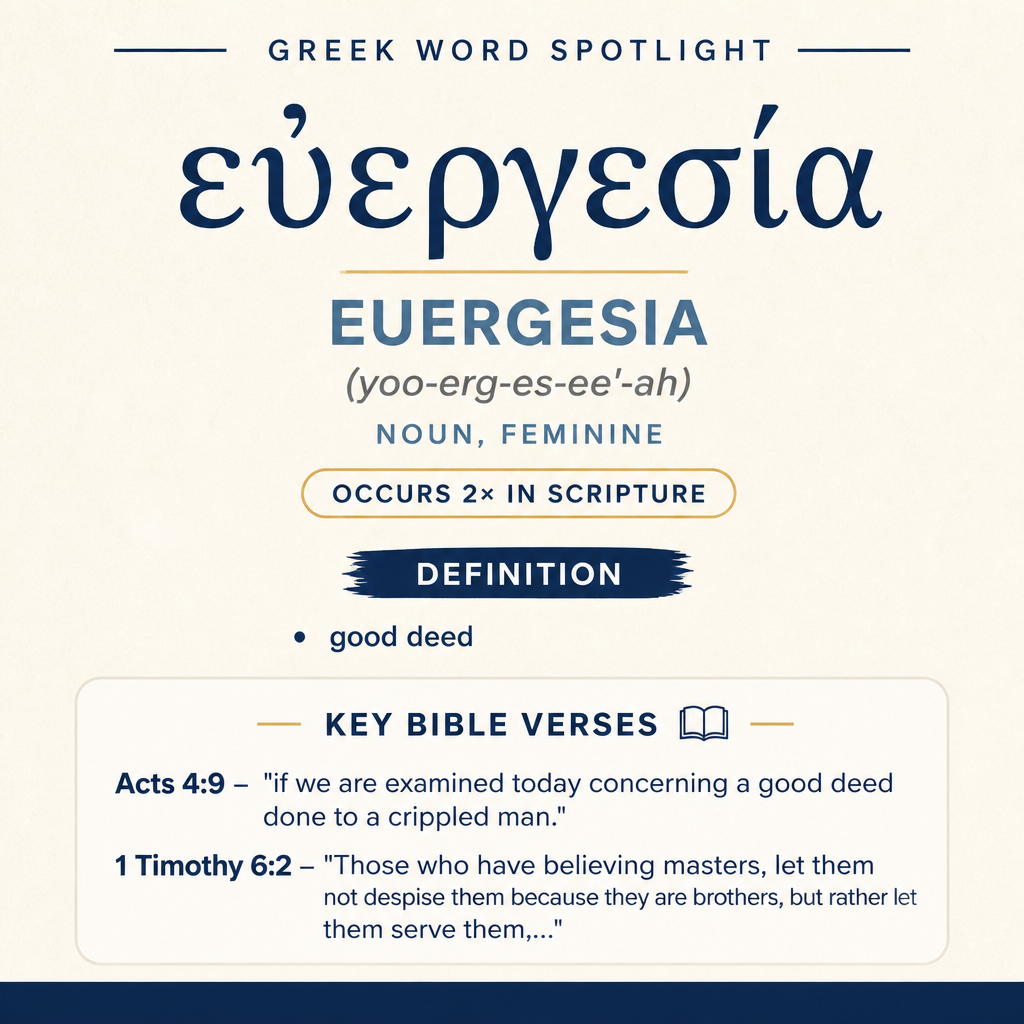
εὐεργεσία (Euergesia) means “good deed” and appears in Acts 4:9 and 1 Timothy 6:2.
Acts Usage
In Acts 4:9 it refers to a good deed done to a crippled man, connected with his healing.
Learn More →εὐεργεσία refers to a good deed, a concrete act that can be pointed to and evaluated. It appears in Acts 4:9 in the context of public examination about a healing, and in 1 Timothy 6:2 where it frames the practical outcome of faithful service in a household relationship.
Root and Related Words
εὐεργεσία is derived from εὐεργέτης (euergētēs), “benefactor” (Strong’s G2110). The related term highlights a personal agent known for doing good, while εὐεργεσία names the deed itself as something performed.

Occurrences
“if we are examined today concerning a good deed done to a crippled man, by what means this man has been healed,” (Acts 4:9)
Here εὐεργεσία is presented as the subject of an inquiry: the speakers describe themselves as being “examined today” with respect to a specific action “done to a crippled man.” The phrase places the deed in the public sphere, where it is treated as an identifiable event open to questioning. The wording also ties the deed to a visible outcome—“this man has been healed”—so that the “good deed” is not an abstract claim of goodwill but an act whose goodness is evidenced in the restored condition of the man. In this setting, εὐεργεσία functions as a label for what the audience can see has happened, while the question “by what means” shows that the discussion is not merely about whether the act was beneficial, but about the agency or instrument through which the healing came.
“Those who have believing masters, let them not despise them because they are brothers, but rather let them serve them, because those who partake of the benefit are believing and beloved. Teach and exhort these things.” (1 Timothy 6:2)
In this verse εὐεργεσία appears in a different social location: the everyday relationship between “believing” servants and “believing masters.” The command is practical—“let them serve them”—and the reason given is relational and communal: “because those who partake of the benefit are believing and beloved.” Within the sentence, εὐεργεσία is what is “partaken of”: it is treated as something received from the servants’ faithful service. The term thus marks the positive, tangible gain that comes to the masters through the servants’ labor, and it is placed alongside the shared identity of both parties as “believing and beloved.” The verse’s closing instruction, “Teach and exhort these things,” shows that εὐεργεσία is not incidental; it is part of the ethical instruction meant to shape how believers conduct themselves in ordinary obligations.
Sense and Usage
Across these two passages, εὐεργεσία consistently points to goodness expressed as an act that brings real advantage to another person. Acts 4:9 uses it for a deed that can be singled out as a discrete event: something “done” to a man and connected to a specific result, “this man has been healed.” The term gathers the whole act under one evaluation—“good”—while still allowing the speakers to discuss the means by which it occurred. In other words, εὐεργεσία marks the action as beneficial and worthy of public notice, even while the conversation turns to causation and authority.
In 1 Timothy 6:2, the deed is not a single dramatic moment but the ongoing yield of service. The term fits into a household economy of giving and receiving: some “partake” of the benefit that comes from others’ work. εὐεργεσία here names the good that results from faithful conduct, and the verse’s logic treats that benefit as a reason to serve all the more, not as a reason to resent the closeness implied by being “brothers.” Thus the word can describe both an exceptional act that draws examination and an ordinary pattern of helpfulness that sustains relationships.
Both contexts also show εὐεργεσία as something that can be discussed in accountable terms. In Acts, it is something for which one may be “examined.” In 1 Timothy, it is something that can be “partaken of,” implying a recognizable share in the benefit and a clear direction of advantage. The word therefore sits naturally in settings where actions and their outcomes are visible: the healed man standing as evidence of a deed, and the household receiving the concrete gains of service.
Imagery
The imagery attached to εὐεργεσία in these passages is grounded in results that can be observed and received. In Acts 4:9 the “good deed” is pictured through the healed condition of “a crippled man,” as an act that changes a life in a way others can see and scrutinize. In 1 Timothy 6:2 the “benefit” is pictured as something shared within a believing household: service rendered, good received, and relationships shaped by that exchange among those described as “believing and beloved.”
Sources: Lexical data from Strong’s Exhaustive Concordance and the Translators Brief Lexicon of Extended Strongs for Greek (STEPBible, CC BY). Occurrence data from the Translators Amalgamated Greek New Testament (STEPBible, CC BY). Scripture quotations from the World English Bible (public domain).




