Exploring the Meaning of Eudokeo in Greek
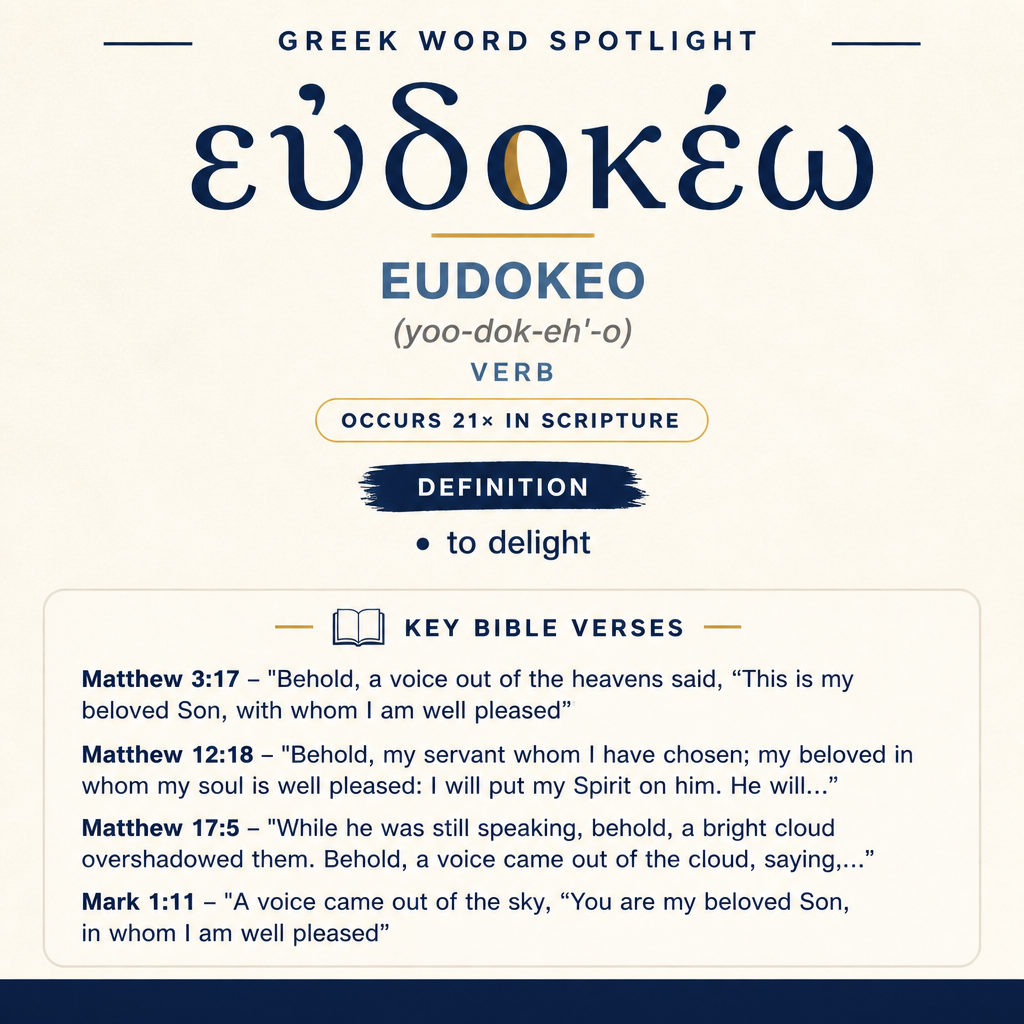
εὐδοκέω means “to delight” and occurs 21 times in Scripture, including in Matthew, Mark, Luke, and Romans.
Core Meaning
εὐδοκέω is defined as “to delight.” Several passages translate it as being “well pleased” or expressing “good pleasure.”
Learn More →Gospel Usage
In Matthew 3:17, Mark 1:11, and Luke 3:22, a heavenly voice declares God is “well pleased” with His beloved Son. Matthew 12:18 also says God’s soul is “well pleased” with His chosen servant.
Learn More →Romans Examples
Romans 15:26–27 uses εὐδοκέω for the “good pleasure” of Macedonia and Achaia to contribute to the poor among the saints.
Learn More →εὐδοκέω expresses “to delight,” appearing in scenes where God voices pleasure in his Son, communities act from shared willingness, and speakers describe what they welcome or embrace. Across the passages quoted here, it marks the personal stance behind words and actions—delight, pleasure, or its opposite—rather than merely the outward act.
Occurrences
Matthew 3:17 — “Behold, a voice out of the heavens said, “This is my beloved Son, with whom I am well pleased.””
Here εὐδοκέω belongs to the heavenly declaration that identifies the Son as “beloved” and adds the evaluative note “with whom I am well pleased.” The word contributes the idea of delight as a settled divine appraisal, publicly spoken “out of the heavens,” tying pleasure to the person named rather than to a specific deed described in the verse.

Matthew 12:18 — ““Behold, my servant whom I have chosen; my beloved in whom my soul is well pleased: I will put my Spirit on him. He will proclaim justice to the nations.”
In this citation, the delight is intensified by the phrase “my soul,” making the pleasure deeply personal and interior. The same statement also places that pleasure alongside choosing (“whom I have chosen”) and empowering (“I will put my Spirit on him”), so εὐδοκέω frames the servant’s mission (“He will proclaim justice to the nations”) as flowing from divine delight.
Matthew 17:5 — “While he was still speaking, behold, a bright cloud overshadowed them. Behold, a voice came out of the cloud, saying, “This is my beloved Son, in whom I am well pleased. Listen to him.””
Delight appears again in a dramatic setting: a “bright cloud” and a voice “out of the cloud.” εὐδοκέω supports the command “Listen to him” by grounding it in the Father’s pleasure in the Son; the hearers are directed toward attentive obedience because the Son is the one in whom God delights.
Mark 1:11 — “A voice came out of the sky, “You are my beloved Son, in whom I am well pleased.””
This wording addresses the Son directly (“You are”), and εὐδοκέω functions as a direct affirmation—delight spoken to the one who receives it. The delight is relational and identifying: belovedness and pleasure are paired in a concise pronouncement.
Luke 3:22 — “and the Holy Spirit descended in a bodily form like a dove on him; and a voice came out of the sky, saying “You are my beloved Son. In you I am well pleased.””
Luke places the statement of delight alongside the Spirit’s descent “in a bodily form like a dove.” εὐδοκέω here marks divine pleasure concurrent with visible divine activity; the voice’s “In you” makes the delight personal and centered on the Son himself in this moment.
Luke 12:32 — “Don’t be afraid, little flock, for it is your Father’s good pleasure to give you the Kingdom.”
In this reassurance, εὐδοκέω (rendered as “good pleasure”) describes the Father’s delighted willingness as the reason the “little flock” need not fear. The word contributes motive and tone: the giving of the Kingdom is presented not as reluctant concession but as an act springing from the Father’s pleasure.
Romans 15:26 — “For it has been the good pleasure of Macedonia and Achaia to make a certain contribution for the poor among the saints who are at Jerusalem.”
Here εὐδοκέω moves from divine speech to human communal action. “Good pleasure” characterizes the disposition of “Macedonia and Achaia” toward their gift; the contribution is not depicted as mere obligation but as something these communities take pleasure in doing for “the poor among the saints who are at Jerusalem.”
Romans 15:27 — “Yes, it has been their good pleasure, and they are their debtors. For if the Gentiles have been made partakers of their spiritual things, they owe it to them also to serve them in fleshly things.”
Paul repeats the point: the contribution is “their good pleasure,” yet he immediately places it beside the language of indebtedness (“they are their debtors,” “they owe it”). εὐδοκέω therefore highlights a striking pairing in the verse: an act can be owed and still be undertaken with genuine pleasure, so that delight and duty are not treated as opposites in this service.
1 Corinthians 1:21 — “For seeing that in the wisdom of God, the world through its wisdom didn’t know God, it was God’s good pleasure through the foolishness of the preaching to save those who believe.”
In this theological explanation, εὐδοκέω describes what God delights to do and how: “through the foolishness of the preaching” God takes pleasure “to save those who believe.” The word emphasizes that this saving approach is not accidental or forced; it expresses God’s pleased intent in choosing a means the “world through its wisdom” would not esteem.
1 Corinthians 10:5 — “However with most of them, God was not well pleased, for they were overthrown in the wilderness.”
This is the negative counterpart: εὐδοκέω is negated (“not well pleased”), and the verse immediately supplies the sobering outcome (“for they were overthrown in the wilderness”). The word contributes evaluative judgment—divine displeasure tied to a community’s fate—showing that delight can be withheld, and that the absence of pleasure is consequential.
2 Corinthians 5:8 — “We are courageous, I say, and are willing rather to be absent from the body and to be at home with the Lord.”
Here εὐδοκέω is expressed as preference and readiness (“are willing rather”). The delight is not aimed at suffering itself but at the chosen state described: being “at home with the Lord.” The word gives emotional and volitional coloring to courage—courage includes a welcome preference for what is desired most.
2 Corinthians 12:10 — “Therefore I take pleasure in weaknesses, in injuries, in necessities, in persecutions, and in distresses, for Christ’s sake. For when I am weak, then am I strong.”
In this personal conclusion, εὐδοκέω is the verb of paradoxical delight: “I take pleasure” in a list of hardships. The phrase “for Christ’s sake” locates the pleasure’s reason within loyalty and purpose, and the closing line (“For when I am weak, then am I strong.”) shows how delight here coheres with a transformed evaluation of weakness.

Sense and Usage
Across these passages, εὐδοκέω marks the inward posture that stands behind a declaration, a gift, a divine plan, or a personal choice. In the baptism and transfiguration scenes (Matthew 3:17; Mark 1:11; Luke 3:22; Matthew 17:5), delight is spoken as a public, identifying verdict: the Son is “beloved,” and God’s pleasure rests “in” him. The repeated formula gives delight the force of recognition and endorsement, and it functions rhetorically to direct attention to the Son—especially where the voice adds, “Listen to him” (Matthew 17:5).
When εὐδοκέω describes God’s “good pleasure” toward saving action or royal giving (Luke 12:32; 1 Corinthians 1:21), delight portrays God’s acts as purposeful and gladly willed. In Luke 12:32, the Father’s pleasure underwrites comfort to a fearful “little flock,” making delight the emotional ground for generosity. In 1 Corinthians 1:21, pleasure is tied to the chosen manner of salvation, underscoring that the route “through the foolishness of the preaching” aligns with what God delights to do, even when it clashes with the world’s expectations about wisdom.
Applied to communities and individuals (Romans 15:26–27; 2 Corinthians 5:8; 2 Corinthians 12:10), εὐδοκέω brings out willing eagerness rather than mere compliance. Romans 15 shows that “good pleasure” can coexist with moral obligation: those who “owe” service can still perform it gladly. In 2 Corinthians 5:8, willingness is expressed as a preference—delight as the inclination toward what is valued (“to be at home with the Lord”). In 2 Corinthians 12:10, delight operates in an especially charged way: pleasure is taken in circumstances ordinarily avoided, and the listed hardships become the arena in which the speaker’s strength is understood in relation to weakness.
The lone negated usage (1 Corinthians 10:5) clarifies the word’s evaluative edge. Delight is not a vague positivity; it is an assessment that may be withheld, and the verse ties displeasure to a disastrous outcome. That contrast sharpens the earlier declarations of pleasure: divine delight is meaningful approval, and its absence signals rejection.
Imagery and Voice
Several occurrences place εὐδοκέω on the lips of a “voice” from above—“out of the heavens,” “out of the sky,” and “out of the cloud” (Matthew 3:17; Mark 1:11; Luke 3:22; Matthew 17:5). In those scenes the word is not private sentiment but an audible pronouncement that interprets what witnesses see: a Son named “beloved,” a Spirit descending “like a dove,” and a cloud overshadowing the scene. Elsewhere the same delight becomes the tone of giving and serving (Luke 12:32; Romans 15:26–27), and finally the tone of chosen endurance (2 Corinthians 12:10), showing how delight can shape both divine speech and human life.
Sources: Lexical data from Strong’s Exhaustive Concordance and the Translators Brief Lexicon of Extended Strongs for Greek (STEPBible, CC BY). Occurrence data from the Translators Amalgamated Greek New Testament (STEPBible, CC BY). Scripture quotations from the World English Bible (public domain).