Exploring the Meaning of Eudia in Greek
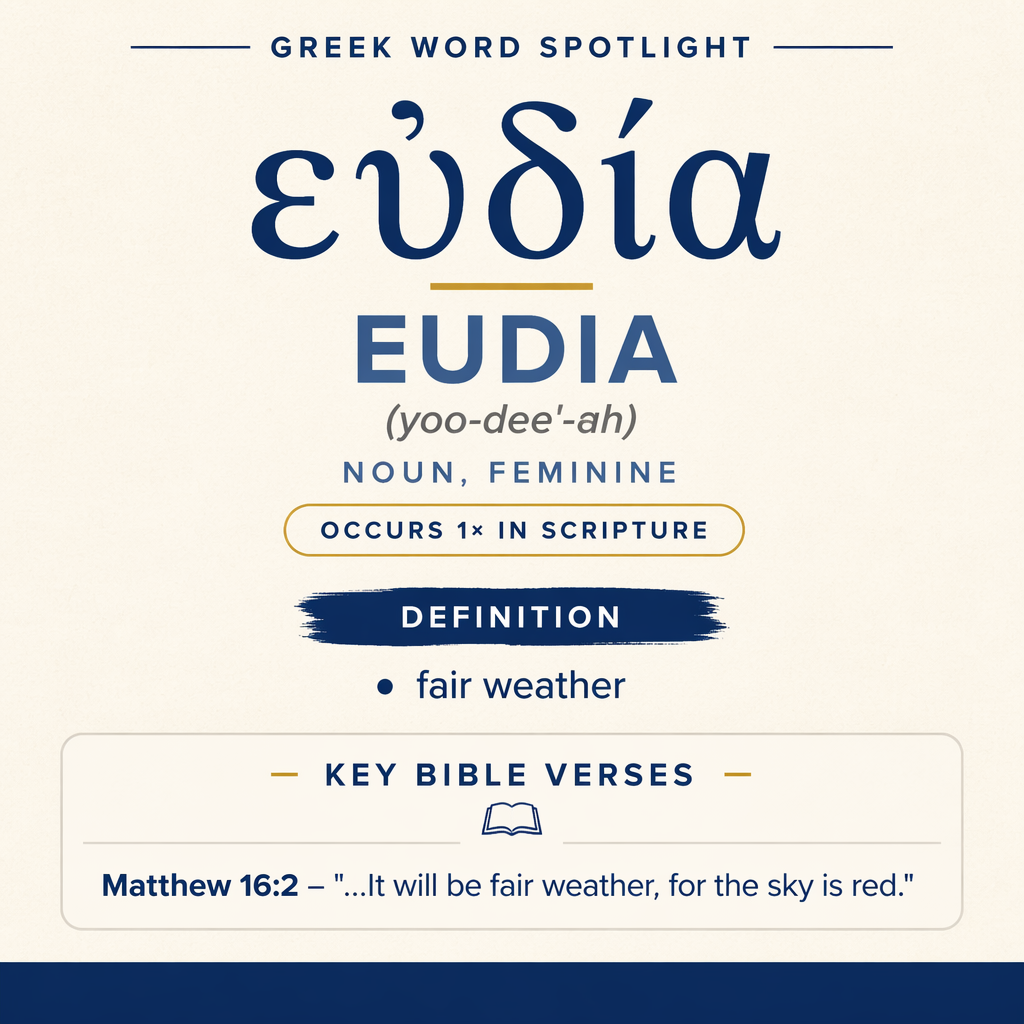
εὐδία means “fair weather” and appears once in Scripture in Matthew 16:2.
Scripture Occurrence
It occurs one time in Scripture. The occurrence is in Matthew 16:2.
Learn More →Verse Context
In Matthew 16:2, it is used in the saying, “It will be fair weather, for the sky is red.”
Learn More →εὐδία means “fair weather” and appears in the saying about interpreting the sky in Matthew 16:2. In that setting it names the expected condition of the weather based on a visible sign.
Root and Related Words
εὐδία is related to eu (εὖ), “well / well done!” (Strong’s G2095), and to Zeus (Ζεύς, Δίς), “Zeus” (Strong’s G2203).

Occurrences
“But he answered them, “When it is evening, you say, ‘It will be fair weather, for the sky is red.’” (Matthew 16:2)
Here εὐδία names the specific outcome people predict as they look at the evening sky: “It will be fair weather.” The line presents a common-sense inference—red sky at evening is taken as a sign pointing toward a coming stretch of agreeable conditions. Within the sentence it functions as the content of a spoken forecast (“you say”), and it stands in direct relation to a stated observational basis (“for the sky is red”). In other words, the word is used for a concrete, everyday judgment about what the next weather will be like, not as a vague feeling but as the expected state of the air and sky that follows from the visible color.
The mention of “evening” anchors the timing: the prediction is made at day’s end, when the color of the sky can be read as a sign. εὐδία therefore participates in a simple pattern of observation → conclusion: a readily seen phenomenon (“the sky is red”) is treated as evidence, and “fair weather” is the conclusion drawn from it. Because it is put into a quoted saying (“you say”), it also evokes the familiar, repeated nature of this forecast—something people commonly express in ordinary conversation when they see the same sign.
Sense and Usage
In its single New Testament appearance, εὐδία has a straightforward meteorological sense: the anticipated state of “fair weather.” Its force in Matthew 16:2 lies in how it can be inferred from a sign that is publicly available and easily recognized. The sentence does not define the term; it assumes the audience knows what such “fair weather” is like and why one might welcome it. The phrase “It will be fair weather” reads as a practical expectation about what conditions will follow, the kind of expectation that would shape plans for travel, work, or daily life, even though those applications are not spelled out in the line.
The word is also tightly bound to the language of speech and interpretation. It appears inside “you say,” marking it as a conclusion people verbalize based on a kind of informal, experience-based wisdom about the sky. The justification clause (“for the sky is red”) shows εὐδία functioning as the named result of a diagnostic process: a sign in the heavens is treated as meaningful, and the meaning is expressed in terms of predicted weather. In that way, εὐδία in this context is not an abstract label but the outcome of a reading of the natural world, expressed succinctly as the expected condition.
Imagery
The imagery attached to εὐδία in Matthew 16:2 is visual and atmospheric: an evening sky colored red and a spoken expectation of “fair weather.” The word draws its immediacy from that scene—standing under a sky whose color is plain to see, people interpret what they observe and give it a name in a short forecast.
Sources: Lexical data from Strong’s Exhaustive Concordance and the Translators Brief Lexicon of Extended Strongs for Greek (STEPBible, CC BY). Occurrence data from the Translators Amalgamated Greek New Testament (STEPBible, CC BY). Scripture quotations from the World English Bible (public domain).