Exploring the Meaning of Eti in Greek
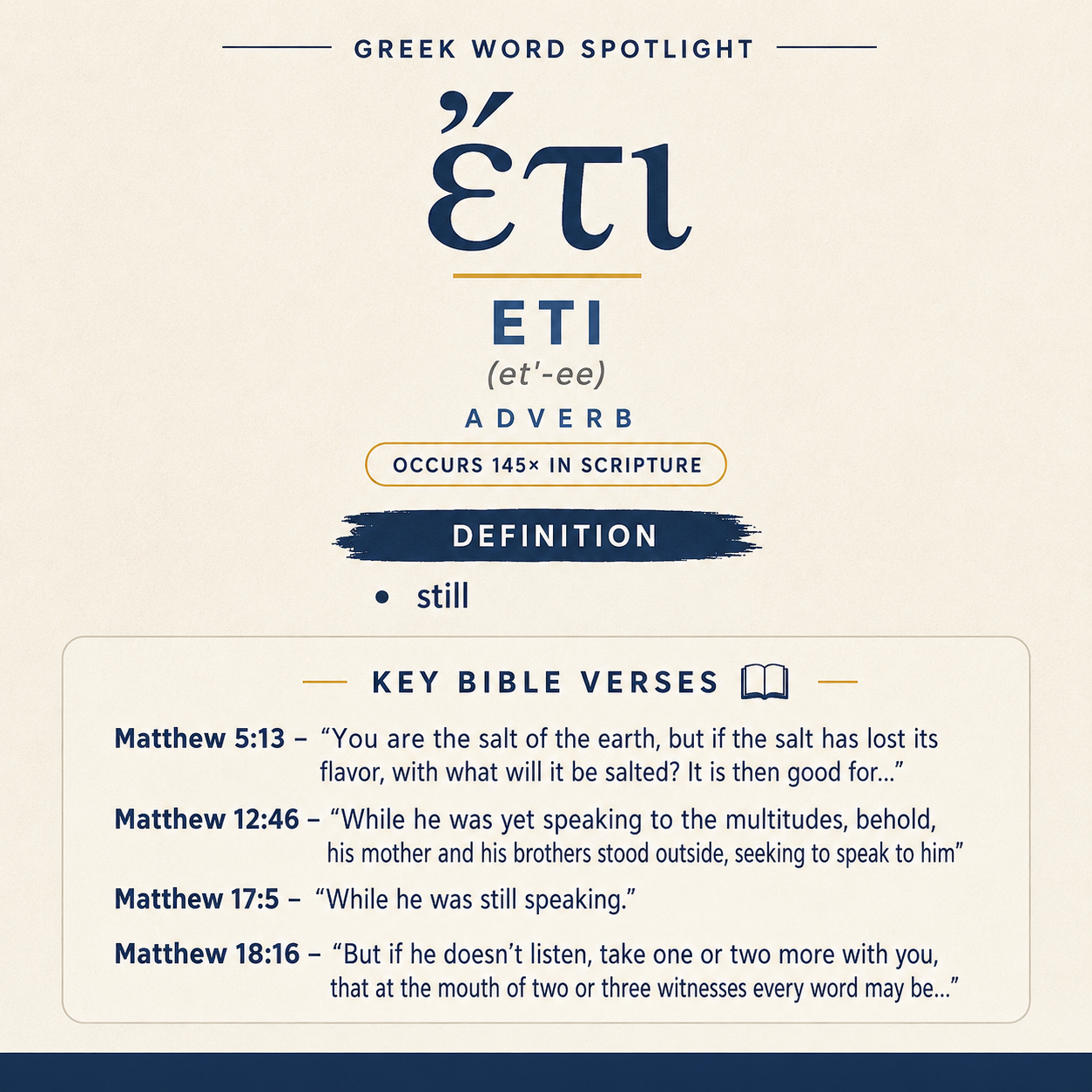
ἔτι (Eti) means “still” and occurs 145 times in Scripture, including Matthew 12:46, 17:5, 19:20, and 26:47.
Sample Occurrences
In Matthew it appears in time-sensitive scenes: “While he was yet/still speaking” (Matthew 12:46; 17:5; 26:47) and “What do I still lack?” (Matthew 19:20).
Learn More →ἔτι expresses the idea of something continuing—“still”—and it appears in a wide range of narrative and dialog contexts. In the verses below, it regularly marks an action, a condition, or a question as ongoing at the moment being described.
Occurrences
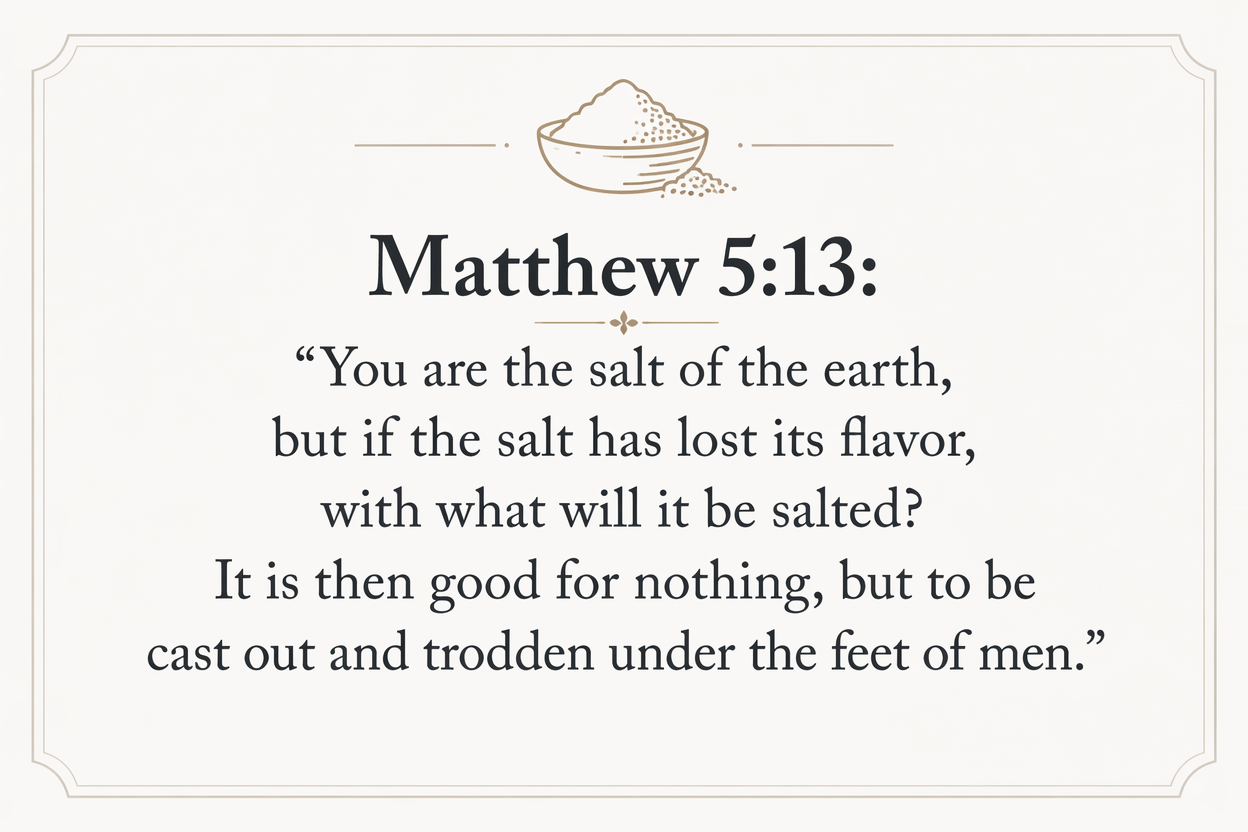
Matthew 5:13: “You are the salt of the earth, but if the salt has lost its flavor, with what will it be salted? It is then good for nothing, but to be cast out and trodden under the feet of men.
In this saying, “still” functions inside a rhetorical question about whether a ruined condition can be reversed. The image is of salt that no longer serves its purpose; “still” sharpens the force of the question by pressing whether anything remains possible once the loss has occurred.
Matthew 12:46: While he was yet speaking to the multitudes, behold, his mother and his brothers stood outside, seeking to speak to him.
“Still” places two events in overlap: Jesus continues speaking, and at the same time his family arrives and waits outside. The adverb highlights that the speaking is in progress; the interruption is not after a conclusion but during the ongoing address.
Matthew 17:5: While he was still speaking, behold, a bright cloud overshadowed them. Behold, a voice came out of the cloud, saying, “This is my beloved Son, in whom I am well pleased. Listen to him.”
Here “still” again marks speech as unfinished at the instant something dramatic occurs: the cloud overshadows them and the voice speaks from it. The ongoing talk is effectively overtaken by a greater announcement; the adverb underscores immediacy—speech is in progress when the scene shifts.
Matthew 18:16: But if he doesn’t listen, take one or two more with you, that at the mouth of two or three witnesses every word may be established.
Within the instruction, “still” belongs to the conditional pattern of a repeated attempt: if the first effort fails (“if he doesn’t listen”), the situation continues unresolved, and further action is taken. The adverb supports the step-by-step logic by implying persistence when a prior approach has not yet succeeded.
Matthew 19:6: So that they are no more two, but one flesh. What therefore God has joined together, don’t let man tear apart.”
In this statement about two becoming one, “still” contributes to the description of a changed state that remains in effect. The wording emphasizes a present reality (“no more two”) that continues; “still” reinforces the enduring character of the joined union in the argument’s frame.
Matthew 19:20: The young man said to him, “All these things I have observed from my youth. What do I still lack?”
The young man’s question uses “still” to express an ongoing deficiency despite a completed track record of obedience “from my youth.” The adverb tightens the tension between what he claims already done and what remains unmet; his concern is not past failure but a present shortfall that continues to stand.
Matthew 22:46: No one was able to answer him a word, neither did any man dare ask him any more questions from that day forward.
Here “still” (expressed as “any more”) describes a continued refusal after a turning point: from “that day forward,” the challengers remain silent. The adverbial idea signals that questioning ceases and does not resume; the change becomes a lasting pattern in the narrative aftermath.
Matthew 26:47: While he was still speaking, behold, Judas, one of the twelve, came, and with him a great multitude with swords and clubs, from the chief priests and elders of the people.
“Still” again sets timing: speech is ongoing when Judas arrives with an armed crowd. The adverb makes the arrival feel abrupt, landing in the middle of the words being spoken; the situation escalates before the speaking has run its course.
Matthew 26:65: Then the high priest tore his clothing, saying, “He has spoken blasphemy! Why do we need any more witnesses? Behold, now you have heard his blasphemy.
In the high priest’s reaction, “still” appears as “any more,” framing the demand for witnesses as unnecessary from this point on. The adverbial force is decisive: once the charge is asserted and the words are heard, the need for further testimony is treated as ended.
Matthew 27:63: saying, “Sir, we remember what that deceiver said while he was still alive: ‘After three days I will rise again.’
“Still” locates a remembered saying within a prior ongoing condition: the deceiver’s being “alive.” The adverb emphasizes that the statement was made during that continuing period of life, before the later events presumed by the speakers; it sets a temporal boundary around the remembered words.
Mark 5:3: He lived in the tombs. Nobody could bind him any more, not even with chains,
“Still” as “any more” describes a persistent inability: attempts to restrain him have ceased to be effective. The adverb conveys that binding may have been attempted, but the situation has reached a point where it continues as an unbindable state.
Mark 5:35: While he was still speaking, people came from the synagogue ruler’s house saying, “Your daughter is dead. Why bother the Teacher any more?”
Two uses of the continuing idea appear in one verse. First, “still” marks Jesus’ speech as ongoing when news arrives; second, “any more” expresses the messengers’ judgment that further action—bothering the Teacher—should not continue. The adverbial force thus ties together timing (speech in progress) and perceived futility (no further effort warranted).

Sense and Usage
Across these passages, ἔτι consistently marks continuance relative to a reference point in the scene. In several narratives it functions as a timing marker that overlaps actions: someone is “still speaking” when another event breaks in (Matthew 12:46; 17:5; 26:47; Mark 5:35). In those lines, the adverb does more than date events; it heightens the abruptness of what follows by emphasizing that the initial action has not yet finished.
In dialog and argument, “still” commonly targets what remains after something has already happened. The young man’s “What do I still lack?” (Matthew 19:20) assumes that much has been done and yet an unmet need persists. A similar logic operates where speech or action is cut off as no longer necessary or no longer attempted—“any more” questions (Matthew 22:46), “any more witnesses” (Matthew 26:65), “bind him any more” (Mark 5:3), and “bother the Teacher any more” (Mark 5:35). In each case, the continuing line that might have been expected is presented as terminated: questioning stops, witnesses are dismissed, restraint fails as an ongoing possibility, and further appeal is judged pointless.
Even where the setting is not a sudden interruption, the adverb can underscore a sustained state. In Matthew 27:63, the phrase “while he was still alive” frames remembered words within a continuing condition that held at the time of speaking. In Matthew 19:6, the language of no longer being “two” but “one flesh” fits a discourse about a present condition that continues; “still” serves the discourse’s emphasis on what holds true in the present, not merely what happened in the past.
Imagery
The recurring picture attached to “still” in these verses is of ongoing speech meeting an intruding event: family members waiting outside, a bright cloud and voice, an arriving crowd with weapons, and messengers bringing death news. Alongside that immediacy, “still” also carries the quieter imagery of what remains: a question about what is lacking, a refusal to continue asking, the collapse of further testimony, and the practical admission that chains cannot keep someone bound any longer.
Sources: Lexical data from Strong’s Exhaustive Concordance and the Translators Brief Lexicon of Extended Strongs for Greek (STEPBible, CC BY). Occurrence data from the Translators Amalgamated Greek New Testament (STEPBible, CC BY). Scripture quotations from the World English Bible (public domain).