
Exploring the Meaning of Hespera in Greek
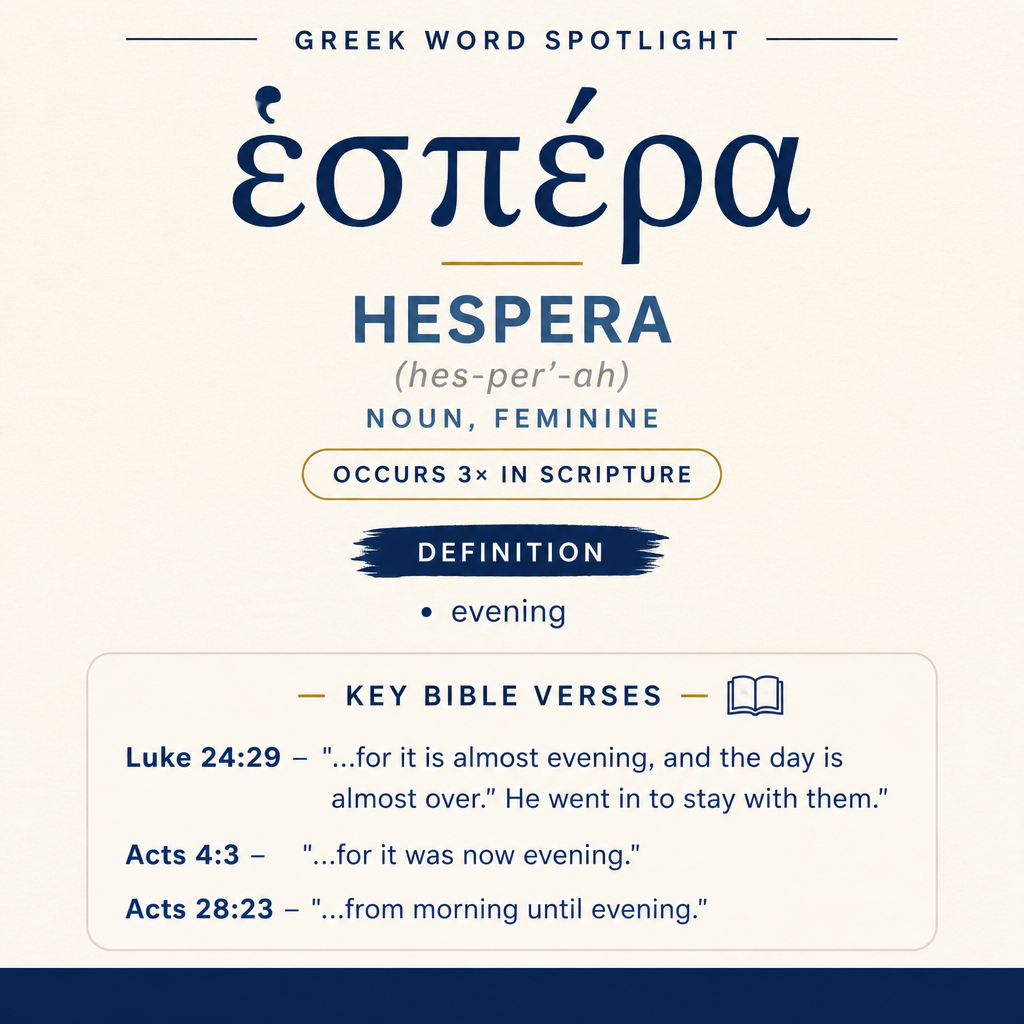
ἑσπέρα (Hespera) means “evening” and appears in Luke 24:29, Acts 4:3, and Acts 28:23.
Scripture Occurrences
It occurs 3 times in Scripture: Luke 24:29; Acts 4:3; Acts 28:23.
Learn More →Context Snapshots
In Luke 24:29 and Acts 4:3 it marks that it was evening, framing the timing of events.
Learn More →ἑσπέρα refers to “evening,” the part of the day associated with fading light and the close of daily activity. It appears in a travel conversation in Luke and in two scenes from Acts, where the passing into evening shapes hospitality, custody, and extended teaching.
Root and Related Words
ἑσπέρα is related to ὥρα (hora, “hour”; Strong’s G5610), linking the term to the way time is measured and marked within a day.

Occurrences
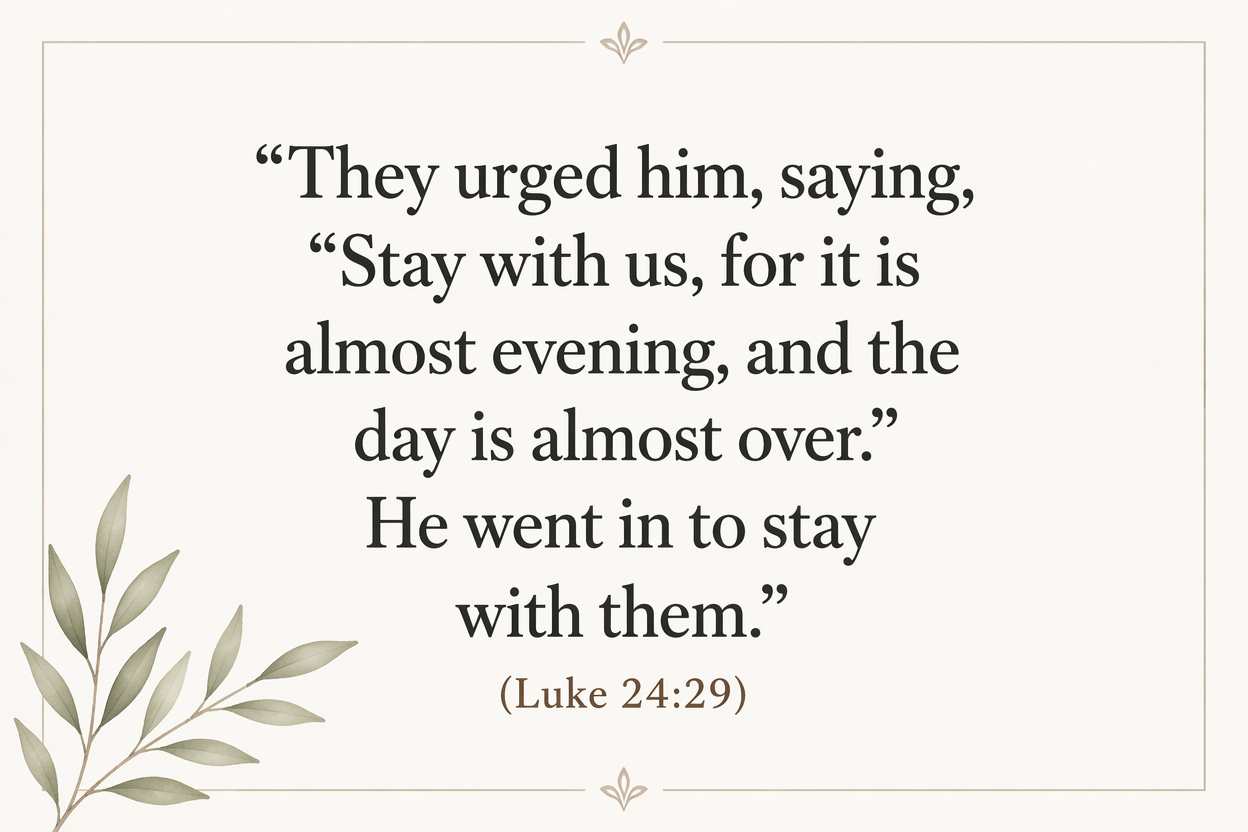
“They urged him, saying, “Stay with us, for it is almost evening, and the day is almost over.” He went in to stay with them.” (Luke 24:29)
Here ἑσπέρα functions as the practical reason the travelers give for pressing their invitation. The phrase “almost evening” pairs naturally with “the day is almost over,” so the approach of evening is not merely a clock time but a threshold: daylight travel is winding down, and the social expectation of lodging comes to the foreground. The request “Stay with us” gains urgency from this time marker; evening is the moment when continuing on the road would no longer fit the rhythm of the day. In the narrative as quoted, evening leads directly to action—“He went in to stay with them”—so ἑσπέρα helps turn a conversation into a settled, indoors scene.
“They laid hands on them, and put them in custody until the next day, for it was now evening.” (Acts 4:3)
In this legal setting, ἑσπέρα explains procedure. The authorities “put them in custody until the next day,” and the stated reason is temporal: “for it was now evening.” Evening here is the boundary that postpones further action; it signals that whatever would happen next will wait. The word therefore contributes a sense of delay and containment—events are stopped and held overnight, not because the conflict is resolved, but because the day has moved into its closing portion. The verse’s movement is sharply divided: immediate seizure (“laid hands on them”), then a holding pattern (“until the next day”), with evening as the hinge that makes that postponement intelligible.
“When they had appointed him a day, many people came to him at his lodging. He explained to them, testifying about God’s Kingdom, and persuading them concerning Jesus, both from the law of Moses and from the prophets, from morning until evening.” (Acts 28:23)
In this final occurrence, ἑσπέρα marks the endpoint of sustained speech and discussion. The meeting has structure: “they had appointed him a day,” the audience arrives “at his lodging,” and the content is described as explanation, testimony, and persuasion “both from the law of Moses and from the prophets.” Against that full agenda, the phrase “from morning until evening” uses evening as the far edge of the day’s span, emphasizing duration and completeness rather than urgency. Evening is not portrayed as a moment that stops the action (as in custody) or redirects it (as in lodging on the road), but as the natural terminus of a long, continuous effort within one appointed day.
Sense and Usage
Across these passages, “evening” consistently operates as a time-boundary that reorients what people do next. In Luke 24:29 it is an approaching boundary—“almost evening”—and that nearness carries persuasive force: the day is ending, so the appropriate response is to remain and take shelter. In Acts 4:3 it is a present boundary—“now evening”—and it justifies postponement: the immediate step is custody, with further proceedings deferred “until the next day.” In Acts 28:23 it is a concluding boundary, paired with “morning” to frame the full arc of daylight hours, highlighting a day filled with extended explanation and argumentation.
The term therefore portrays evening in two complementary ways. First, it can signal an approaching close that calls for settlement—staying put rather than continuing. Second, it can signal the close as an institutional limit—action is held over, decisions wait. Third, it can serve as a measuring point for the reach of effort—how long an engagement lasts “until evening.” In each case, evening is not treated as an isolated clock reading but as part of the day’s lived structure: travel yields to hospitality, immediate action yields to delay, and an appointed gathering is measured from its start to its finish.
Because the word is used in ordinary narrative statements (“almost evening,” “now evening,” “until evening”), it contributes realism and pacing. Evening is the kind of detail that quietly governs choices: where one stays, what authorities do next, and how long a teacher can speak in a single day. The passages also show that evening can be described relative to the day (“almost over”) or as the endpoint of a span (“from morning until evening”), both of which treat the day as a coherent unit moving toward completion.
Imagery
The imagery associated with ἑσπέρα in these contexts is the daily transition from open activity to closure. Luke depicts the road giving way to an interior stay as evening approaches; Acts 4 depicts public confrontation giving way to overnight custody as evening arrives; Acts 28 depicts a full day of concentrated dialogue stretching until the day reaches its end. Evening, in these scenes, is the quiet limit that gathers scattered movement into a stopping place and sets the day’s final boundary.
Sources: Lexical data from Strong’s Exhaustive Concordance and the Translators Brief Lexicon of Extended Strongs for Greek (STEPBible, CC BY). Occurrence data from the Translators Amalgamated Greek New Testament (STEPBible, CC BY). Scripture quotations from the World English Bible (public domain).




