
Exploring the Meaning of Esli in Greek
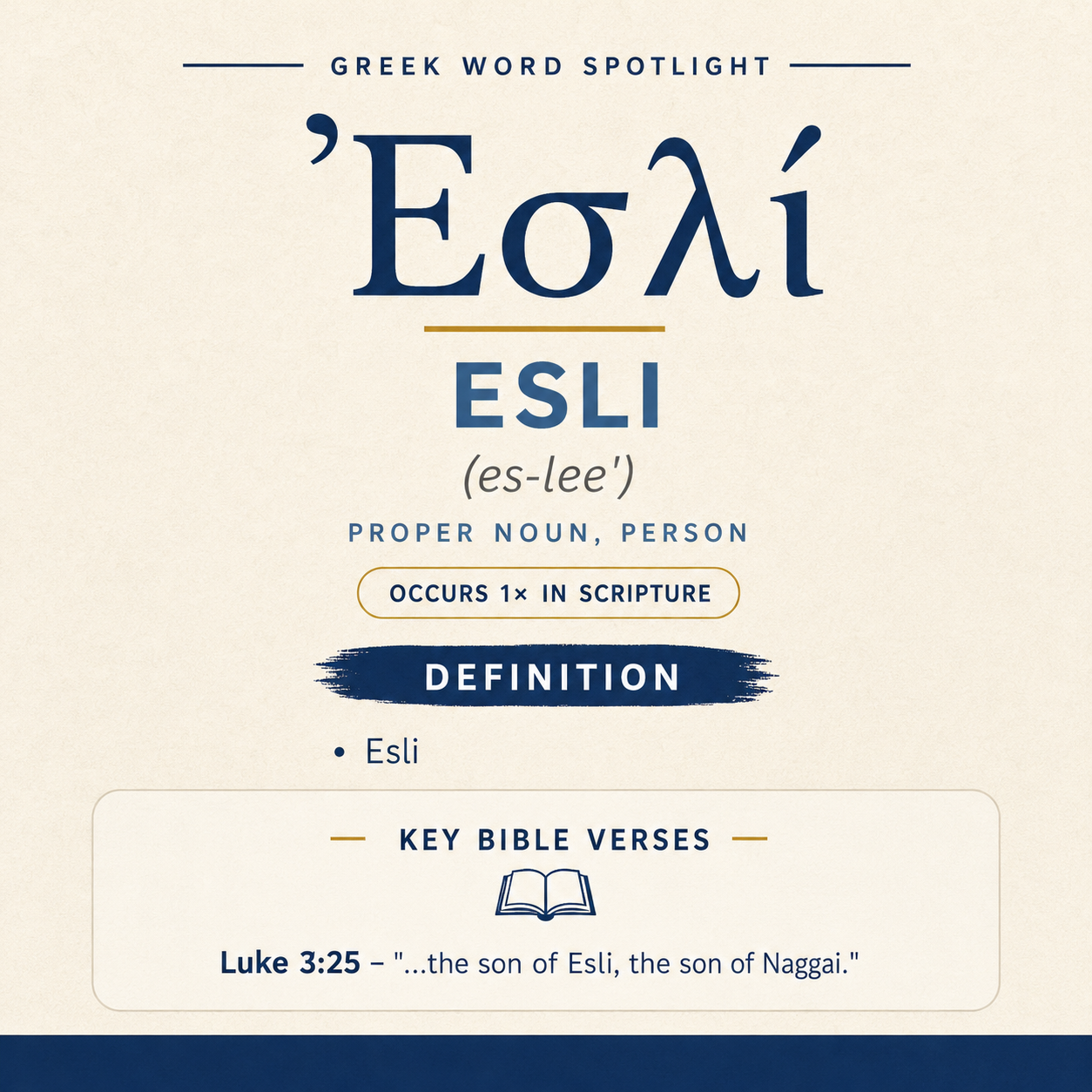
Ἐσλί (Esli) is the name Esli, appearing in Luke 3:25 within Jesus’ genealogy.
Genealogy Context
In Luke 3:25, Esli is listed between Nahum and Naggai. The verse reads: “the son of Nahum, the son of Esli, the son of Naggai”.
Learn More →Ἐσλί (Esli) is a personal name, appearing in the New Testament within a genealogical sequence. It occurs in Luke’s lineage list, where it functions to identify a particular link in a chain of descent.
Occurrences
“the son of Mattathias, the son of Amos, the son of Nahum, the son of Esli, the son of Naggai,” (Luke 3:25)
Here Esli appears as one named individual positioned between two others in a repeated pattern of “the son of …, the son of ….” The phrasing places Esli as the father of Nahum (“the son of Nahum, the son of Esli”) and as the son of Naggai (“the son of Esli, the son of Naggai”). In this compact line, the name does not stand alone as a subject of action or speech; instead, it serves the genealogy’s identifying work, marking a specific generational step so that Nahum’s place in the sequence is anchored by named parentage and, at the same time, Esli’s own place is anchored by naming his parent. The effect is to keep the list continuous and traceable, with Esli functioning as a fixed point within a larger set of familial links.

The repetition of the same relational formula gives Esli a clear grammatical role: the name is inserted into a standardized structure that defines each person by relation rather than by narrated deeds. In such a construction, the contribution of Esli is not descriptive but referential—his name distinguishes one ancestral connection from all others in the chain. Because several names are presented in close succession, each one, including Esli, bears the weight of maintaining clarity: the list would be less precise if any single name were omitted, since the immediate relationships (“son of”) would become ambiguous or compressed. By appearing exactly where it does, Esli helps Luke’s line of descent move from Naggai through Esli to Nahum, then on to Amos and Mattathias, one generation at a time.

Sense and Usage
As a proper name, Esli’s sense lies in identifying a particular person. In Luke 3:25 the name operates within a formal genealogical register, where names function as markers of lineage rather than as carriers of additional description. The definition “Esli” matches this usage: the word’s role is to designate the individual called by that name, and the surrounding words supply the only information attached to him in the passage—his position as an ancestor, defined by the two immediate kinship relations expressed in the line.
This setting highlights a common feature of genealogical naming: the name’s significance in the sentence is chiefly relational. The line does not pause to explain Esli’s location, origin, or character; the name’s purpose is satisfied by placing him correctly within a chain of “son of” statements. Esli therefore functions as a connective element, ensuring that the sequence proceeds by discrete, named steps. In a genealogy, that connective function is substantial: the list depends on each name to preserve the structure of descent, so even an otherwise silent figure like Esli plays an essential part in the passage’s orderly presentation of ancestry.
The immediate context also shows how such names are heard and processed: the audience encounters Esli alongside other names—Mattathias, Amos, Nahum, Naggai—without narrative interruption. The rhythmic accumulation of names frames Esli not as an isolated identity but as one node within an extended family line. In that way, the usage of Esli in Luke 3:25 is inseparable from the genealogy’s broader method: identification through succession, where the meaning of each named person, as far as the verse states, is expressed through placement between forebears and descendants.
Imagery
Luke 3:25 evokes the imagery of an unbroken line of descent articulated through names, each one like a link in a chain. Esli’s place “the son of Nahum, the son of Esli, the son of Naggai” contributes to that picture by standing at a single, precisely located point where the line passes from one generation to the next.
Sources: Lexical data from Strong’s Exhaustive Concordance and the Translators Brief Lexicon of Extended Strongs for Greek (STEPBible, CC BY). Occurrence data from the Translators Amalgamated Greek New Testament (STEPBible, CC BY). Scripture quotations from the World English Bible (public domain).





