
Exploring the Meaning of Esthes in Greek
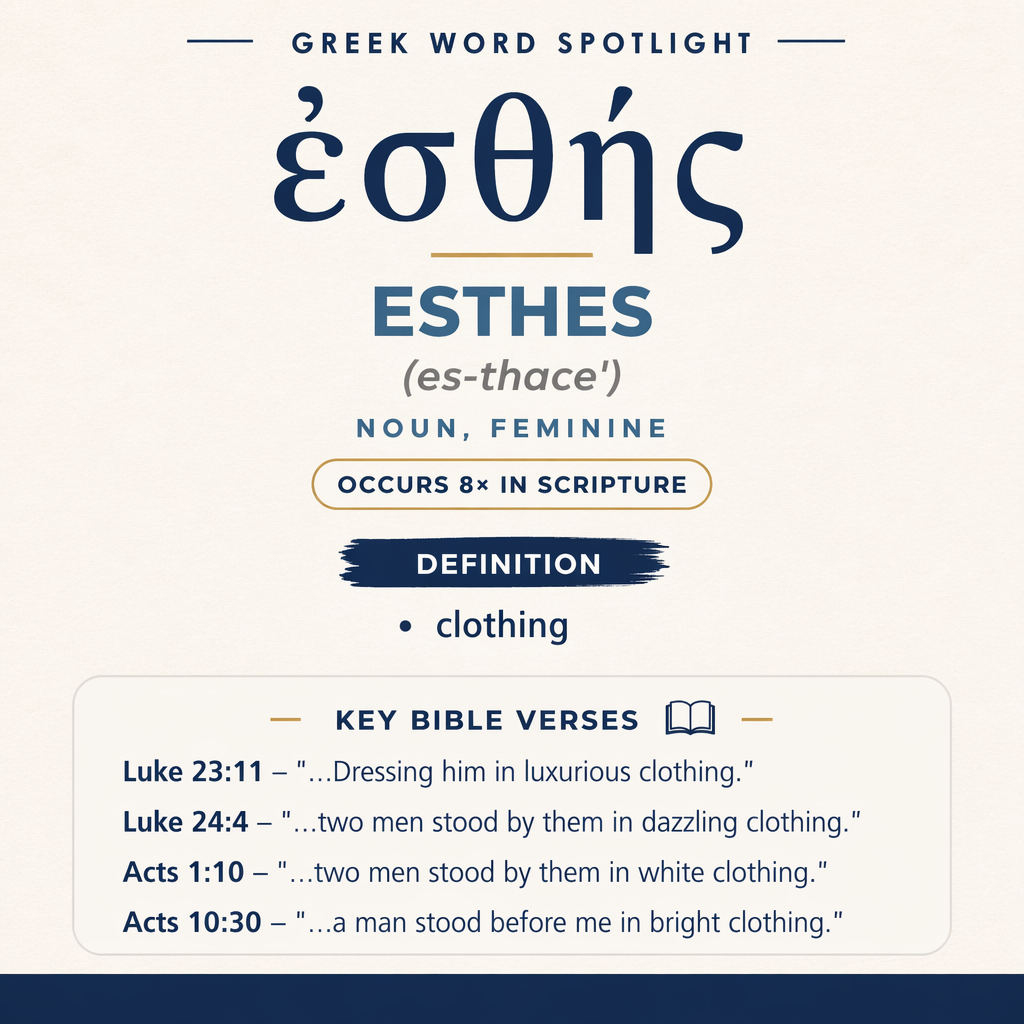
ἐσθής means “clothing” and occurs 8 times in Scripture, including Luke 23:11; Luke 24:4; Acts 1:10; Acts 12:21; James 2:2–3.
Core Meaning
ἐσθής is defined as “clothing.” It is used for apparel described as luxurious, dazzling, white, royal, fine, or filthy.
Learn More →Narrative Scenes
In Luke 23:11, Jesus is mocked and dressed in luxurious clothing. In Luke 24:4 and Acts 1:10, two men appear in dazzling or white clothing.
Learn More →Social Contrast
James 2:2–3 contrasts a man in fine clothing with a poor man in filthy clothing. The term also appears with Herod’s royal clothing in Acts 12:21.
Learn More →ἐσθής refers to clothing. In the New Testament passages where it appears, it can mark humiliation and display, signal heavenly brilliance, and serve as a concrete measure of social standing and partiality.
Occurrences
Luke 23:11 — “Herod with his soldiers humiliated him and mocked him. Dressing him in luxurious clothing, they sent him back to Pilate.”
Here ἐσθής is “luxurious clothing” used as an instrument of contempt. The action of dressing Jesus is not a simple change of outfit; it belongs to the larger sequence of “humiliated” and “mocked,” so the clothing functions like a costume imposed by hostile hands. The adjective “luxurious” turns clothing into a prop of irony: an outward splendor that, in this scene, is meant to sharpen ridicule rather than to honor. The word therefore carries the weight of public treatment—clothing as something put on a person to frame how others view him.
Luke 24:4 — “While they were greatly perplexed about this, behold, two men stood by them in dazzling clothing.”
In the tomb scene, ἐσθής is “dazzling clothing,” contributing to the startling presence of the “two men” and intensifying the women’s “greatly perplexed” reaction. Clothing here marks an appearance that does not fit ordinary expectations of the setting. The emphasis falls on visible brightness (“dazzling”), making ἐσθής part of the sensory shock of the encounter: what the women see is not only two figures, but figures whose clothing radiates.
Acts 1:10 — “While they were looking steadfastly into the sky as he went, behold, two men stood by them in white clothing,”
As the disciples stare “steadfastly into the sky,” ἐσθής appears in the description of two sudden attendants: “two men stood by them in white clothing.” The clothing provides immediate visual identification within the narrative moment: the men arrive in a context of upward attention and awe, and their “white” clothing underscores their distinctness from the onlookers. The term helps the reader picture the interruption—these are not simply two additional spectators, but two figures whose clothing stands out as part of their role in the scene.
Acts 10:30 — “Cornelius said, “Four days ago, I was fasting until this hour, and at the ninth hour, I prayed in my house, and behold, a man stood before me in bright clothing,”
In Cornelius’s report, ἐσθής (“bright clothing”) belongs to a private setting—“in my house”—during fasting and prayer “at the ninth hour.” Clothing is again a defining feature of the visitor: Cornelius does not first describe speech or gesture, but the striking visual of “a man…in bright clothing.” The word thus functions as part of the immediacy of the encounter and supports Cornelius’s presentation of the event as extraordinary. Within the narrative, the clothing’s brightness sets the visitor apart without requiring a longer description.
Acts 12:21 — “On an appointed day, Herod dressed himself in royal clothing, sat on the throne, and gave a speech to them.”
Here ἐσθής is “royal clothing,” and it serves the scene of ceremony and authority. The sequence is deliberate: Herod “dressed himself” (a self-conscious act), then “sat on the throne,” then “gave a speech.” Clothing is placed alongside throne and speech as part of the public staging of power. In this setting ἐσθής is not incidental fabric but a visible badge of office, chosen and worn to match an “appointed day” and a formal appearance before an audience (“to them”).
James 2:2 — “For if a man with a gold ring, in fine clothing, comes into your synagogue, and a poor man in filthy clothing also comes in,”
James uses ἐσθής to contrast two entrants into a worship gathering: one arrives “with a gold ring, in fine clothing,” and another arrives “poor…in filthy clothing.” Clothing becomes a readable social signal, placed parallel to the “gold ring” on the one hand and “poor” on the other. The paired descriptions invite the audience to notice how quickly the community may categorize people based on outward appearance. In this line, ἐσθής is the concrete, visible detail that makes the moral test immediate: both men “come in,” and what differentiates them at first glance is what they wear.
James 2:3 — “and you pay special attention to him who wears the fine clothing and say, “Sit here in a good place;” and you tell the poor man, “Stand there,” or “Sit by my footstool””
This verse shows ἐσθής at work in community behavior: “you pay special attention to him who wears the fine clothing.” Clothing is not merely descriptive; it becomes the basis for differential treatment—preferred seating (“Sit here in a good place”) versus dismissal and humiliation (“Stand there,” “Sit by my footstool”). By tying the action directly to what someone “wears,” James highlights how clothing can function as a social lever within the assembly, shaping words, posture, and spatial arrangements.

Sense and Usage
Across these passages, ἐσθής is consistently concrete: it names what is worn, but the narrative force shifts depending on who wears it, who puts it on, and what kind of clothing is specified. In Luke 23:11, clothing is imposed—Jesus is “Dressing…in luxurious clothing” as part of mockery—so ἐσθής participates in humiliation and misrepresentation. In Acts 12:21, by contrast, clothing is chosen—Herod “dressed himself in royal clothing”—so ἐσθής becomes a tool of self-presentation and political theater, aligned with throne and speech.
Several occurrences attach brightness or whiteness to ἐσθής (Luke 24:4; Acts 1:10; Acts 10:30). In these scenes, clothing helps portray a visitor whose presence is startling and sets the moment apart from ordinary experience: “dazzling,” “white,” and “bright” clothing contributes to the sense of sudden nearness of the heavenly realm within ordinary locations (a tomb, an outdoor gathering looking into the sky, a house during prayer). The clothing is not explained; it is shown. ἐσθής thereby operates as a visual marker that the encounter is extraordinary, and it does so with a single, immediately graspable feature.
In James 2:2–3, ἐσθής becomes the visible index of social difference within a religious gathering. “Fine clothing” and “filthy clothing” do more than describe fabric quality; they cue the community’s instinctive judgments, which then translate into concrete actions: paying “special attention,” assigning “a good place,” and relegating another to stand or sit low. In this argument, clothing is the surface feature that prompts partiality; the noun ἐσθής helps James keep the issue tangible. The passage does not deal in abstractions first; it starts with what is seen when people enter and how that sight guides speech and seating.
Taken together, these uses show ἐσθής functioning as a narrative and rhetorical hinge between outward appearance and social meaning. It can be a costume of derision, an emblem of royal display, a sign of radiant otherness, or a prompt for bias in community life. The noun’s power in these texts lies in its immediacy: clothing is public, visible, and quickly interpreted, so mentioning it can establish tone and status in a line or two.
Imagery
The imagery associated with ἐσθής in these passages clusters around two poles. One is spectacle: “luxurious clothing” used to mock, and “royal clothing” worn to command attention—garments as staging for power or its parody (Luke 23:11; Acts 12:21). The other is brilliance: “dazzling,” “white,” and “bright” clothing that accompanies sudden appearances and heightens awe (Luke 24:4; Acts 1:10; Acts 10:30). James adds a third, everyday register—“fine” versus “filthy” clothing—where ordinary garments become the flashpoint for how a community honors or dishonors those who enter (James 2:2–3).
Sources: Lexical data from Strong’s Exhaustive Concordance and the Translators Brief Lexicon of Extended Strongs for Greek (STEPBible, CC BY). Occurrence data from the Translators Amalgamated Greek New Testament (STEPBible, CC BY). Scripture quotations from the World English Bible (public domain).





