Exploring the Meaning of Eruthros in Greek
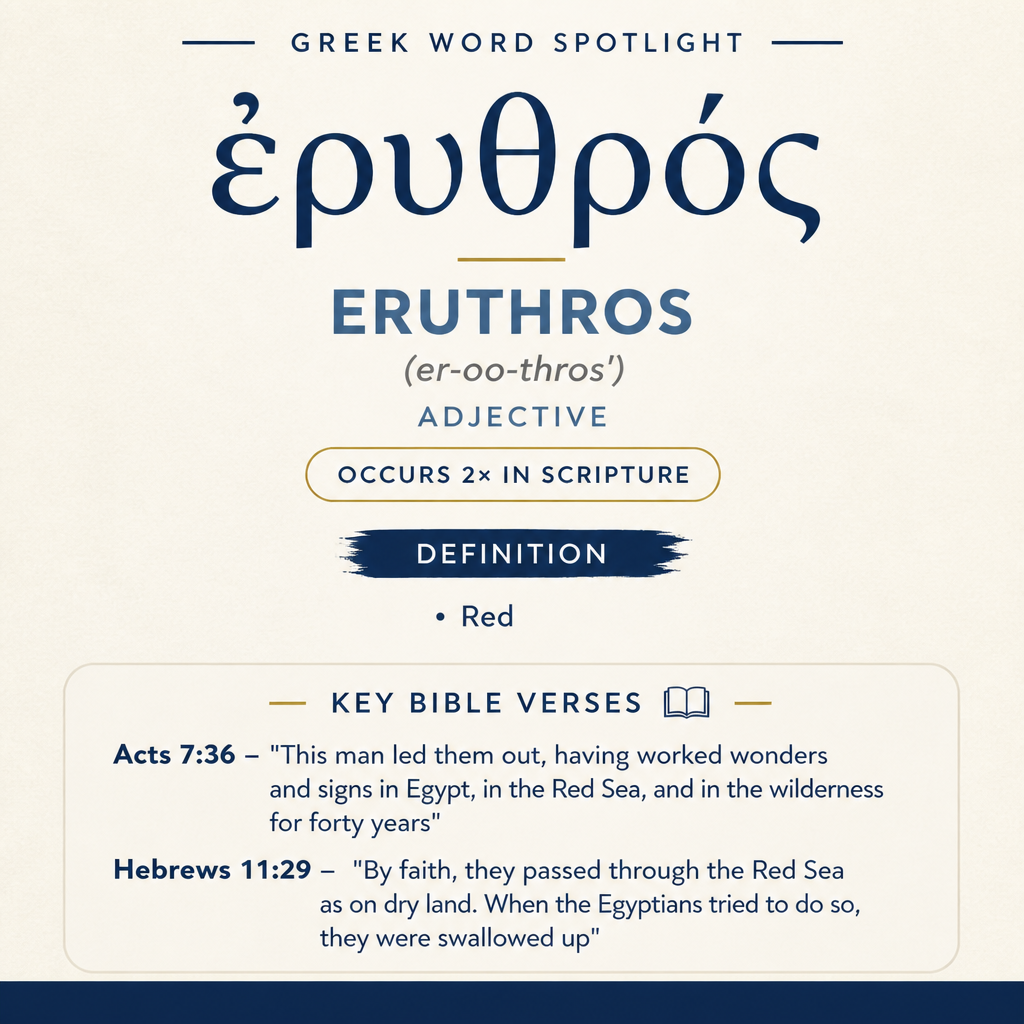
ἐρυθρός means “red” and appears twice in Scripture, both times describing the Red Sea (Acts 7:36; Hebrews 11:29).
Scripture Occurrences
It occurs 2 times in Scripture. The references are Acts 7:36 and Hebrews 11:29.
Learn More →Red Sea Usage
In Acts 7:36, it appears in the phrase “Red Sea” within a summary of signs and wonders. In Hebrews 11:29, it appears in “Red Sea” describing Israel’s passage by faith.
Learn More →ἐρυθρός means “Red” and appears in the New Testament only in connection with “the Red Sea,” once in a historical retelling and once in a faith-focused remembrance. In both places, the adjective colors the setting where deliverance and danger meet at the same body of water.
Root and Related Words
ἐρυθρός is linked with thalassa (θάλασσα), “sea” (Strong’s G2281), the common noun used for a sea as a geographic feature. In these passages, ἐρυθρός functions alongside that idea, marking a particular sea by a descriptive color term.

Occurrences
Acts 7:36 — “This man led them out, having worked wonders and signs in Egypt, in the Red Sea, and in the wilderness for forty years.”
Here ἐρυθρός appears inside a compact chain of locations: “in Egypt, in the Red Sea, and in the wilderness.” The adjective “Red” serves as a precise qualifier, narrowing “Sea” to the well-known site of a decisive passage, set between Egypt (the place of oppression) and the wilderness (the long span that follows). Within the verse’s rhythm, the phrase “in the Red Sea” stands as one station in a larger record of divine action: “wonders and signs” are not confined to one setting but extend across distinct terrains—land (Egypt), sea (the Red Sea), and desert (the wilderness). By specifying the sea as “Red,” the text gives the maritime location a concrete identity and makes the movement of the narrative vivid: the deliverance being recalled is not an abstract “escape,” but something enacted in a real, named environment where “wonders and signs” occurred.
The color adjective also contributes to how the sequence is heard. A simple “sea” could blur into generic geography; “the Red Sea” functions as a fixed point that anchors the account. In Stephen’s speech (as presented in Acts), the phrase works almost like a landmark in Israel’s collective memory: it is one of the main scenes in which the leader “worked wonders and signs.” The adjective “Red” does not add a new action to the verse; it sharpens the backdrop against which the action is remembered, helping the reader picture the setting in which these signs took place.
Hebrews 11:29 — “By faith, they passed through the Red Sea as on dry land. When the Egyptians tried to do so, they were swallowed up.”
In Hebrews, ἐρυθρός again modifies “Sea,” but the emphasis lands on the manner of passage and the contrast between two outcomes. The statement “By faith, they passed through the Red Sea as on dry land” places the sea—normally a barrier—into a role that, for a moment, resembles stable ground. The adjective “Red” identifies the same particular sea, but here it frames an experience: crossing a sea “as on dry land.” In this line, the color term helps fix the scene while the author highlights the paradox of the event: a sea is traversed in a way characteristic of land travel.
The second sentence tightens the dramatic contrast: “When the Egyptians tried to do so, they were swallowed up.” The “Red Sea” becomes the setting where identical action (“tried to do so,” i.e., to pass through) produces opposite results. The adjective “Red,” attached to “Sea,” keeps the reader’s imagination on the concrete place where this reversal happens. The sea is not simply scenery; it is the medium through which deliverance and judgment are experienced in the same episode. Within the verse’s logic, “Red Sea” is the locus of testing and outcome: the same route that is opened for one group becomes the place of destruction for another.
Because Hebrews 11 is structured around examples introduced with “By faith,” the phrase “the Red Sea” functions as a remembered site of faith’s expression. The adjective “Red” is not the focus of faith itself, but it helps stabilize the memory: faith is pictured not as inward feeling but as movement through a specific, formidable environment described in ordinary terms of color and geography.
Sense and Usage
Across its two attestations, ἐρυθρός operates as a straightforward color adjective, attached to “Sea” as part of a fixed place-name: “the Red Sea.” Even with so limited a range of contexts, the usage shows how a simple color term can carry narrative weight by identifying a location where pivotal actions occur. In Acts 7:36, the adjective contributes to a summary of a long story compressed into a few place-markers: Egypt → Red Sea → wilderness. The “Red” descriptor helps distinguish the sea portion of that story as its own stage of divine activity, set alongside the other stages.
In Hebrews 11:29, the adjective functions in a more tightly focused scene. The sea is not only named but used rhetorically: it is the obstacle that is crossed “as on dry land,” and then it becomes the means by which the pursuers “were swallowed up.” Here, “Red” helps point to the remembered event without adding extra explanation, allowing the author to concentrate on the faith-dynamic and the reversal of outcomes. The adjective does its work quietly: it identifies, evokes, and fixes the setting so the reader can follow the comparison between those who pass through and those who attempt to follow.
Thus, ἐρυθρός in these passages shows the descriptive power of color language in Scripture’s storytelling and exhortation. The word remains literal and concrete—simply “Red”—yet, because it is attached to a sea that is central to communal memory, it naturally gathers the associations supplied by each immediate context: in Acts, “wonders and signs” spanning years and regions; in Hebrews, a faith-driven passage and an ensuing judgment. The adjective itself stays within the domain of color, while the surrounding clauses supply the theological and narrative significance.
Imagery
Both verses present “the Red Sea” as a boundary-space where extraordinary things happen. Acts 7:36 sets it among other broad settings—Egypt and the wilderness—so that the sea becomes one vivid station in a journey marked by “wonders and signs.” Hebrews 11:29 presses the image into a single moment: a sea crossed “as on dry land,” followed by a sudden reversal in which others “were swallowed up.” In this way ἐρυθρός, though only a color adjective, contributes to a scene that is easy to picture and hard to forget: a named sea, a passage through it, and outcomes that diverge sharply within the same waters.
Sources: Lexical data from Strong’s Exhaustive Concordance and the Translators Brief Lexicon of Extended Strongs for Greek (STEPBible, CC BY). Occurrence data from the Translators Amalgamated Greek New Testament (STEPBible, CC BY). Scripture quotations from the World English Bible (public domain).