
Exploring the Meaning of Eriphion in Greek
ἐρίφιον (Eriphion) means “a goat” and appears once in Scripture, in Matthew 25:33.
Scripture Occurrence
It occurs one time in the New Testament. The only reference listed is Matthew 25:33.
Learn More →Context in Verse
In Matthew 25:33, Jesus speaks of setting the sheep on His right hand and the goats on the left.
Learn More →ἐρίφιον means “a goat” and appears once in the New Testament, in Jesus’ description of a final separation in Matthew 25:33. In that saying, the word names one of two groups placed to opposite sides in a scene of judgment.

Root and Related Words
ἐρίφιον (Eriphion) derives from ἔριφος (eriphos), “a goat” (Strong’s G2056).

Occurrences
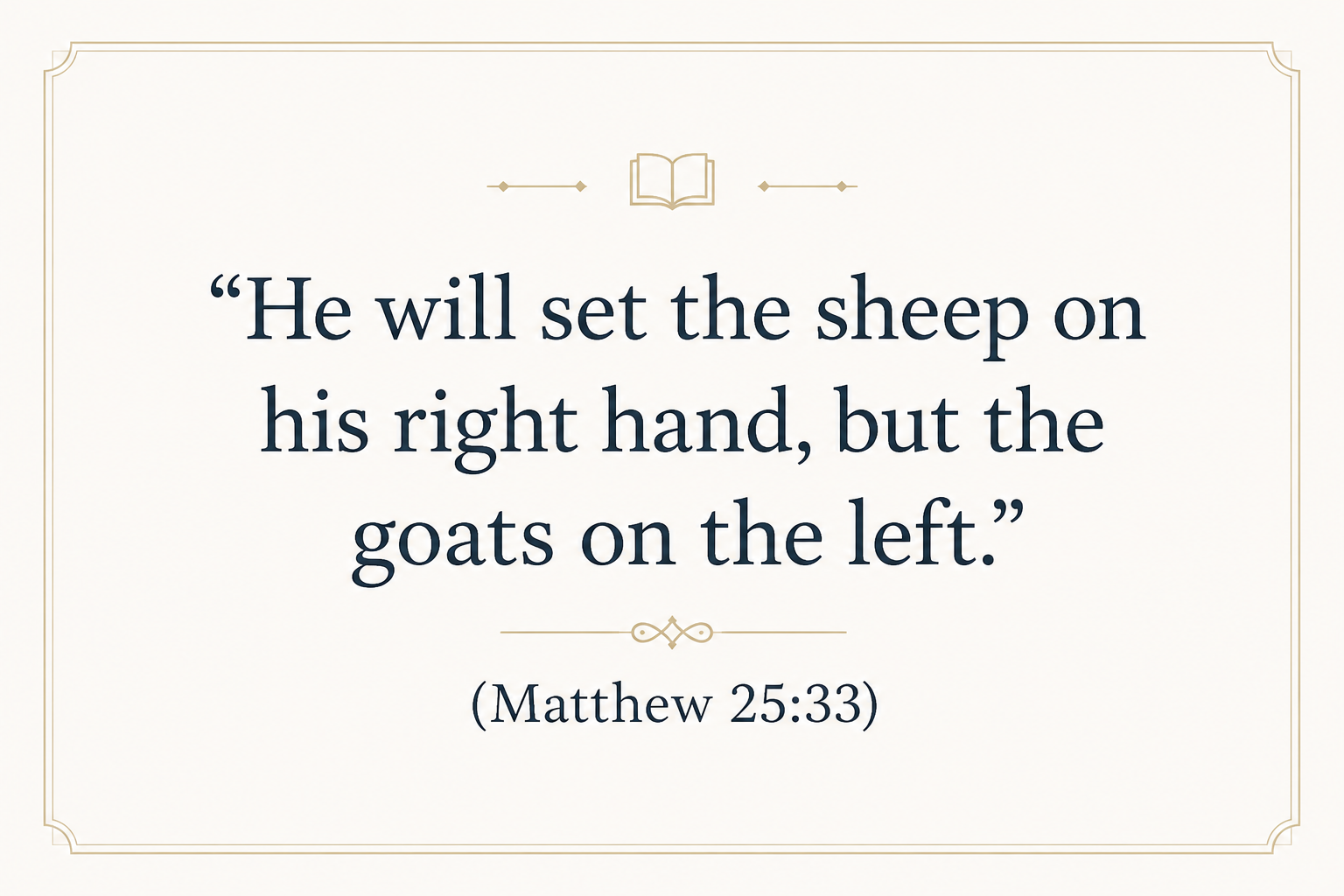
“He will set the sheep on his right hand, but the goats on the left.” (Matthew 25:33)
Here ἐρίφιον supplies the concrete animal term that anchors the contrast in the sentence: “the sheep” versus “the goats.” The verb “set” presents an ordered placement rather than a casual grouping, and the opposition is made visible through space—“on his right hand” and “on the left.” Within this single line, the goats are not described by behavior, age, or appearance; they are identified simply as “the goats,” defined by where they are placed in relation to the one doing the setting. The word thus functions as a label for a distinct class in a twofold division, and its force comes from the pairing: as surely as there are sheep placed to one side, there are goats placed to the other.
The sentence also makes the goats grammatically parallel to the sheep. The same action (“will set”) governs both objects, and the same possessive framing (“on his…”) establishes the two sides. ἐρίφιον therefore participates in a carefully balanced statement: right/left, sheep/goats. The simplicity of the animal term allows the placement itself to carry the weight of the contrast.
Sense and Usage
With only one attested New Testament occurrence, ἐρίφιον is used in a plain, literal sense: it names a goat as a recognizable animal. In Matthew 25:33, that literal animal reference is employed within a judicial tableau, where living creatures serve as vivid, everyday referents for a decisive sorting. The word does not require explanation in the verse; it works because “goats” are familiar enough to form one half of an intuitive pair alongside “sheep.” That familiarity lets the saying remain sharply concrete: the hearer can picture animals being stationed on opposite sides without being told anything else about them.
The usage also shows how a simple noun can take on rhetorical weight without changing its basic referent. “Goats” remain goats, yet in this line they become the name for a separated company. The term’s contribution is to make the division visible and memorable: the scene is not described in abstract categories but in the kind of distinction that can be seen at a glance—one kind on the right, the other kind on the left. In this way ἐρίφιον supports the verse’s emphasis on separation and placement: it is one of the two concrete markers that make the final arrangement intelligible.
Imagery
Matthew 25:33 relies on the stark clarity of a pastoral image: animals are arranged to opposite sides by an authoritative figure. ἐρίφιον contributes the left-side half of that image, giving the line its visual symmetry and its sense of an irrevocable sorting—“the goats on the left” set in contrast to “the sheep on his right hand.”
Sources: Lexical data from Strong’s Exhaustive Concordance and the Translators Brief Lexicon of Extended Strongs for Greek (STEPBible, CC BY). Occurrence data from the Translators Amalgamated Greek New Testament (STEPBible, CC BY). Scripture quotations from the World English Bible (public domain).





