Exploring the Meaning of Eris in Greek
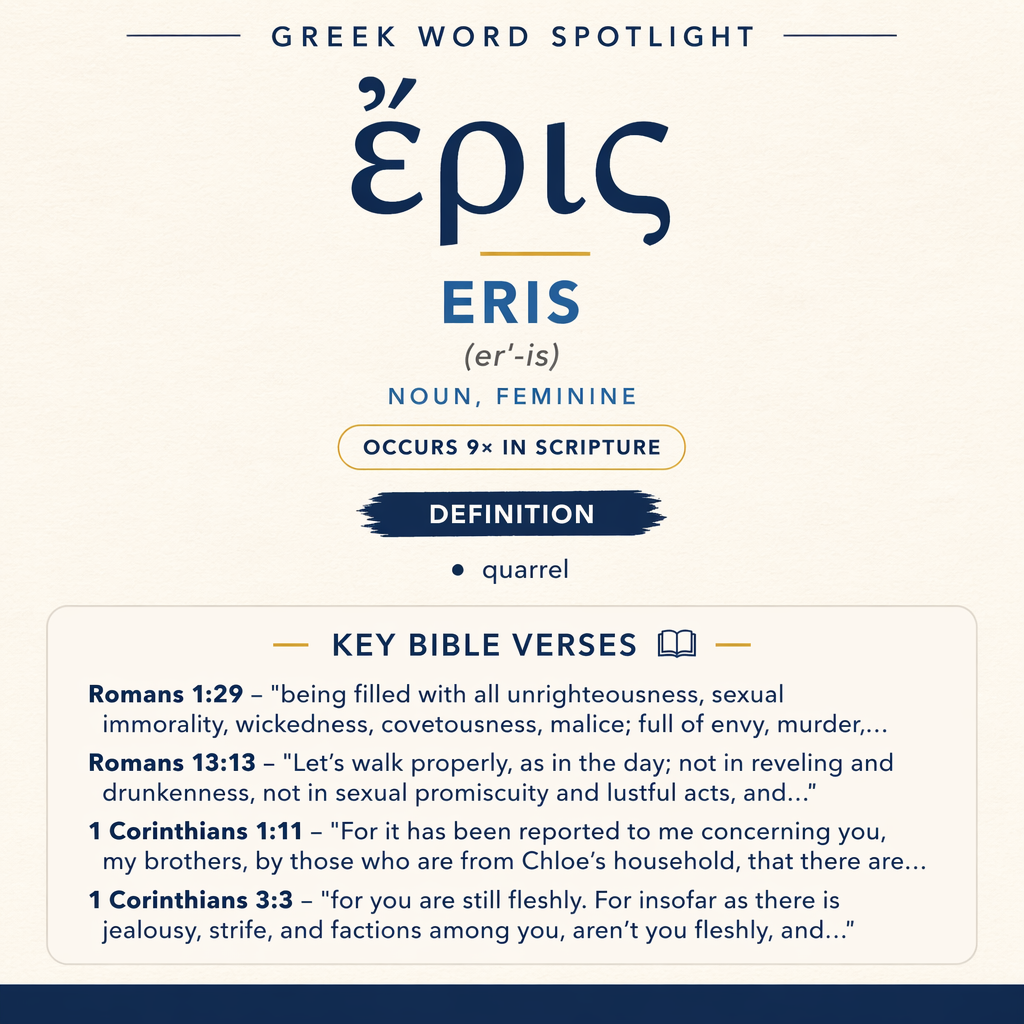
ἔρις (Eris) means “quarrel” and occurs 9 times in Scripture, including Romans, Corinthians, Galatians, Philippians, and 1 Timothy.
Core Meaning
ἔρις is defined as “quarrel.” It appears in lists of vices and conflicts in several epistles.
Learn More →Romans Usage
In Romans 1:29, it appears as “strife” among other sins. Romans 13:13 warns against living in “strife.”
Learn More →Pauline Contexts
It is reported among believers in 1 Corinthians 1:11 and named in Galatians 5:20 as “strife.” Philippians 1:15 and 1 Timothy 6:4 connect it with envy and disputes.
Learn More →ἔρις means “quarrel” and appears in a cluster of New Testament exhortations and diagnoses of communal and moral disorder. In the passages where it is named, it is treated as a disruptive force that surfaces both in public conduct and in the inner motives that drive speech and relationships.
Occurrences
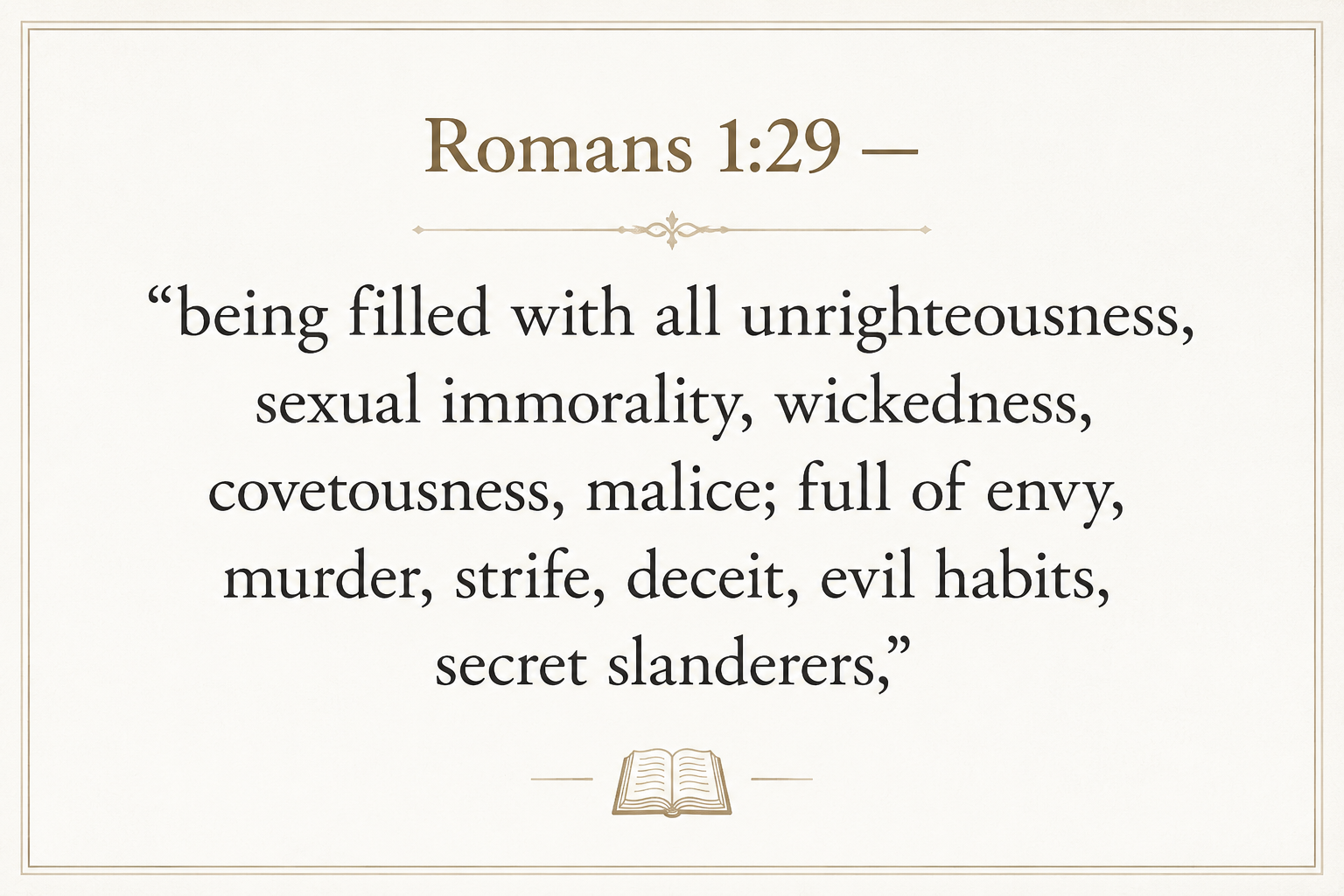
Romans 1:29 — “being filled with all unrighteousness, sexual immorality, wickedness, covetousness, malice; full of envy, murder, strife, deceit, evil habits, secret slanderers,”
Here ἔρις belongs to a dense list describing a life “filled with all unrighteousness.” The placement between “murder” and “deceit” frames quarrel as part of a broader collapse of social trust: it is not an isolated disagreement but one feature of a community marked by malice, deception, and slander.
Romans 13:13 — “Let’s walk properly, as in the day; not in reveling and drunkenness, not in sexual promiscuity and lustful acts, and not in strife and jealousy.”
In this call to “walk properly,” ἔρις is treated as a behavior to be refused, paired closely with “jealousy.” The pairing links quarrel with rivalrous desire: the outward friction of conflict stands alongside an inward posture that feeds it, both of which are set in contrast to conduct fitting for “the day.”
1 Corinthians 1:11 — “For it has been reported to me concerning you, my brothers, by those who are from Chloe’s household, that there are contentions among you.”
ἔρις is the concrete issue being reported from within the congregation: “contentions among you.” The wording makes quarrel a communal condition rather than a private failing, something observable enough to be carried as a report. In this scene it signals strained relationships inside the church body.
1 Corinthians 3:3 — “for you are still fleshly. For insofar as there is jealousy, strife, and factions among you, aren’t you fleshly, and don’t you walk in the ways of men?”
Quarrel is evidence for a diagnosis: “you are still fleshly.” ἔρις is named alongside “jealousy” and “factions,” showing quarrel as one expression of a broader pattern that fractures unity. The phrase “among you” again locates it in the shared life of the group, and it functions as a marker of walking “in the ways of men” rather than in a transformed manner.
2 Corinthians 12:20 — “For I am afraid that by any means, when I come, I might find you not the way I want to, and that I might be found by you as you don’t desire, that by any means there would be strife, jealousy, outbursts of anger, factions, slander, whisperings, proud thoughts, or riots,”
In this anticipation of a difficult visit, ἔρις is part of a feared catalogue of relational breakdown. Quarrel stands near “outbursts of anger” and “riots,” showing how ordinary disputes can sit on a continuum with more explosive disorder. The list also includes quieter corrosions—“slander” and “whisperings”—so ἔρις fits a picture in which speech, emotion, and group dynamics all contribute to conflict.
Galatians 5:20 — “idolatry, sorcery, hatred, strife, jealousies, outbursts of anger, rivalries, divisions, heresies,”
Here ἔρις is embedded in a vice list where interpersonal sins cluster together: “hatred, strife, jealousies, outbursts of anger, rivalries, divisions.” Quarrel is presented not as an incidental social irritation but as a recognizable moral feature that belongs with antagonism and group-splitting behaviors.
Philippians 1:15 — “Some indeed preach Christ even out of envy and strife, and some also out of good will.”
In this striking setting, ἔρις is not a topic of arguments within the church so much as a motive that can energize religious activity: “preach Christ even out of envy and strife.” Quarrel appears as an inward competitive impulse—an edge of contentiousness—that can shape proclamation itself, contrasted sharply with preaching “out of good will.”
1 Timothy 6:4 — “he is conceited, knowing nothing, but obsessed with arguments, disputes, and word battles, from which come envy, strife, insulting, evil suspicions,”
ἔρις is depicted as an outcome: it “come[s]” from a pattern of being “obsessed with arguments, disputes, and word battles.” Quarrel is thus linked to a particular way of using words—argumentation pursued as a fixation—which then yields a chain of relational sins including “insulting” and “evil suspicions.” In this verse, ἔρις sits downstream from contentious speech habits.
Titus 3:9 — “but shun foolish questionings, genealogies, strife, and disputes about the law; for they are unprofitable and vain.”
In Titus, ἔρις is something to “shun,” grouped with controversies that generate heat without benefit: “foolish questionings, genealogies… disputes about the law.” Quarrel is characterized by its futility here—“unprofitable and vain”—so the concern is not merely that it is unpleasant, but that it consumes energy without constructive gain.

Sense and Usage
Across these nine passages, ἔρις consistently names quarrel as a relational disorder that shows up in community life, public conduct, and the speech patterns that animate conflict. Several texts place it in close association with “jealousy” (Romans 13:13; 1 Corinthians 3:3; 2 Corinthians 12:20; Galatians 5:20), which gives quarrel a recognizable social profile: rivalry of desire becomes rivalry of words and posture. The repeated coupling suggests that quarrel is not treated as a neutral debate or a simple difference of opinion, but as the outward disturbance produced by inward competition.
Paul’s letters also locate ἔρις amid networks of related behaviors that show how quarrel spreads. In Romans 1:29 it stands among actions that corrode communal life—“deceit” and “secret slanderers”—implying that quarrel can thrive where speech is bent toward harm. In 2 Corinthians 12:20 it is placed beside both loud and quiet forms of conflict: “outbursts of anger” and “riots” on one side, “slander” and “whisperings” on the other. This framing makes quarrel a flexible term for discord that can take multiple intensities, from persistent bickering to escalated factional chaos, without needing to name each stage separately.
Another pattern is the way ἔρις functions as evidence of deeper problems in a group’s maturity and identity. In 1 Corinthians 3:3, quarrel is one of the signs that the community is “still fleshly,” bound up with “factions.” The quarrel is not merely regrettable; it becomes diagnostic, marking the character of the group’s walk. Similarly, in Titus 3:9 and 1 Timothy 6:4, quarrel is tied to a certain kind of contentious discourse—“word battles,” “disputes about the law”—and is judged by its fruit: it produces “insulting” and “evil suspicions,” and it proves “unprofitable and vain.” In these contexts, quarrel is treated as a predictable outcome of habits that prize winning arguments over building trust.
Philippians 1:15 introduces a distinct nuance by placing ἔρις inside motivation rather than overt quarrelsome events. Some “preach Christ even out of envy and strife,” revealing that quarrel can operate as a competitive drive, an impulse to contend for status or advantage even within religious speech. Yet the verse’s contrast—others preach “out of good will”—also clarifies what quarrel is not in these letters: it is the opposite of goodwill, a posture set against benevolent intention toward others.
Imagery and Force
The recurring lists where ἔρις appears give the word a vivid social texture: quarrel is pictured less as a single argument and more as a condition that can fill a community’s air—alongside jealousy, factions, whisperings, and suspicions. Whether it is something “among you” (1 Corinthians 1:11; 3:3) or something that “come[s]” from word battles (1 Timothy 6:4), it carries the sense of unrest that spreads through speech and relationships, breaking the peace that communal life requires.
Sources: Lexical data from Strong’s Exhaustive Concordance and the Translators Brief Lexicon of Extended Strongs for Greek (STEPBible, CC BY). Occurrence data from the Translators Amalgamated Greek New Testament (STEPBible, CC BY). Scripture quotations from the World English Bible (public domain).