Exploring the Meaning of Erizo in Greek
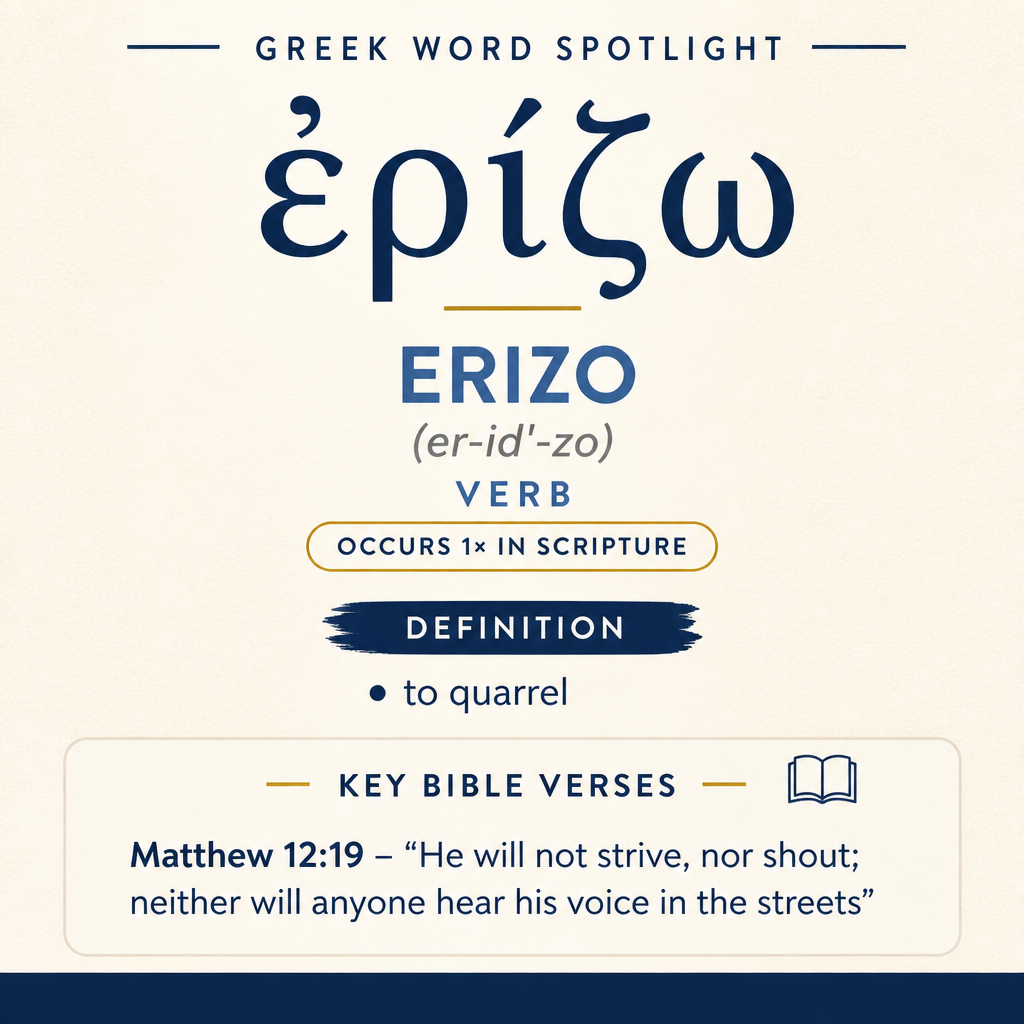
ἐρίζω means “to quarrel” and appears once in Scripture, in Matthew 12:19.
Scripture Occurrence
This verb occurs one time in Scripture. Its single occurrence is in Matthew 12:19.
Learn More →Verse Context
In Matthew 12:19 it appears in the line, “He will not strive, nor shout; neither will anyone hear his voice in the streets.”
Learn More →ἐρίζω means “to quarrel,” and it is attested once in the New Testament, in Matthew 12:19. In that setting it appears in a description of a figure whose public manner is marked by restraint rather than contention.
Root and Related Words
ἐρίζω is related to
eris (ἔρις) — quarrel (Strong’s G2054)
and is presented as deriving from that noun. The relationship links the verb to the idea of “quarrel” as a recognizable kind of social friction: not merely strong feeling, but an interpersonal clash expressed in words and conduct.

Occurrences
“He will not strive, nor shout; neither will anyone hear his voice in the streets.” (Matthew 12:19)
In Matthew 12:19, ἐρίζω stands in a compact chain of negatives that describe how this person does not present himself in public. The verse places “strive” alongside “shout,” and then adds the concrete result that “neither will anyone hear his voice in the streets.” Within that sequence, the verb marks the refusal to engage in quarrelsome contention—behavior that would naturally spill into raised volume and public disturbance. The wording frames quarrel not as a private, internal posture, but as an outward mode of interaction that can become audible and conspicuous in public spaces (“in the streets”).
The verse also suggests an everyday social setting: streets where voices carry, where arguments attract attention, and where a person seeking to win a dispute might project himself. By denying that pattern (“will not”), the line contrasts quarrelling with a calmer presence that does not rely on loudness or public contest. The quarrel in view is therefore the kind of striving that makes itself heard—an escalation that turns disagreement into clamor.
Sense and Usage
The definition “to quarrel” is expressed here through opposition: the text defines the action partly by what accompanies it and what it produces. In Matthew 12:19, quarrelling is placed next to shouting, and both are linked to the public audibility of a voice. This does not expand the basic sense beyond “to quarrel,” but it does show how quarrelling functions in this portrayal: it is an active, outward striving, the sort of contentious engagement that can dominate a public environment.
Because the occurrence is cast as a negation (“He will not …”), the verb contributes to characterization by exclusion. The verse is not describing an isolated moment when a quarrel could have happened, but a settled pattern of conduct: the person described is not one who makes his way by contentious confrontation. In this portrayal, quarrelling is treated as a recognizable public posture—something that can be paired with loud speech and that can be detected by bystanders who “hear his voice.”
The immediate neighbors of the verb—“shout” and “hear his voice”—also help define the social shape of quarrelling. Quarrelling is not presented as silent resistance, nor as a purely internal struggle; it is the kind of striving that tends toward noise and display. Matthew 12:19 therefore presents ἐρίζω as a marked contrast to gentleness of public demeanor: it is the verbal and relational contentiousness that often aims to win, to dominate a conversation, or to draw an audience. The verse’s language keeps the focus on how quarrelling sounds and appears, rather than on the specific content of any dispute.
At the same time, the verse frames this refusal of quarrelling as consistent with a broader refusal to amplify oneself. “He will not strive, nor shout” moves naturally into “neither will anyone hear his voice in the streets,” so that the three clauses together form a portrait of restrained public speech. Within that portrait, ἐρίζω carries the sense of contentious engagement as a kind of striving that can be performed in public and measured by its effect on the surrounding space—whether it becomes loud enough to be “heard … in the streets.”
Imagery
Matthew 12:19 evokes the street as a place where quarrels become audible, where striving is enacted in raised voices, and where passersby become unwilling listeners. Against that urban soundscape, ἐρίζω is imagined as the kind of conflict that would otherwise be broadcast outward; the verse’s negative description paints a scene in which that broadcast never happens.
Sources: Lexical data from Strong’s Exhaustive Concordance and the Translators Brief Lexicon of Extended Strongs for Greek (STEPBible, CC BY). Occurrence data from the Translators Amalgamated Greek New Testament (STEPBible, CC BY). Scripture quotations from the World English Bible (public domain).