Exploring the Meaning of Heptakischilioi in Greek
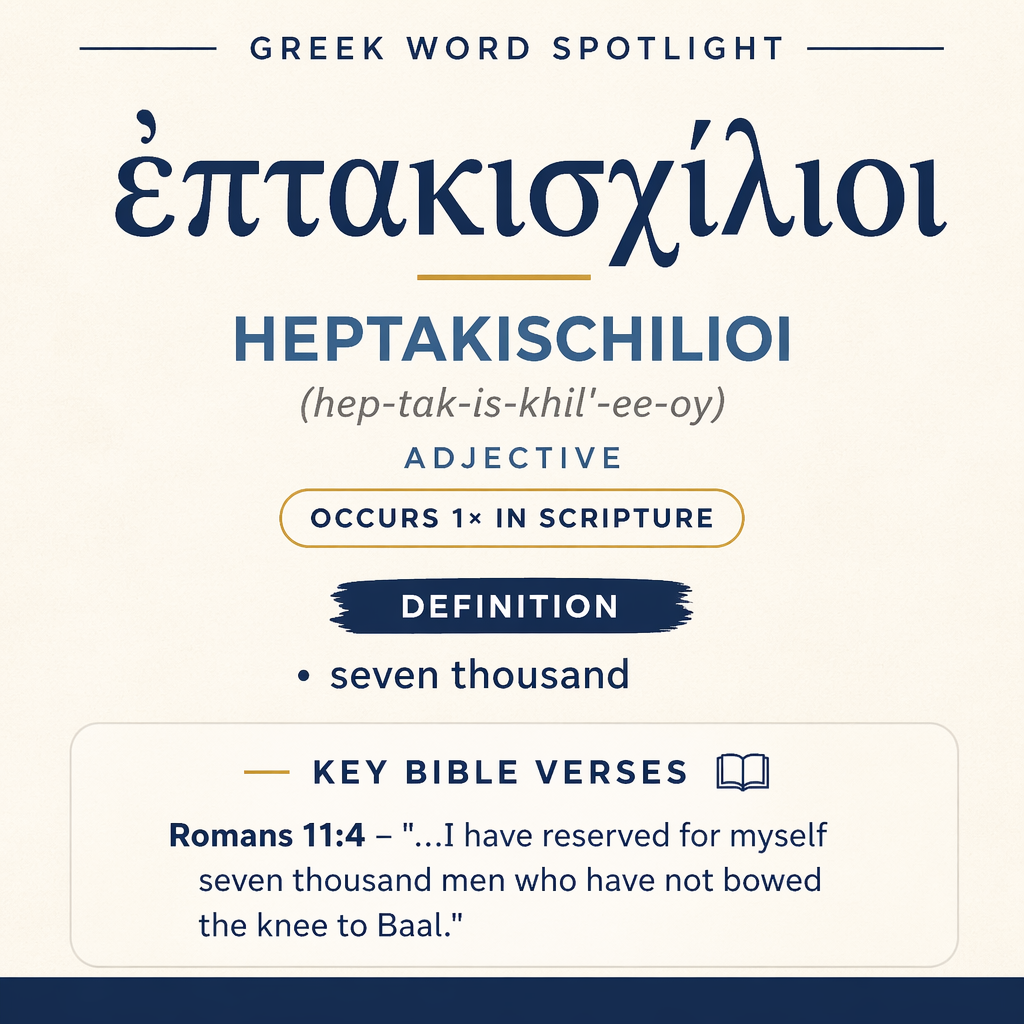
ἑπτακισχίλιοι means “seven thousand” and appears once in Scripture in Romans 11:4.
Scripture Occurrence
This word occurs 1 time in Scripture. It appears in Romans 11:4.
Learn More →Context in Romans
In Romans 11:4, God says He has reserved for Himself seven thousand men. These men have not bowed the knee to Baal.
Learn More →ἑπτακισχίλιοι means “seven thousand,” and it appears in Paul’s quotation of God’s reply about a preserved remnant in Romans 11:4. In that single setting, the word functions as a concrete numerical designation that anchors the statement in a specific, counted group.
Root and Related Words
ἑπτακισχίλιοι is formed from ἑπτάκις (heptakis), “seven times” (Strong’s G2034), and χίλιοι (chilioi), “thousand” (Strong’s G5507). The compound structure joins a “seven-” element with a “thousand” element, producing a single numerical descriptor.
Occurrences
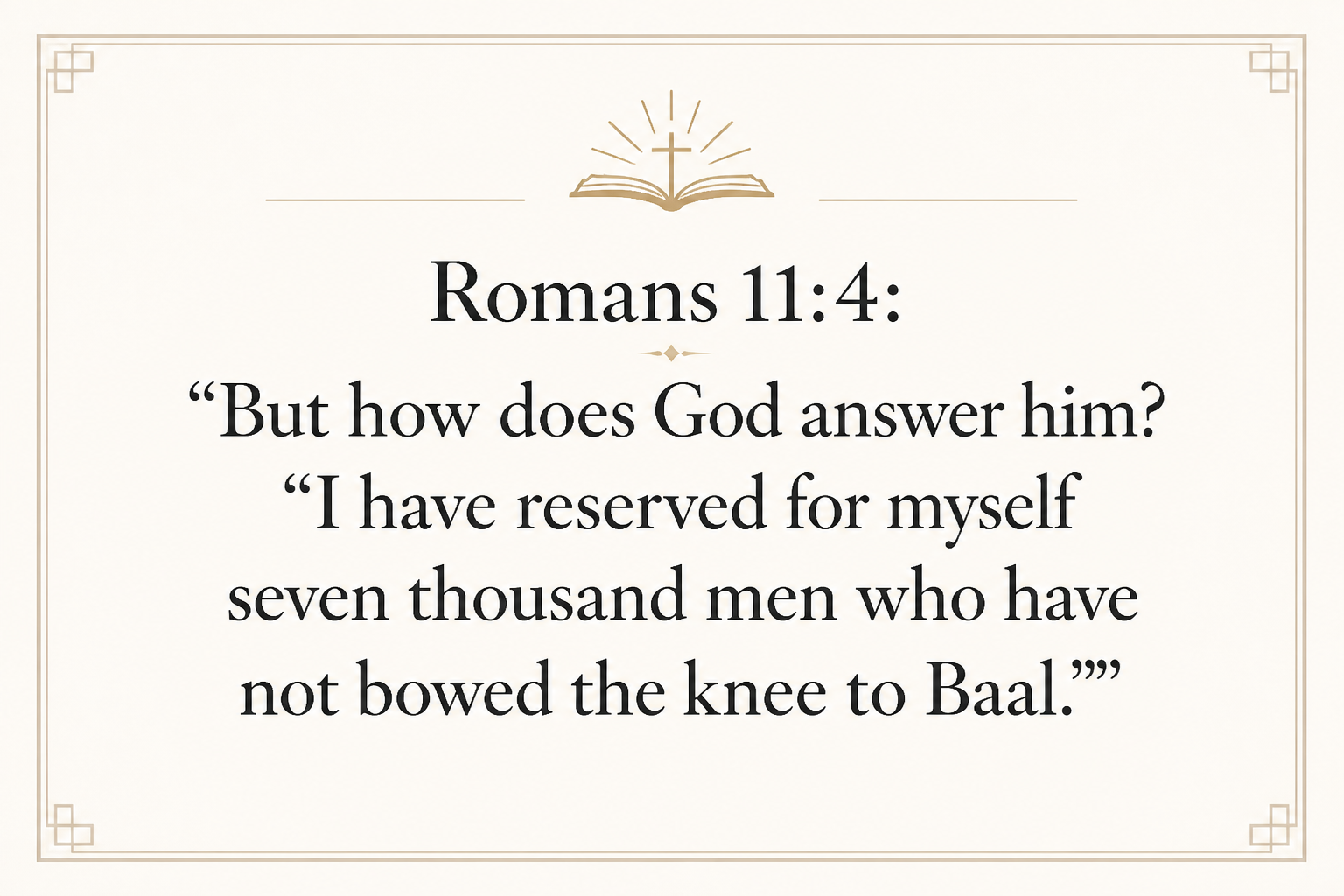
Romans 11:4: “But how does God answer him? “I have reserved for myself seven thousand men who have not bowed the knee to Baal.””
In Romans 11:4, ἑπτακισχίλιοι supplies the precise size of the group God describes as “reserved for myself.” The number is not presented in isolation; it is attached to “men” and further qualified by their defining action: they “have not bowed the knee to Baal.” Within the sentence, the numeral therefore does two things at once: it identifies the remnant as a real, countable body, and it puts a clear boundary around who is being spoken of—neither an undefined crowd nor a merely symbolic idea, but a specified company marked out by their refusal to bow.
The verb phrase “I have reserved for myself” frames the quantity as the result of God’s own action. The number “seven thousand” is thus integrated into a statement about divine keeping: the group exists as those whom God has set aside, and the numeral fixes the scale of that preservation in a way that is easy to grasp. The following clause, “who have not bowed the knee to Baal,” turns the numeric designation into a moral and religious description without changing the number’s role: ἑπτακισχίλιοι still names how many, while the relative clause names what kind. In this context, the numeric word helps the whole answer land with clarity—God’s reply is not simply that some remain, but that a definite number of faithful persons remain.
Sense and Usage
The sense “seven thousand” in ἑπτακισχίλιοι is straightforwardly quantitative, yet its rhetorical effect depends on how it is embedded in the claim. Romans 11:4 places the numeral inside a divine first-person declaration (“I have reserved for myself”), so the figure is part of an assertion of intentional preservation rather than a statistic offered for curiosity. The word therefore serves as a stabilizing detail: it makes the statement concrete and measurable, and it prevents the remnant from being reduced to a vague impression.
Because the noun it modifies is “men,” the number is personal rather than material; it counts people, not objects. And because the people are described by what they have not done (“have not bowed the knee to Baal”), the number does not merely quantify a population but quantifies a distinct subset within a larger religious landscape implied by the mention of Baal. The implied contrast in the line is between those who bow and those who do not; ἑπτακισχίλιοι gives the size of the non-bowing group. In that way, the numeral becomes a tool of definition: it marks the remnant as a discrete community with identifiable boundaries.
The compound’s internal shape (linked to heptakis, “seven times,” and chilioi, “thousand”) also suits this usage: it expresses a large, rounded quantity in a single word, allowing the sentence to move quickly from God’s action (“I have reserved”) to the group’s identity (“seven thousand men”) and then to the decisive qualifier (“who have not bowed the knee to Baal”). The result is a compact line in which the number functions as a pivotal middle term—bridging divine preservation and human fidelity.
Imagery
Romans 11:4 attaches the number to an embodied gesture: “bowed the knee.” Against that physical act of devotion, “seven thousand men” evokes a visible minority who remain standing—defined not by an inward claim alone, but by a public refusal expressed through the posture they will not take toward Baal. The numeral gives that image weight and scale: the scene is not one solitary figure resisting, but a substantial, countable group preserved and distinguished by their unbending knees.
Sources: Lexical data from Strong’s Exhaustive Concordance and the Translators Brief Lexicon of Extended Strongs for Greek (STEPBible, CC BY). Occurrence data from the Translators Amalgamated Greek New Testament (STEPBible, CC BY). Scripture quotations from the World English Bible (public domain).