
Exploring the Meaning of Epiballo in Greek
ἐπιβάλλω means “to put on/seize” and occurs 18 times in Scripture, including Matthew 9:16; 26:50; Mark 4:37; 11:7; 14:46; 14:72; Luke 5:36; 9:62.
Core Meaning
ἐπιβάλλω is defined as “to put on/seize.” In the listed passages it covers both placing something on and taking hold of someone.
Learn More →Putting On
It appears for putting on cloth on a garment (Matthew 9:16; Luke 5:36) and throwing garments on a young donkey (Mark 11:7).
Learn More →Seizing
It is used for laying hands on and seizing Jesus (Matthew 26:50; Mark 14:46). It also occurs in Mark 4:37; Mark 14:72; and Luke 9:62.
Learn More →ἐπιβάλλω moves in these passages between putting something onto something else and seizing by physical action. The scenes range from mending clothes and equipping a mount to storms that beat into a boat and authorities attempting to take hold of Jesus or His followers.
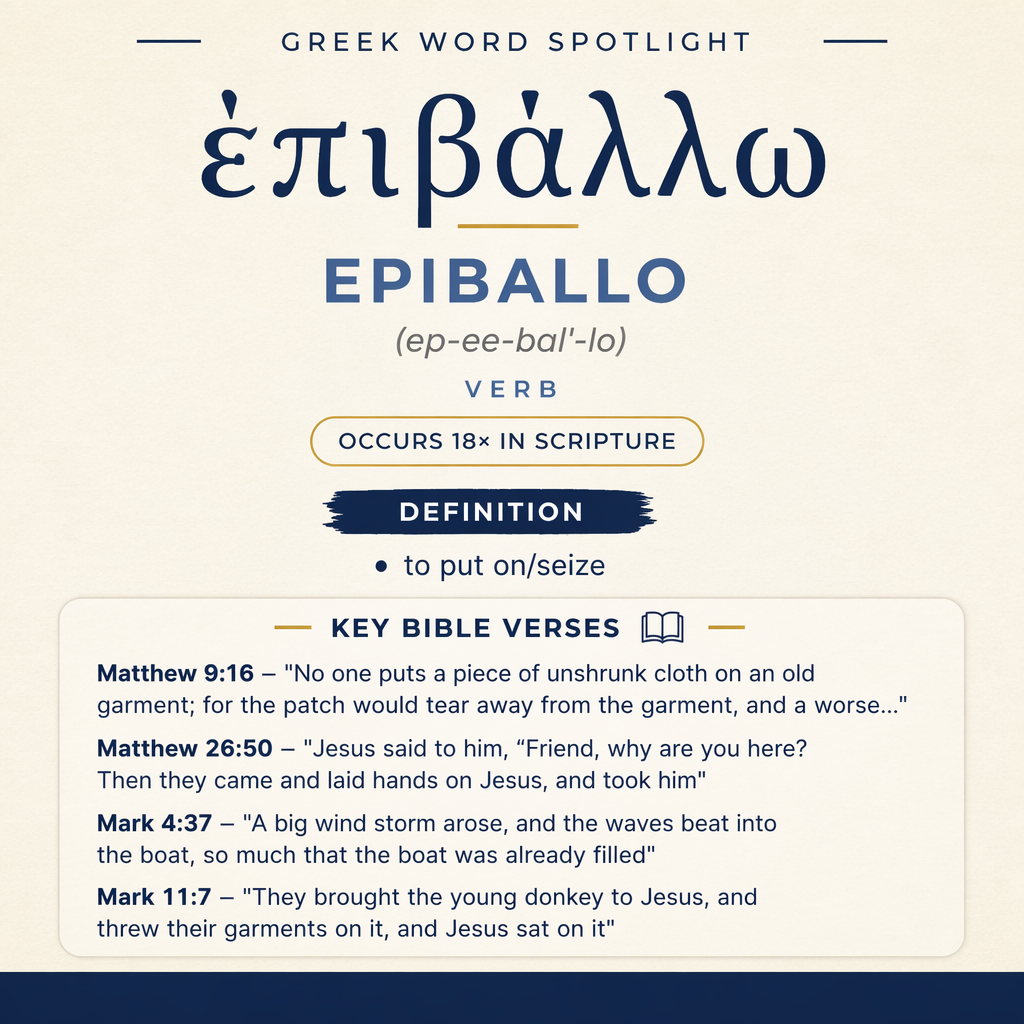
Occurrences
Matthew 9:16 — “No one puts a piece of unshrunk cloth on an old garment; for the patch would tear away from the garment, and a worse hole is made.”
Here the action is placing one material upon another: a patch laid onto an old garment. The saying turns on the practical force of “put on”—the patch is applied in such a way that the act itself creates stress, so that what is put on does not simply remain attached but “would tear away,” worsening the damage.
Matthew 26:50 — “Jesus said to him, “Friend, why are you here?” Then they came and laid hands on Jesus, and took him.”
The verb describes hands being set upon a person as the initiating movement of arrest. The sequence in the sentence makes the physicality vivid: they “laid hands” first, and the taking follows as the outcome of that contact.
Mark 4:37 — “A big wind storm arose, and the waves beat into the boat, so much that the boat was already filled.”
The word is used for the waves’ forceful action in relation to the boat: the water is not merely near it but driven onto/into it. The result—“the boat was already filled”—shows that what is “put on” is an intrusive, overwhelming pressure of water upon the vessel.
Mark 11:7 — “They brought the young donkey to Jesus, and threw their garments on it, and Jesus sat on it.”
In this scene the action is the placing of garments upon the animal as a kind of improvised covering or saddle. The verb fits the quick, practical movement: garments are cast onto the donkey immediately before Jesus sits, so what is put on becomes the immediate surface for riding.
Mark 14:46 — “They laid their hands on him, and seized him.”
The act of “laying hands” is again the opening gesture of seizure. The pairing with “seized him” sets the verb in the sphere of physical control: hands are set upon him to secure him, and the seizure names the completed intention of that act.
Mark 14:72 — “The rooster crowed the second time. Peter remembered the word, how that Jesus said to him, “Before the rooster crows twice, you will deny me three times.” When he thought about that, he wept.”
Within Peter’s reaction, the word expresses an inward, sudden “seizing” in the realm of thought and emotion: the remembered saying comes upon him with force. The final clause, “When he thought about that, he wept,” presents the remembered word as something that lands heavily, gripping him and producing immediate sorrow.
Luke 5:36 — “He also told a parable to them. “No one puts a piece from a new garment on an old garment, or else he will tear the new, and also the piece from the new will not match the old.”
As in Matthew’s garment saying, the verb depicts attaching a piece onto an old garment. Luke’s wording stresses the consequence for both items: the attempt to apply the new piece onto the old causes tearing and a mismatch, so the “putting on” is the decisive act that exposes incompatibility.
Luke 9:62 — “But Jesus said to him, “No one, having put his hand to the plow, and looking back, is fit for God’s Kingdom.”
Here “put” is focused and deliberate: a hand is set to a plow as the bodily commitment that begins the work. The image depends on the firmness of the gesture—once the hand is placed, turning the gaze backward conflicts with the forward-directed task implied by the plow.
Luke 15:12 — “The younger of them said to his father, ‘Father, give me my share of your property.’ He divided his livelihood between them.”
In this familial and economic scene, the verb is used for distributing: what the father has is apportioned and placed upon each son as his share. The action is concrete and effectual—division is not merely planned but carried out so that each receives a portion assigned to him.
Luke 20:19 — “The chief priests and the scribes sought to lay hands on him that very hour, but they feared the people—for they knew he had spoken this parable against them.”
The phrase “lay hands on him” signals the intended move to arrest or restrain. Luke adds the immediacy (“that very hour”) and the inhibition (“they feared the people”), so the verb names the specific physical act they want to execute, even though fear prevents it.
Luke 21:12 — “But before all these things, they will lay their hands on you and will persecute you, delivering you up to synagogues and prisons, bringing you before kings and governors for my name’s sake.”
The same action is projected onto the disciples: hostile parties will “lay their hands on you” as the first touchpoint of persecution. The following verbs—“delivering you up… bringing you”—unfold what that initial seizing leads to: formal confinement and public examination before authorities.
John 7:30 — “They sought therefore to take him; but no one laid a hand on him, because his hour had not yet come.”
John places the verb at the boundary between intent and action. The crowd (or authorities) “sought… to take him,” yet the decisive physical step—laying a hand on him—does not occur; the narrative emphasizes restraint, so that the absence of the grasping act carries the weight of the moment.

Sense and Usage
Across these passages, ἐπιβάλλω consistently conveys an action that is more than proximity: something is set upon something else, or hands are set upon someone, with tangible effect. In the garment sayings (Matthew 9:16; Luke 5:36), the “putting on” is an attempt to attach and reinforce, but it becomes the very cause of tearing. The verb therefore suits an act that initiates a chain reaction: the patch is applied, and the result follows inevitably (“a worse hole is made”; “he will tear the new”).
In Mark 11:7, the placing is quick and practical—garments are thrown onto the donkey—showing that the verb can describe a simple, physical laying-on that prepares for immediate use. Luke 9:62 narrows the focus to a single body part: the hand is put to the plow. The effect is not damage but commitment; the gesture marks a decisive engagement with a task that assumes continued forward attention.
In the arrest contexts (Matthew 26:50; Mark 14:46; Luke 20:19; Luke 21:12; John 7:30), the word belongs to the concrete sphere of touch and control. “Laying hands” functions as the recognizable first move of seizure, whether accomplished (“and took him”; “and seized him”), attempted (“sought to lay hands on him”), predicted (“they will lay their hands on you”), or withheld (“no one laid a hand on him”). These variations show how the verb can mark the threshold where intention becomes embodied action; to “lay hands” is to convert hostility into physical possession.
Mark 4:37 extends the same forceful “laying on” into nature: waves “beat into the boat.” The water is portrayed as acting upon the boat with enough pressure to fill it; the verb thus captures impact and intrusion, not a gentle covering. Mark 14:72 turns the energy inward: Peter is struck by remembrance and breaks down. Even without an external object being placed, the sense of being seized fits the emotional turn—something comes upon him in a way that grips and alters him.
Finally, Luke 15:12 uses the verb in a distribution scene: the father divides his livelihood between his sons. The action still involves placing/assigning something onto others in a concrete way—portions are set out and allocated—so the verb’s core idea of an effectual “putting on” operates in an economic register rather than a bodily one.
Imagery
The passages cluster around hands, surfaces, and pressure: cloth placed on cloth, garments placed on an animal, a hand placed on a plow, hands placed on a person, and waves driven into a boat. Whether the result is tearing, readiness, arrest, peril, or tears, ἐπιβάλλω repeatedly marks the moment when an action lands—when something is brought to bear upon another thing, and the scene turns because of that contact.
Sources: Lexical data from Strong’s Exhaustive Concordance and the Translators Brief Lexicon of Extended Strongs for Greek (STEPBible, CC BY). Occurrence data from the Translators Amalgamated Greek New Testament (STEPBible, CC BY). Scripture quotations from the World English Bible (public domain).





