
Exploring the Meaning of Eperotema in Greek
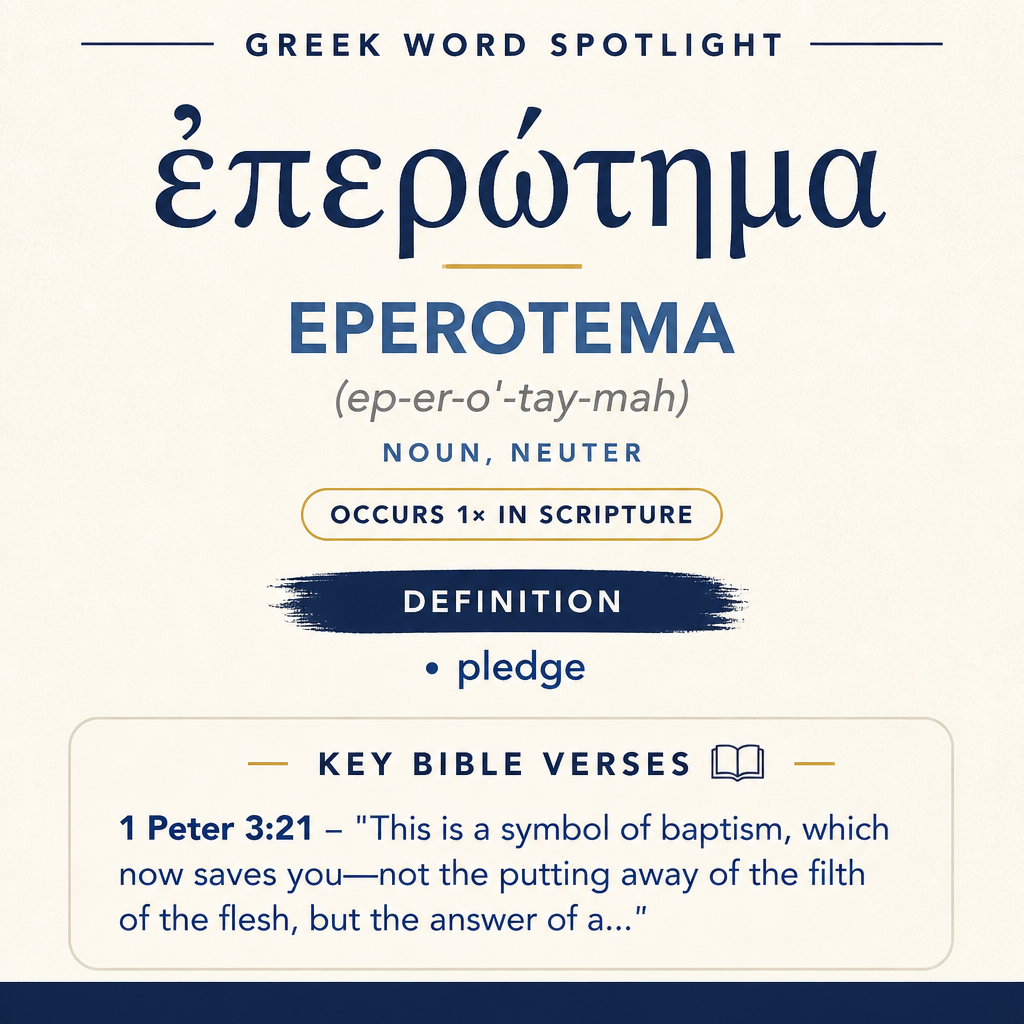
ἐπερώτημα means “pledge” and occurs once in Scripture, in 1 Peter 3:21.
Scripture Occurrence
It appears 1 time in Scripture. The occurrence is in 1 Peter 3:21.
Learn More →Verse Context
In 1 Peter 3:21, it occurs in a statement about baptism saving, contrasted with putting away bodily filth.
Learn More →ἐπερώτημα means “pledge” and appears once in the New Testament, in Peter’s discussion of baptism and the conscience before God. In that context it is set in contrast with a merely outward washing and is linked to salvation “through the resurrection of Jesus Christ.”
Root and Related Words
ἐπερώτημα (Eperotema) is related to the verb ἐπερωτάω (eperotao), “to question” (Strong’s G1905). The relationship points to a word-family concerned with directed speech acts—addressing another with words—within which ἐπερώτημα functions as a noun.

Occurrences
“This is a symbol of baptism, which now saves you—not the putting away of the filth of the flesh, but the answer of a good conscience toward God, through the resurrection of Jesus Christ,” (1 Peter 3:21)
In 1 Peter 3:21, ἐπερώτημα is the key term in a careful clarification of what baptism is doing in Peter’s argument. He first identifies baptism as “a symbol” and then states its present effect: it “now saves you.” Immediately, however, he narrows the point by denying a reduction of baptism to physical cleansing: it is “not the putting away of the filth of the flesh.” Against that outward, bodily reading he sets ἐπερώτημα, placed within the phrase “the answer of a good conscience toward God.” The term therefore marks an inward, God-ward dimension of baptism, describing it as something expressed from within a person’s moral awareness (“conscience”) and oriented “toward God.”
The structure of the sentence gives ἐπερώτημα a defining role: Peter sets up two alternatives, the negated external action (“putting away…”) and the positive reality (“but the answer…”). Within that contrast, the noun carries the weight of what baptism signifies and accomplishes on the inside. The immediate qualifier “of a good conscience” situates this pledge-language in the realm of integrity and moral alignment; it is not presented as a bare ritual act but as something bound up with “good conscience.” The added directional phrase “toward God” further specifies the target: the pledge is not merely private self-reflection, nor primarily a statement to other people, but an act or reality facing God.
Finally, Peter attaches the whole statement to a Christ-centered basis: “through the resurrection of Jesus Christ.” In this sentence, ἐπερώτημα does not stand alone as a self-generated human assurance; it is framed as operating “through” the resurrection. That placement keeps the pledge associated with baptism tethered to the saving work Peter names, rather than being treated as a purely subjective intention detached from what God has done.
Sense and Usage
As “pledge,” ἐπερώτημα in this passage functions as covenantal-sounding language without requiring any further technical elaboration beyond what Peter himself states. A pledge is the sort of thing that binds; it has the character of a committed engagement rather than a casual or momentary feeling. That basic idea fits Peter’s pairing of baptism with the conscience: he describes something that involves the person’s inner moral stance, not simply the body’s exposure to water. The pledge is specifically linked with “a good conscience,” so the commitment in view is ethically charged; it speaks to sincerity and to a conscience that is not accusing but “good” in its posture before God.
Because Peter sets ἐπερώτημα over against “the putting away of the filth of the flesh,” the word also helps distinguish sign from substance in his sentence. Baptism is called “a symbol,” and the pledge-language identifies what that symbol is pointing to: an inward orientation and commitment Godward. Thus, in Peter’s usage, the pledge is neither a substitute for baptism nor a separate achievement added on top of it; it is how he explains baptism’s saving significance in a way that avoids collapsing it into mere washing.
The immediate context also indicates the pledge’s direction and grounding. It is “toward God,” so it is relational and addressed beyond the self; it is not merely the conscience talking to itself but the conscience placed before God. And it is “through the resurrection of Jesus Christ,” so the pledge is situated within the sphere of resurrection power and saving action. In Peter’s single use of ἐπερώτημα, the term therefore contributes a concentrated idea: baptism, as symbol, is tied to a committed stance of conscience toward God, made effective in connection with the resurrection.
Imagery
Even without describing water explicitly in this verse, the sentence evokes the concrete contrast between external washing and inner commitment. The mention of “the filth of the flesh” sets the scene of physical cleansing, but ἐπερώτημα shifts the focus to a pledge arising from “a good conscience toward God.” The imagery is of an outward rite that points beyond itself to an inward, God-facing pledge, held together by the resurrection named at the end of the verse.
Sources: Lexical data from Strong’s Exhaustive Concordance and the Translators Brief Lexicon of Extended Strongs for Greek (STEPBible, CC BY). Occurrence data from the Translators Amalgamated Greek New Testament (STEPBible, CC BY). Scripture quotations from the World English Bible (public domain).




