Exploring the Meaning of Eperotao in Greek
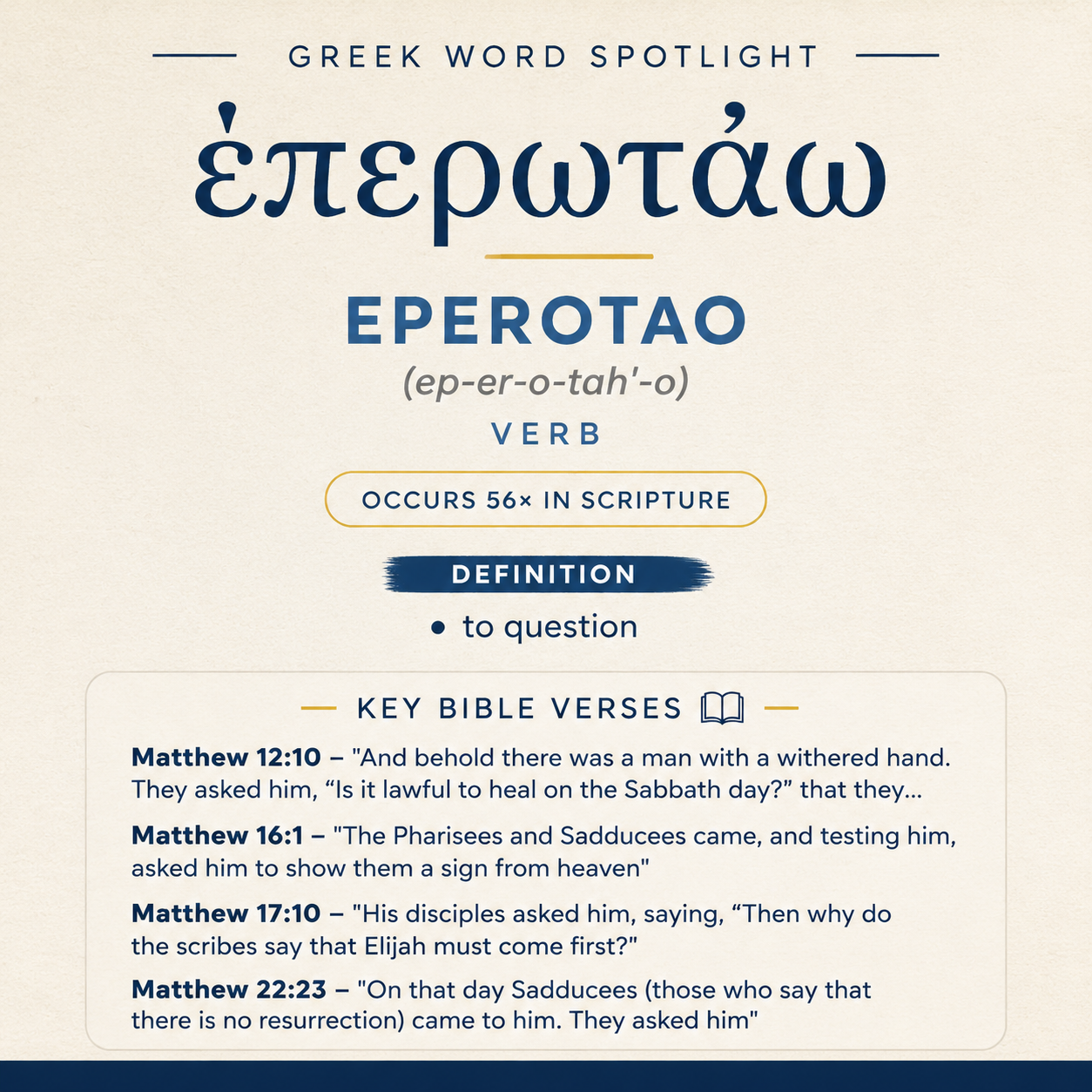
ἐπερωτάω means “to question” and appears 56 times in Scripture, including in Matthew where people question and test Jesus.
Core Meaning
ἐπερωτάω means “to question.” In Matthew it introduces direct questions posed to Jesus and others.
Learn More →Matthew Examples
It appears when opponents test Jesus (Matthew 16:1; 22:35) and when disciples ask Him for understanding (Matthew 17:10).
Learn More →Before Authorities
It is used when the governor questions Jesus, “Are you the King of the Jews?” (Matthew 27:11).
Learn More →ἐπερωτάω expresses the act of questioning, whether in public dispute, private instruction, or formal examination. In the Gospel scenes quoted below, it marks moments where a question presses for a decision, an explanation, or a disclosure.
Occurrences
“And behold there was a man with a withered hand. They asked him, “Is it lawful to heal on the Sabbath day?” that they might accuse him.” (Matthew 12:10)
Here ἐπερωτάω frames a question asked with an accusatory aim. The wording turns the man’s condition (“a withered hand”) into a test-case, and the question is shaped to set up an accusation (“that they might accuse him”). The verb therefore signals not mere curiosity, but questioning as a strategic move in conflict.
“The Pharisees and Sadducees came, and testing him, asked him to show them a sign from heaven.” (Matthew 16:1)
In this scene the act of questioning is explicitly coupled with “testing him.” ἐπερωτάω introduces a demand: they ask “to show them a sign from heaven.” The question functions as a challenge, requiring Jesus to respond by producing something visible and decisive, and the verb places that challenge in the mouth of opponents who approach together.
“His disciples asked him, saying, “Then why do the scribes say that Elijah must come first?”” (Matthew 17:10)
ἐπερωτάω here marks a learner’s question. The disciples’ “Then why…?” seeks clarification about a claim attributed to “the scribes.” The verb signals a move from observation to interpretation: they want the reasoning that would make sense of the sequence (“must come first”) implied in the statement they cite.
“On that day Sadducees (those who say that there is no resurrection) came to him. They asked him,” (Matthew 22:23)
Even with the question itself left unquoted here, ἐπερωτάω introduces an encounter defined by doctrinal dispute: the Sadducees are described as “those who say that there is no resurrection,” and then they “came to him” and “asked him.” The verb sets the stage for questioning that springs from a stated stance and is poised to press that stance in interaction with Jesus.
“One of them, a lawyer, asked him a question, testing him.” (Matthew 22:35)
In this compact notice, ἐπερωτάω is paired again with “testing him.” The question comes from “a lawyer,” and the phrase “asked him a question” highlights the deliberate, formal character of the inquiry. The verb points to questioning as examination—an attempt to probe, measure, and possibly entrap through a carefully chosen query.
“Now while the Pharisees were gathered together, Jesus asked them a question,” (Matthew 22:41)
Here the direction of questioning reverses: Jesus is the one who ἐπερωτάω’s, and the Pharisees are the audience. The setting (“gathered together”) suggests a public or semi-public exchange, and the verb signals an initiative taken by Jesus—he does not merely respond to tests but also poses his own question into a gathered group.
“No one was able to answer him a word, neither did any man dare ask him any more questions from that day forward.” (Matthew 22:46)
ἐπερωτάω appears here in the idiom of continued questioning: “ask him any more questions.” The statement links inability (“No one was able to answer him a word”) with reluctance (“neither did any man dare”), portraying questions as a kind of engagement that can be shut down by decisive replies. The verb thus helps describe the collapse of a hostile questioning campaign—after this point, further questioning is not attempted.
“Now Jesus stood before the governor: and the governor asked him, saying, “Are you the King of the Jews?” Jesus said to him, “So you say.”” (Matthew 27:11)
In a judicial setting, ἐπερωτάω marks formal interrogation. “Jesus stood before the governor,” and the governor’s question is direct and politically charged: “Are you the King of the Jews?” The verb carries the weight of official inquiry, and the concise exchange (“So you say”) shows how a question can force a precise, consequential point onto the record.
“He asked him, “What is your name?” He said to him, “My name is Legion, for we are many.”” (Mark 5:9)
ἐπερωτάω introduces a question aimed at identification: “What is your name?” The response provides self-designation and explanation (“My name is Legion, for we are many”), so the verb here signals questioning that draws out disclosure. The question functions as an opening that elicits an unsettling, clarifying statement about the speaker’s identity and condition.
“The Pharisees and the scribes asked him, “Why don’t your disciples walk according to the tradition of the elders, but eat their bread with unwashed hands?”” (Mark 7:5)
In this confrontation, ἐπερωτάω frames a “Why…?” question about conduct and tradition. The wording contrasts expected behavior (“walk according to the tradition of the elders”) with the alleged failure (“eat their bread with unwashed hands”). The verb highlights questioning as an accusation in the form of inquiry: the question presumes a standard and presses Jesus to account for his disciples’ deviation from it.
“When he had entered into a house away from the multitude, his disciples asked him about the parable.” (Mark 7:17)
Here ἐπερωτάω occurs in a private teaching context. The setting shifts “into a house away from the multitude,” and the disciples’ question concerns understanding (“about the parable”). The verb signals a transition from hearing in public to asking in private, where questioning becomes a means of seeking explanation beyond what was grasped amid the crowd.
“He took hold of the blind man by the hand, and brought him out of the village. When he had spat on his eyes, and laid his hands on him, he asked him if he saw anything.” (Mark 8:23)
ἐπερωτάω here accompanies an enacted healing. The narrative lists physical actions—taking the man by the hand, leading him out, spitting on his eyes, laying hands on him—then the question: “if he saw anything.” The verb marks a diagnostic inquiry within the process, using a question to assess result and perception rather than to debate doctrine or test authority.

Sense and Usage
Across these passages, ἐπερωτάω functions as a pivot point in dialogue: it introduces speech that demands a response and so drives the scene forward. The question may be hostile, as in Matthew 12:10 and Mark 7:5, where opponents shape “Is it lawful…?” and “Why don’t…?” to press an accusation or enforce a standard. It may be a test framed as a challenge, as in Matthew 16:1 and Matthew 22:35, where the act of questioning is explicitly described as “testing him,” and what is asked is meant to measure Jesus under pressure.
The same verb also supports earnest inquiry. In Matthew 17:10 the disciples’ “Then why…?” seeks conceptual clarity about an assertion they have heard; in Mark 7:17 they ask “about the parable” once they are “away from the multitude,” using question-and-answer as the pathway to understanding. In Mark 8:23 the question becomes practical and immediate, checking the outcome of a healing action (“if he saw anything”); and in Mark 5:9 it seeks identification (“What is your name?”), drawing out a revealing reply that defines the situation (“for we are many”).
Several scenes also show how questioning establishes roles and authority. Matthew 22:41 depicts Jesus as the questioner, addressing a gathered group, while Matthew 22:46 depicts the end of a cycle of adversarial questions—people cease questioning because they cannot answer and do not dare continue. Matthew 27:11 places questioning in the mouth of a governor, with a direct interrogative that bears legal and political weight; ἐπερωτάω there signals not debate but examination in an official hearing. Taken together, these occurrences show that questioning can be weapon, tool, or safeguard: a weapon when aimed to accuse, a tool when seeking explanation or assessment, and a safeguard when used to establish what is true about identity, understanding, or outcome.
Imagery and Scene
The quoted narratives attach ἐπερωτάω to vivid moments where a single question turns the focus: a Sabbath controversy beside “a man with a withered hand” (Matthew 12:10), a demand for “a sign from heaven” (Matthew 16:1), a governor’s courtroom inquiry (Matthew 27:11), an encounter where the answer “Legion” reshapes the listener’s sense of the danger (Mark 5:9), a quiet house where disciples press for meaning (Mark 7:17), and a healing where the question checks whether sight has begun (Mark 8:23). In each case, the act of questioning is not background noise; it is the hinge on which the action or argument turns.
Sources: Lexical data from Strong’s Exhaustive Concordance and the Translators Brief Lexicon of Extended Strongs for Greek (STEPBible, CC BY). Occurrence data from the Translators Amalgamated Greek New Testament (STEPBible, CC BY). Scripture quotations from the World English Bible (public domain).