
Exploring the Meaning of Enalios in Greek
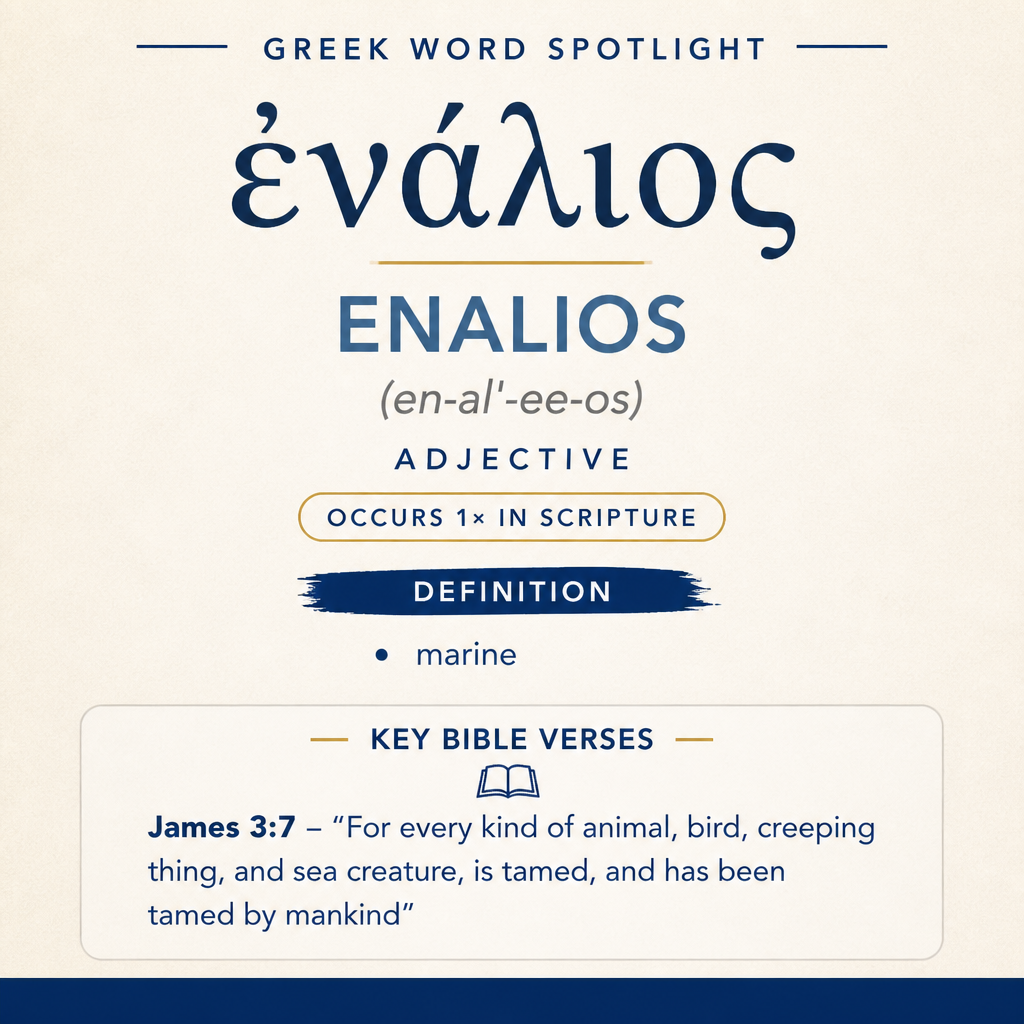
ἐνάλιος means “marine” and appears once in Scripture, in James 3:7.
Scripture Occurrence
It occurs 1 time in Scripture. Its single occurrence is in James 3:7.
Learn More →Context In James
In James 3:7 it describes a “sea creature” among kinds of animals tamed by mankind.
Learn More →ἐνάλιος means “marine.” It appears once in the New Testament, in a list of living kinds that human beings have managed to tame.
Root and Related Words
ἐνάλιος is associated with the preposition en (ἐν), “in/on/among” (Strong’s G1722), and with hals (ἅλς), “salt” (Strong’s G251). The combination points the adjective toward the realm characterized by salt and by being “in” that environment.
Occurrences
“For every kind of animal, bird, creeping thing, and sea creature, is tamed, and has been tamed by mankind;” (James 3:7)
In James 3:7, ἐνάλιος qualifies the final category in a fourfold list of living kinds: “animal,” “bird,” “creeping thing,” and “sea creature.” The word places that last category within the salty realm implied by its associations, marking it as the kind that belongs to the sea. Within the verse’s argument, this category is not a scenic detail but part of a sweeping statement: “every kind” from land, air, ground-level movement, and the sea has been subject to taming by “mankind.” The inclusion of the marine realm enlarges the claim beyond what is immediately visible in ordinary human life, reinforcing the breadth of “every kind” by ensuring the sea is not left outside the scope of the comparison.
The structure of the list also shows how ἐνάλιος functions semantically: it does not introduce a new action, but narrows and specifies the kind of creature being mentioned. The verse does not speak of places directly; it speaks of “kind” and of taming. Yet by marking the “sea creature” as marine, the adjective implicitly brings the sea’s domain into view as one more sphere from which living kinds are drawn. In that way, the word helps James describe human dominion over diverse creatures without needing to describe sea, salt, or water explicitly; the adjective carries the domain with it.
Finally, because the list is framed by repetition—“is tamed, and has been tamed”—the marine term contributes to the rhetorical force: the statement is not limited to a particular class of creatures that might be easier to manage. The marine category stands alongside the others as another member of the total set, presenting the human capacity to tame as remarkably expansive in scope.
Sense and Usage
The sense “marine” operates in James 3:7 as a domain-marker. It distinguishes the sea-related kind from the other three kinds, which are categorized by their characteristic sphere: the animal as a general terrestrial kind, the bird as belonging to the air, the creeping thing as moving along the ground, and the marine creature as belonging to the sea. In a single modifier, ἐνάλιος provides a clear boundary: this is the kind connected with the sea as its proper environment.
Because the verse’s grammar is general (“every kind … is tamed”), the adjective’s contribution is likewise general rather than technical. It does not name a species; it assigns a setting. That is often the practical work of such an adjective in discourse: it lets the author speak comprehensively without cataloguing individual members. The meaning “marine” therefore functions as part of a coverage strategy—an economical way to include an entire realm of creatures in a claim about mankind’s relationship to the animal world.
The associations with en (ἐν), “in/on/among,” and hals (ἅλς), “salt,” also align well with this kind of usage. Marine life is characteristically “in” the salty domain, and the adjective naturally evokes that environment even when the verse itself speaks only of “sea creature.” In James 3:7, that environmental coloring strengthens the contrast among the kinds: the verse ranges from land to air to ground-movers to the salt-water world, building a sense of comprehensiveness by spanning different habitats.
Within the statement about taming, “marine” also helps ensure the claim is not heard as limited to what humans encounter most readily. The sea is a distinct sphere with its own living kinds, often less accessible than those on land. Including a marine category beside the others underlines the scale of “every kind” and prepares the reader for the broader comparison the sentence supports: the ability to tame creatures is presented as wide-reaching, even as the surrounding context moves toward a more pointed moral application.
Imagery
Even in a single occurrence, ἐνάλιος carries a vivid image: the sea as a realm populated with its own “kind” of creature. James 3:7 evokes a world filled with varied life—animal, bird, creeping thing, and marine creature—gathered into one sentence to express the extent of what “mankind” has mastered in taming.
Sources: Lexical data from Strong’s Exhaustive Concordance and the Translators Brief Lexicon of Extended Strongs for Greek (STEPBible, CC BY). Occurrence data from the Translators Amalgamated Greek New Testament (STEPBible, CC BY). Scripture quotations from the World English Bible (public domain).





