Exploring the Meaning of Emmor in Greek
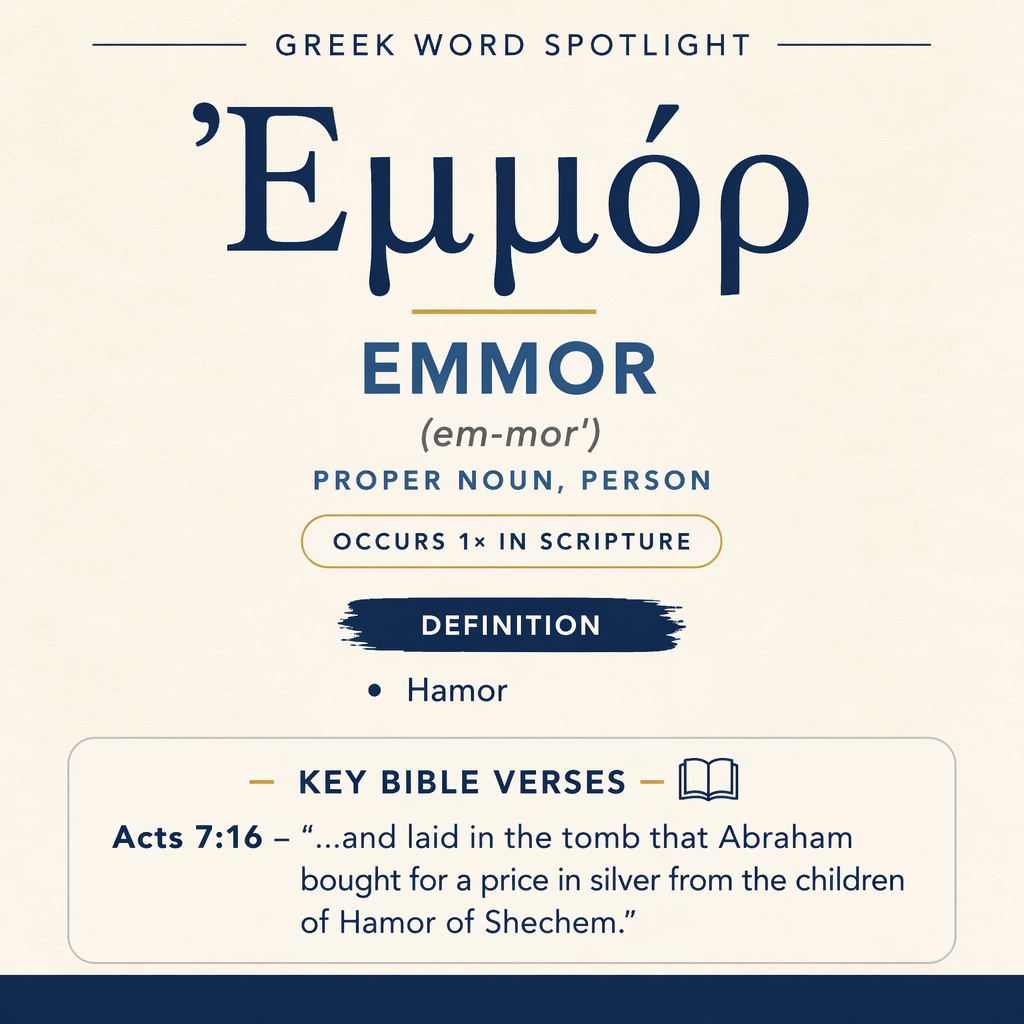
Ἐμμόρ (Emmor) means Hamor and appears once in Scripture, in Acts 7:16.
Context in Acts
In Acts 7:16, it appears in the account of burial at Shechem and a tomb purchase.
Learn More →Ἐμμόρ means “Hamor” and appears in the New Testament in a single place, within a brief reference to a burial site connected with Shechem. In that setting, the name functions to locate a family line and a place of origin for those involved in a land purchase.
Occurrences
“and they were brought back to Shechem, and laid in the tomb that Abraham bought for a price in silver from the children of Hamor of Shechem.” (Acts 7:16)
Here Ἐμμόρ (“Hamor”) appears in a chain of relationships that anchors the tomb’s purchase in both people and place. The verse presents a movement of remains—“they were brought back to Shechem”—and then a careful statement of where they were placed: “laid in the tomb.” The mention of a purchase “for a price in silver” highlights the transaction’s formal, tangible character. Within that description, “the children of Hamor of Shechem” names the party from whom the tomb was bought, with Hamor standing as the identifying ancestor for those “children,” while “of Shechem” further ties that family to a specific locale. The proper name, then, is not used as an isolated personal reference but as part of a legal-geographical identifier: it helps specify which “children” are meant and which Shechem-related line is in view in the purchase of the burial place.

The placement of Hamor within the phrase “the children of Hamor of Shechem” also gives the sentence a compact structure: the tomb is characterized not only by its purpose (a place of burial) but by its provenance (acquired in a silver-priced purchase) and by the seller’s identity (defined through descent from Hamor and association with Shechem). In that way, Ἐμμόρ contributes to the verse’s emphasis on concreteness—bodies “brought back,” a tomb “bought,” a “price in silver,” and a seller group traceable to a named figure tied to a named place.

Sense and Usage
As a proper personal name meaning “Hamor,” Ἐμμόρ functions in Acts 7:16 to supply an identifying label within a transactional and memorial context. The verse does not focus on Hamor as an acting character; instead, the name operates genealogically: Hamor is the reference point that defines “the children” mentioned in the sale. This use is typical of name-based identification in which an ancestor’s name can stand for the lineage associated with him, especially when the text needs to distinguish one group from another in a brief narrative summary.
The way the name is embedded in a prepositional phrase (“from the children of Hamor of Shechem”) shows its role as part of a seller designation. The tomb’s legitimacy and specificity are underscored by the explicit mention of payment (“for a price in silver”) and by the precise identification of those involved in the transfer. In this verse, the name “Hamor” therefore carries a documentary weight: it is tied to ownership and transfer of a burial location, grounding the statement about burial in a particular, traceable acquisition.
Within the same sentence, Ἐμμόρ also works alongside “Shechem” to fuse family identity and geographical association. “Children of Hamor” identifies the group through descent; “of Shechem” situates that group in relation to a place-name. Together they provide a twofold marker—lineage and location—so that the seller group is not left vague. The name’s contribution is thus precise and delimiting: it narrows the referent of “children” to a known line connected with Shechem in the context of a purchased tomb.
Imagery
Although Ἐμμόρ itself is a personal name, the verse in which it appears evokes a concrete scene: a return to “Shechem,” the quiet finality of being “laid in the tomb,” and the remembered solidity of a purchase “for a price in silver.” In that setting, “Hamor of Shechem” belongs to the imagery of place-bound memory—names attached to land, a burial site, and a transaction that fixes that site in a particular human network.
Sources: Lexical data from Strong’s Exhaustive Concordance and the Translators Brief Lexicon of Extended Strongs for Greek (STEPBible, CC BY). Occurrence data from the Translators Amalgamated Greek New Testament (STEPBible, CC BY). Scripture quotations from the World English Bible (public domain).