Exploring the Meaning of Ektenos in Greek
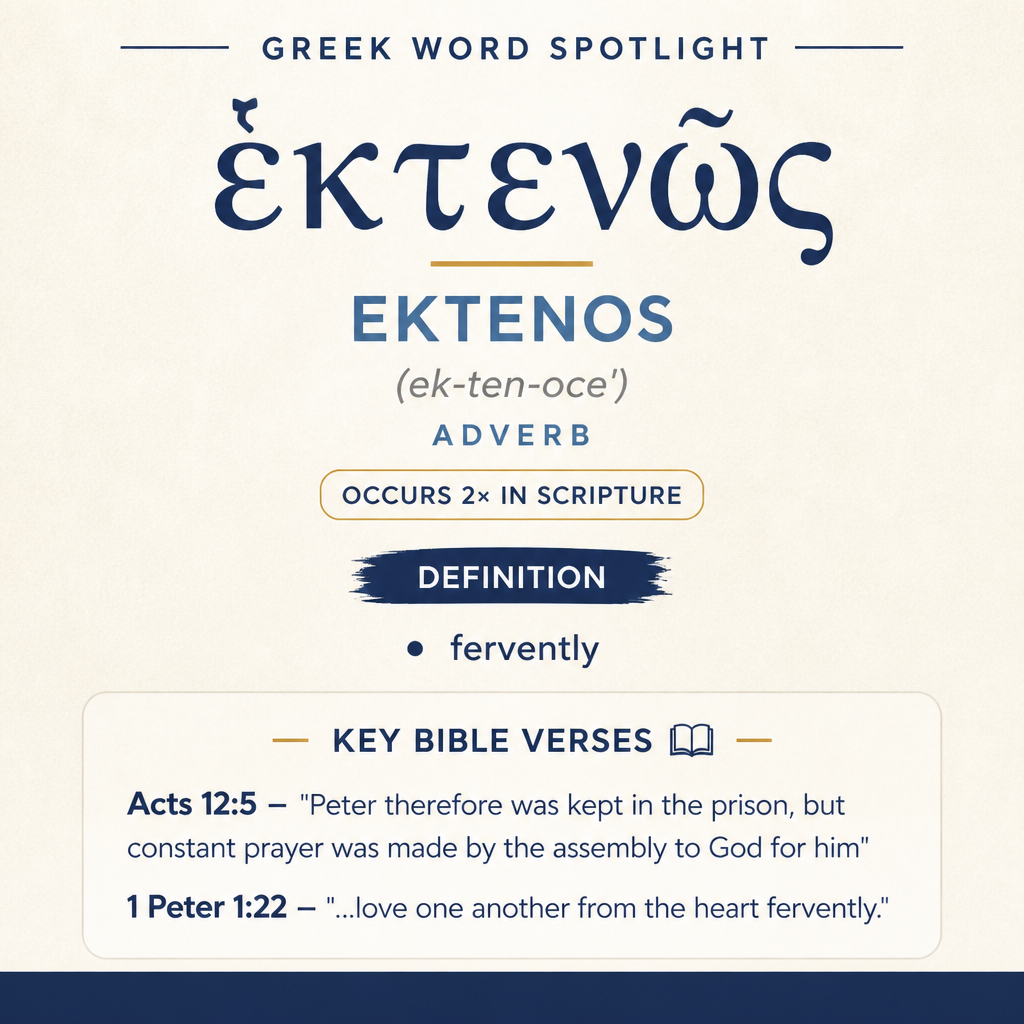
ἐκτενῶς means “fervently” and appears twice in Scripture: Acts 12:5 and 1 Peter 1:22.
Biblical Occurrences
The word occurs 2 times in Scripture. It appears in Acts 12:5 and 1 Peter 1:22.
Learn More →Context Snapshots
In Acts 12:5 it describes the assembly’s prayer to God for Peter. In 1 Peter 1:22 it appears in a call tied to sincere brotherly affection.
Learn More →ἐκτενῶς means “fervently.” It appears in a narrative description of the church’s prayer for Peter and in an exhortation to Christians to love one another from the heart.
Root and Related Words
ἐκτενῶς (Ektenos) derives from ἐκτενής (ektenes), “fervent” (Strong’s G1618). The relationship between the two forms reflects the common pairing of an adverb in -ῶς with a related adjective, so that the adverb characterizes the manner in which an action is carried out.

Occurrences
“Peter therefore was kept in the prison, but constant prayer was made by the assembly to God for him.” (Acts 12:5)
In Acts 12:5, ἐκτενῶς qualifies the community’s praying for Peter while he is “kept in the prison.” The verse sets two realities side by side: Peter’s confinement and the assembly’s response. By placing the manner of prayer in the foreground, ἐκτενῶς frames the church’s intercession as engaged and sustained rather than casual or merely occasional. The sentence is economical, but the adverb thickens the scene: prayer is not presented as a bare fact (“prayer was made”) but as prayer carried out with an intensity that matches the urgency of the moment. It also emphasizes that this was a corporate act—“by the assembly to God”—so the fervency described is not limited to one individual’s devotion but marks the community’s united approach to God on Peter’s behalf.

The surrounding details within the verse itself reinforce what ἐκτενῶς contributes. “Kept in the prison” implies a situation beyond the believers’ direct control; the adverb highlights the earnestness with which they turn to God as the one able to act where they cannot. In a context of confinement and danger, ἐκτενῶς makes the prayer feel like a concentrated effort of the whole church, aligning the manner of praying with the seriousness of the need named in the verse: “for him.”
“Seeing you have purified your souls in your obedience to the truth through the Spirit in sincere brotherly affection, love one another from the heart fervently,” (1 Peter 1:22)
In 1 Peter 1:22, ἐκτενῶς modifies the command “love one another,” specifying how that love is to be expressed. The verse is built as a tightly connected sequence: purification of the soul; obedience to the truth; this occurring “through the Spirit”; resulting in “sincere brotherly affection”; culminating in the exhortation to love. Against that backdrop, ἐκτενῶς does not introduce a new topic but sharpens the quality of love being commanded. The love envisioned is not performative or minimal, because it is to be “from the heart” and is to be offered fervently. The adverb presses the reader away from surface-level relational duty toward love marked by earnest, whole-person engagement.
Because the verse explicitly mentions “sincere brotherly affection,” ἐκτενῶς also works to keep the imperative from being reduced to sentiment. Brotherly affection might be acknowledged in polite gestures or in basic communal cohesion; ἐκτενῶς insists on a posture of active intensity. It modifies not the existence of love but the manner in which love is practiced within the community. The final position of “fervently” in the clause gives it rhetorical weight: after “love one another from the heart,” the adverb serves as the last word that seals the kind of love demanded—earnest love that matches the spiritual cleansing and sincerity already described earlier in the sentence.
Sense and Usage
Across its two attestations, ἐκτενῶς consistently functions as a manner-adverb that heightens the reader’s sense of effort, earnestness, and intensity in an action already named. In Acts it concentrates the assembly’s posture toward God; in 1 Peter it intensifies the community’s posture toward one another. The word therefore bridges two key directions of early Christian life displayed in these passages: upward (prayer “to God”) and horizontal (“love one another”). In both directions, the adverb does similar work—turning a familiar religious or ethical activity into something depicted as full-bodied and engaged.
The adverb also attaches to actions that are communal rather than solitary. Acts 12:5 speaks of what “the assembly” was doing; 1 Peter 1:22 speaks to a plural audience and commands mutual love (“one another”). ἐκτενῶς thus becomes a descriptor not only of personal interior feeling but of shared practice. It marks the tone of a community’s life together: prayer that is not thin, and love that is not restrained. The two contexts show that fervency is not limited to crisis moments (prison and a threatened apostle) but also belongs to ordinary, ongoing relationships in the believing community.
Another shared feature is that ἐκτενῶς is paired with language that already points to genuineness. In Acts, the prayer is not merely mentioned; it is identified as directed “to God for him,” naming both the object and the beneficiary, which naturally calls for seriousness. In 1 Peter, love is framed by “sincere brotherly affection” and “from the heart,” then ἐκτενῶς further intensifies the call. In both passages, the adverb does not replace other descriptors; it amplifies them. It pushes the reader to imagine prayer and love not as formalities but as real, concentrated acts corresponding to real needs and real spiritual realities.
Because ἐκτενῶς is an adverb, it does not supply the content of prayer in Acts or define the specific acts of love in 1 Peter. Instead, it colors the manner of what is already commanded or described. This is part of its force: it can attach to different kinds of activity without changing its basic contribution, namely, to present the action as earnest and fully engaged. The word is therefore well suited to contexts where the writer wants to move beyond bare acknowledgment (“they prayed,” “love one another”) and portray the quality of that response.
Imagery
In these two verses, ἐκτενῶς carries imagery of intensity that fits both a crisis and a command. Acts evokes the picture of a community gathered in sustained appeal to God while one of their own is confined. 1 Peter evokes the inward-and-outward movement of a heart-shaped life: purified souls and sincere affection expressed in love that is not halfhearted but pressed outward with fervor toward fellow believers.
Sources: Lexical data from Strong’s Exhaustive Concordance and the Translators Brief Lexicon of Extended Strongs for Greek (STEPBible, CC BY). Occurrence data from the Translators Amalgamated Greek New Testament (STEPBible, CC BY). Scripture quotations from the World English Bible (public domain).