
Exploring the Meaning of Ekteneia in Greek
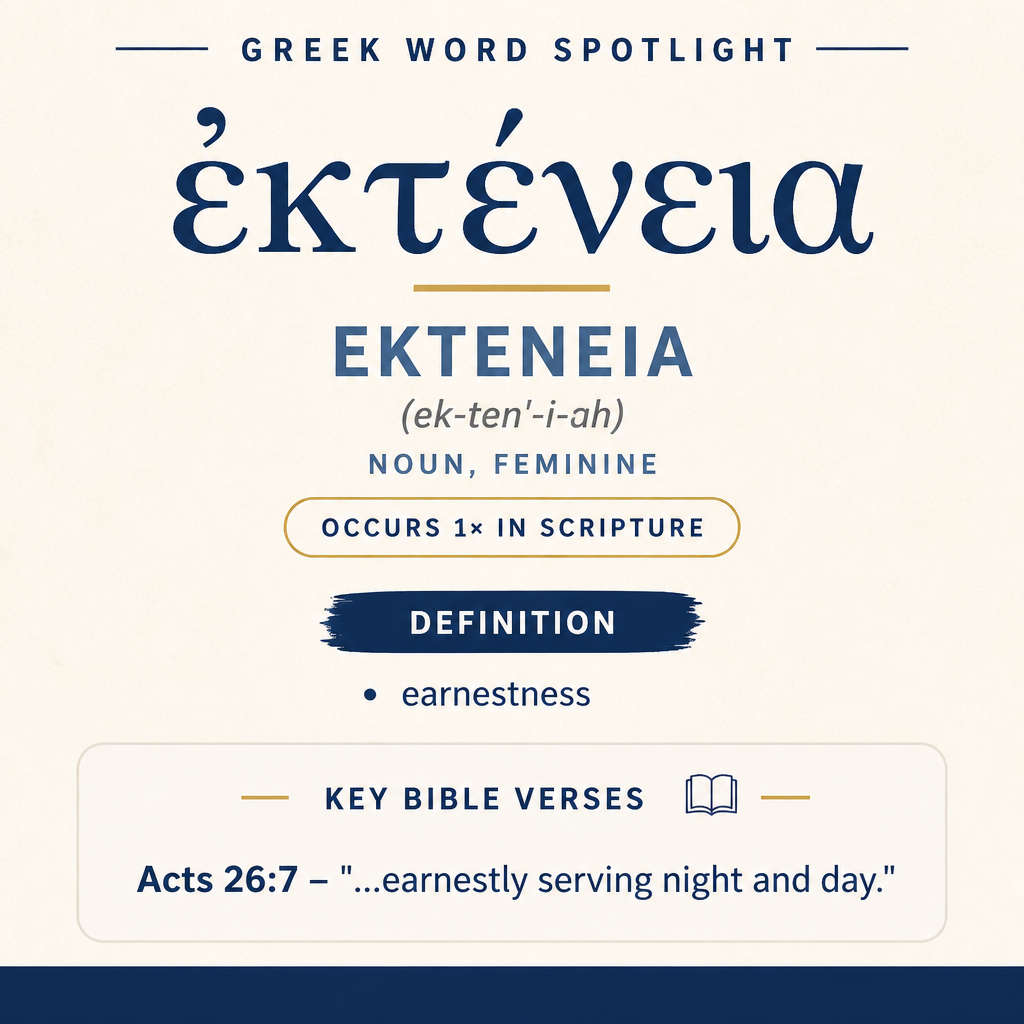
ἐκτένεια means “earnestness” and appears once in Scripture in Acts 26:7.
Context in Acts
In Acts 26:7, it describes the twelve tribes “earnestly serving night and day” in hope of attaining the promise.
Learn More →ἐκτένεια refers to earnestness. It appears once, in Paul’s defense speech before King Agrippa, where it describes the character of Israel’s ongoing religious service as they hold to a particular hope.
Root and Related Words
ἐκτένεια is derived from ἐκτενής (ektenēs), “fervent” (Strong’s G1618). The relationship points to a close conceptual link between a quality expressed as an adjective (fervent) and the corresponding noun that names the trait itself.

Occurrences
“which our twelve tribes, earnestly serving night and day, hope to attain. Concerning this hope I am accused by the Jews, King Agrippa!” (Acts 26:7)
Here ἐκτένεια stands within a compressed description of Israel’s long-standing posture: “our twelve tribes” are portrayed as a unified people whose service is not occasional but sustained—“night and day.” The word characterizes the manner of that service. Paul is not merely stating that the tribes serve; he selects language that portrays their service as marked by earnestness, a quality that fits the intensity implied by uninterrupted devotion (“night and day”).

In the sentence, the earnest service is directly linked to hope: the tribes are “earnestly serving night and day” as they “hope to attain.” The earnestness therefore functions as a descriptor of their active religious orientation toward a goal they are seeking. Paul then frames his own trial in relation to the same expectation: “Concerning this hope I am accused by the Jews, King Agrippa!” In this setting, ἐκτένεια helps Paul describe Israel’s collective pursuit as serious and persistent, and it sets a context in which his own position is presented as bound up with that shared, long-cherished hope.
The placement of ἐκτένεια also highlights a contrast within the narrative logic of the verse: the people are depicted as engaged in earnest service aimed at attaining hope, yet Paul says that in connection with that hope he is “accused.” The word thus contributes to the tension of the scene. Paul’s point depends on portraying the object of accusation as not novel or frivolous but situated within a pattern of earnest, continual devotion attributed to Israel as a whole.
Sense and Usage
The single attestation of ἐκτένεια in Acts 26:7 displays earnestness as an observable quality of action rather than a private feeling. The verse anchors the term in public, repeated practice: “serving night and day.” Earnestness here is not defined by an inner mood but by a way of serving that matches the long duration and steady rhythm expressed in the phrase “night and day.” The term therefore naturally aligns with actions that are ongoing, deliberate, and oriented toward an anticipated outcome (“hope to attain”).
Within Paul’s speech, earnestness also serves a rhetorical purpose. By speaking of “our twelve tribes” and pairing their service with the hope they seek, Paul presents the hope as belonging to the shared story and worship of Israel. ἐκτένεια sharpens that portrayal: the pursuit is described as serious enough to be carried on continuously. In that argumentative setting, earnestness functions as a verbal marker of weight and gravity—language suited to a matter that is significant enough to shape a people’s continual service.
The link to the related adjective ἐκτενής (“fervent”) helps clarify the kind of earnestness envisioned: earnestness that can be spoken of as a quality of someone’s conduct. Acts 26:7 does not isolate the quality; it embeds it in a participial description (“earnestly serving”), showing that ἐκτένεια is naturally used to qualify ongoing activity. Even in a single occurrence, the term’s usage demonstrates how earnestness can be expressed as the intensity and constancy of service directed toward a hoped-for attainment.
Imagery
The imagery carried by ἐκτένεια in Acts 26:7 is shaped by the time phrase “night and day.” The word calls up the picture of continual religious service sustained across the full cycle of time, as a people persist in worshipful action while holding to a hope they seek to reach.
Sources: Lexical data from Strong’s Exhaustive Concordance and the Translators Brief Lexicon of Extended Strongs for Greek (STEPBible, CC BY). Occurrence data from the Translators Amalgamated Greek New Testament (STEPBible, CC BY). Scripture quotations from the World English Bible (public domain).





