
Exploring the Meaning of Eite in Greek
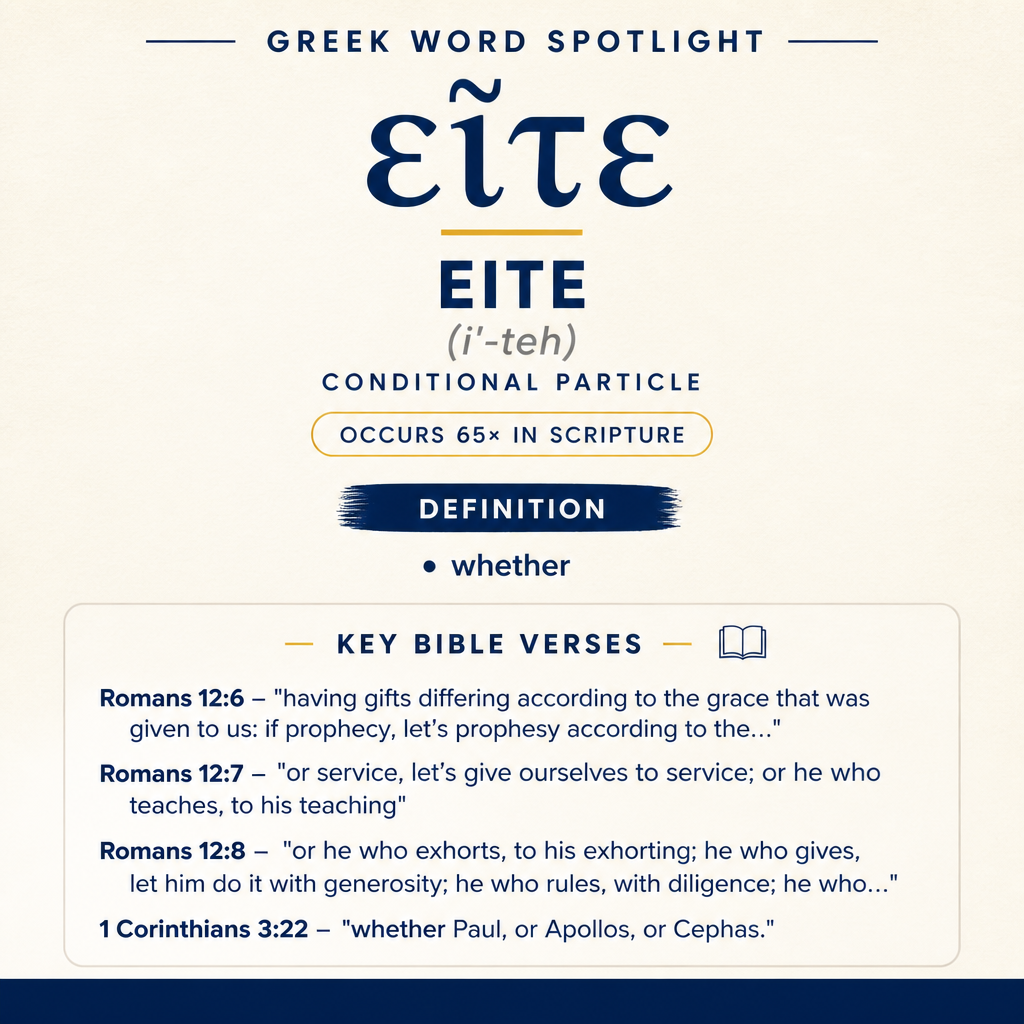
εἴτε means “whether” in Greek and occurs 65 times in Scripture, including Romans 12:6–8 and 1 Corinthians 3:22; 8:5; 10:31; 12:13, 26.
Core Meaning
εἴτε is defined as “whether.” It introduces alternatives in a statement.
Learn More →Scripture Examples
It appears in lists of alternatives such as “whether Paul, or Apollos, or Cephas” (1 Corinthians 3:22). It also frames comprehensive choices like “Whether therefore you eat, or drink” (1 Corinthians 10:31).
Learn More →Range of Contrast
Romans 12:6–8 uses εἴτε to move through differing gifts (“if prophecy… or service… or teaching”). In 1 Corinthians 12:13 it contrasts groups (“whether Jews or Greeks, whether bond or free”).
Learn More →εἴτε expresses an alternative (“whether”) and is used to frame choices, comparisons, or paired categories. In these passages it commonly widens a statement so that it holds true across multiple possible cases.
Occurrences
Romans 12:6: “having gifts differing according to the grace that was given to us: if prophecy, let’s prophesy according to the proportion of our faith;”
Here εἴτε introduces one possible gift within a set of varied gifts. The sentence sets up a conditional alternative: in the case that the gift is prophecy, the fitting response is to prophesy in a manner aligned with faith’s “proportion,” keeping the exhortation specific to that particular “whether” scenario.
Romans 12:7: “or service, let’s give ourselves to service; or he who teaches, to his teaching;”
In this line of instructions, εἴτε continues the pattern of alternatives. Each “whether” case (service; teaching) narrows the application to the corresponding activity, so that the community’s response matches the particular form grace takes in each person.
Romans 12:8: “or he who exhorts, to his exhorting; he who gives, let him do it with generosity; he who rules, with diligence; he who shows mercy, with cheerfulness.”
εἴτε sustains a chain of distinct options, mapping each role to an appropriate manner (generosity, diligence, cheerfulness). The particle’s force is not to blur the gifts together but to distribute fitting conduct across multiple possible callings: whether one exhorts, gives, rules, or shows mercy, the exhortation adjusts to that case.
1 Corinthians 3:22: “whether Paul, or Apollos, or Cephas, or the world, or life, or death, or things present, or things to come. All are yours,”
εἴτε functions expansively, stacking alternatives to sweep in a broad range of names and realities. By using “whether” repeatedly, the sentence claims that the statement “All are yours” is not restricted to one favored leader or one sphere of experience; it covers each item in the list, from apostles to “life” and “death” to “things present” and “things to come.”
1 Corinthians 8:5: “For though there are things that are called “gods”, whether in the heavens or on earth; as there are many “gods” and many “lords”;”
Here εἴτε divides the realm of so-called deities into locations: “in the heavens” and “on earth.” The particle frames the claim so that it encompasses both domains—whether the label is applied above or below, the observation about “things that are called ‘gods’” remains in view.
1 Corinthians 10:31: “Whether therefore you eat, or drink, or whatever you do, do all to the glory of God.”
εἴτε introduces everyday alternatives (“eat” or “drink”) and then extends to “whatever you do,” making the exhortation comprehensive. The particle helps show that ordinary acts are not exceptions: whether the action is as basic as eating or drinking—or anything else—the aim is unified (“to the glory of God”).
1 Corinthians 12:13: “For in one Spirit we were all baptized into one body, whether Jews or Greeks, whether bond or free; and were all given to drink into one Spirit.”
In a statement about unity, εἴτε pairs social and ethnic categories (“Jews or Greeks,” “bond or free”). The particle’s repeated “whether” marks these as alternative groupings that do not alter the central reality: baptism “into one body” and shared participation in “one Spirit” hold across each contrasted identity.
1 Corinthians 12:26: “When one member suffers, all the members suffer with it. When one member is honored, all the members rejoice with it.”
εἴτε frames two contrasting situations within the body: suffering and honor. The effect is to cover both emotional poles—whether the experience is pain or recognition, the response is corporate and shared, not isolated to the individual member.
1 Corinthians 13:8: “Love never fails. But where there are prophecies, they will be done away with. Where there are various languages, they will cease. Where there is knowledge, it will be done away with.”
Though the verse contrasts multiple phenomena with love’s permanence, εἴτε serves to coordinate alternatives implied by the repeated “Where there are…” clauses. The point is that the outcome does not depend on which impressive gift is in view—whether prophecies, languages, or knowledge—each is placed on the side of what ends, over against love’s unfailing character.
1 Corinthians 14:7: “Even things without life, giving a voice, whether pipe or harp, if they didn’t give a distinction in the sounds, how would it be known what is piped or harped?”
εἴτε introduces two instruments as alternatives (“pipe or harp”) to make an analogy about intelligibility and distinction. Whether the sound comes from one instrument or another, meaningful recognition requires “a distinction in the sounds”; the alternative reinforces that the principle applies across different sources of musical tone.
1 Corinthians 14:27: “If any man speaks in another language, let it be two, or at the most three, and in turn; and let one interpret.”
In regulating speech in another language, εἴτε supports the practical alternatives involved in orderly participation (a limited number of speakers; speaking “in turn”). The instructions are framed so that, whether there are two speakers or up to three, the orderly pattern and interpretation remain required.
1 Corinthians 15:11: “Whether then it is I or they, so we preach, and so you believed.”
εἴτε here minimizes rivalry and centers agreement in proclamation. Whether the preaching was done by the speaker (“I”) or by others (“they”), the content and result are treated as consistent: “so we preach, and so you believed.”

Sense and Usage
Across these passages, εἴτε regularly works as a linking particle that keeps a statement stable while the specific case varies. It can narrow an instruction to the appropriate circumstance (as with differing gifts in Romans 12), or it can broaden a claim so that no listed alternative escapes its scope (as with the wide-ranging inventory in 1 Corinthians 3:22). In ethical exhortation, it gathers ordinary actions into a single aim: the command in 1 Corinthians 10:31 is intentionally protected against loopholes by naming basic activities and then extending beyond them.
εἴτε also serves an important rhetorical role in unity and commonality. In 1 Corinthians 12:13 it places well-known divisions side by side as mere alternatives—real distinctions, yet not determinative for belonging to “one body.” In 1 Corinthians 15:11 it levels the messenger question (“I or they”) so that attention falls on the shared proclamation and the community’s shared believing. Even in the analogy of instruments (1 Corinthians 14:7), “whether pipe or harp” carries the same logic: the principle being argued does not change when the example changes.
Finally, εἴτε can cover contrasting outcomes, not just parallel options. In 1 Corinthians 12:26, the alternatives are not two similar categories but two opposite experiences (suffering; honor). The particle helps state that communal solidarity holds at both extremes: whether the body is in grief or in celebration, the response is collective.
Imagery
Several occurrences set εἴτε in vivid lists that feel almost panoramic: named leaders and the sweep from “life” to “death” to “things present” and “things to come” (1 Corinthians 3:22), the heights and depths of “the heavens” and “on earth” (1 Corinthians 8:5), and the simple table-scene of eating and drinking (1 Corinthians 10:31). In these contexts, “whether” acts like a verbal hinge, turning the reader from one scene to the next while holding the main claim steady over them all.
Sources: Lexical data from Strong’s Exhaustive Concordance and the Translators Brief Lexicon of Extended Strongs for Greek (STEPBible, CC BY). Occurrence data from the Translators Amalgamated Greek New Testament (STEPBible, CC BY). Scripture quotations from the World English Bible (public domain).





