
Exploring the Meaning of Eisodos in Greek
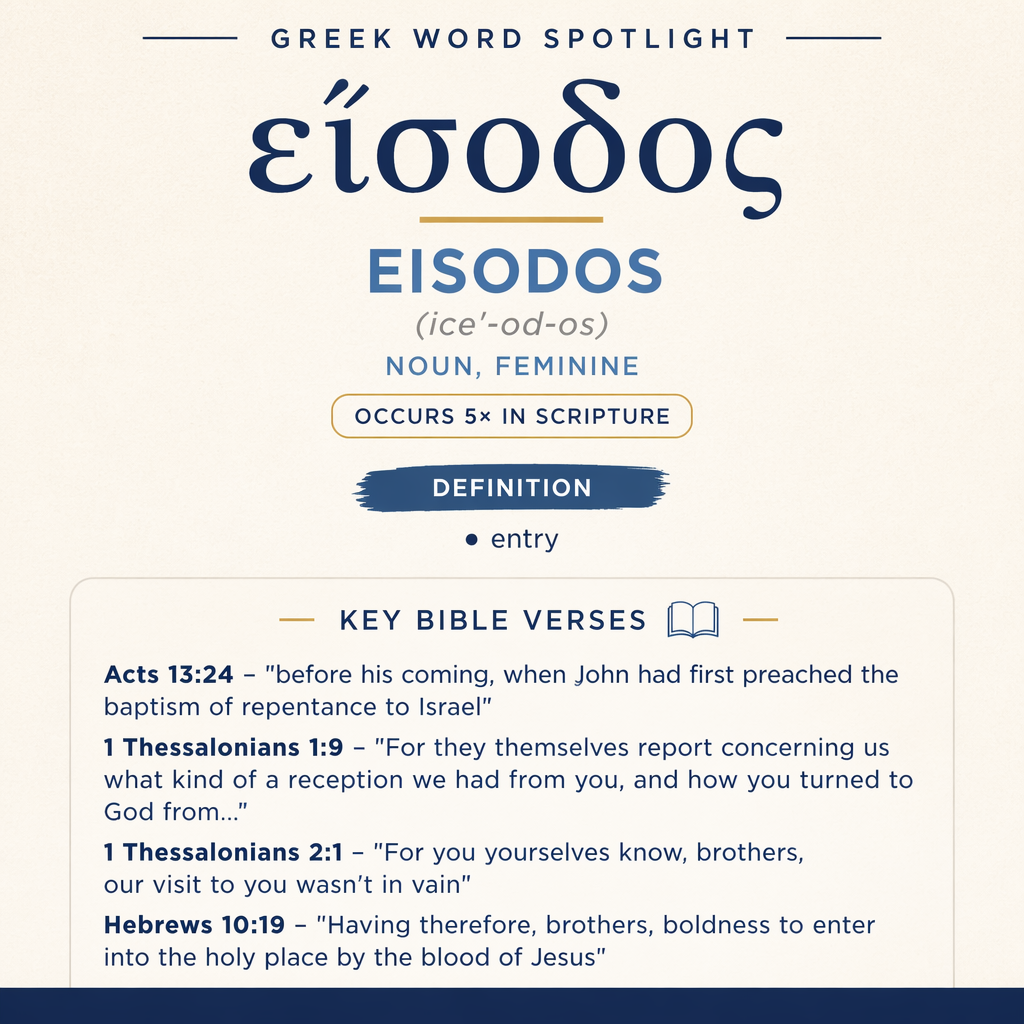
εἴσοδος means “entry” and occurs five times in Scripture: Acts 13:24; 1 Thessalonians 1:9; 2:1; Hebrews 10:19; 2 Peter 1:11.
Core Meaning
εἴσοδος is defined as “entry.” In its listed passages, it refers to entry or entrance in various contexts.
Learn More →New Testament Occurrences
It appears 5 times: Acts 13:24; 1 Thessalonians 1:9 and 2:1; Hebrews 10:19; 2 Peter 1:11. These references include both narrative and epistolary settings.
Learn More →Context Highlights
Hebrews 10:19 speaks of boldness to enter the holy place by Jesus’ blood. 2 Peter 1:11 describes an entrance into the eternal Kingdom of Jesus Christ.
Learn More →εἴσοδος means “entry,” and in the New Testament it appears in settings that range from a person’s coming, to an apostolic visit, to access into sacred space, and finally to the future entrance into the eternal Kingdom. The passages where it occurs show how a single word for entry can describe both ordinary movement and weighty, covenantal access.
Root and Related Words
εἴσοδος (Eisodos) is connected with εἰς (eis), “toward” (Strong’s G1519), and ὁδός (hodos), “road” (Strong’s G3598). In these related terms, the idea of motion “toward” a destination and the notion of a “road” provide a natural linguistic frame for speaking about entry as arrival into a place or sphere.

Occurrences
Acts 13:24 — “before his coming, when John had first preached the baptism of repentance to Israel.”
Here εἴσοδος is tied to “his coming” and is placed within a sequence: first John preached “the baptism of repentance,” and this preaching was directed “to Israel.” The word “entry” (rendered as “coming” in this line) contributes the idea of an arrival that stands at the end of preparation. The scene frames entry not as a casual appearance but as an event preceded by public proclamation and moral turning, giving the “entry” a sense of being anticipated and prepared for.
1 Thessalonians 1:9 — “For they themselves report concerning us what kind of a reception we had from you, and how you turned to God from idols, to serve a living and true God,”
In this testimony about the Thessalonian believers, εἴσοδος is bound up with “what kind of a reception we had from you.” “Entry” is presented through the lens of welcome and response: the Thessalonians’ turning “to God from idols” is narrated in the same breath as the report of the missionaries’ reception. The word thus helps depict entry as relational and communal—an arrival that is evaluated by how it was received and by what it set in motion among those who heard.
1 Thessalonians 2:1 — “For you yourselves know, brothers, our visit to you wasn’t in vain,”
Here εἴσοδος is expressed as “our visit to you,” and the emphasis falls on its outcome: it “wasn’t in vain.” The “entry” is not only the act of coming in but the significance of that coming. By linking entry with effectiveness (“wasn’t in vain”), the verse treats entry as something that can be assessed for fruitfulness, not merely recorded as travel. The word’s contribution is to mark the apostolic arrival as a meaningful moment whose value is known by the community addressed (“you yourselves know”).
Hebrews 10:19 — “Having therefore, brothers, boldness to enter into the holy place by the blood of Jesus,”
In Hebrews, εἴσοδος appears as “to enter into the holy place,” and the statement is shaped by two strong features: “boldness” and “by the blood of Jesus.” Entry here is not simply spatial movement; it is access granted under a stated basis. The “holy place” is presented as a destination that would require authorization, and the verse speaks of confidence to enter rather than hesitation. εἴσοδος contributes the concrete notion of crossing a threshold into sacred space, while the surrounding language locates that entry within worship and priestly imagery where access itself is the point.
2 Peter 1:11 — “For thus you will be richly supplied with the entrance into the eternal Kingdom of our Lord and Savior, Jesus Christ.”
In this promise, εἴσοδος is “the entrance into the eternal Kingdom,” and it is described as something “richly supplied.” Entry is portrayed as a bestowed provision, not a bare arrival. The destination is not a building or a room but a reign—“the eternal Kingdom of our Lord and Savior, Jesus Christ.” The word therefore carries the force of admission into an enduring realm, with the language of abundance (“richly supplied”) underscoring that this entry is generous and secure rather than minimal or precarious.
Sense and Usage
Across these passages, εἴσοδος consistently names “entry” while flexing to fit distinct contexts. In Acts 13:24, the word is linked with public preparation and expectation: entry stands at the culmination of repentance-preaching directed to a people. In 1 Thessalonians 1:9 and 2:1, entry is social and evaluative: it can be received in a certain way, reported by others, and judged to be empty or effective. The term is therefore able to carry the idea of entry as an event that leaves traces—memories of welcome, reports circulating, and outcomes that communities can recognize.
Hebrews 10:19 and 2 Peter 1:11 place εἴσοδος in settings where entry involves access to a sphere that is not automatically open. In Hebrews, the destination is “the holy place,” and the verse focuses on the confidence to enter grounded in “the blood of Jesus.” Entry is pictured as a movement into sacred proximity, and its defining feature is that it is approached with “boldness.” In 2 Peter, the destination is “the eternal Kingdom,” and the defining feature is that the entrance is “richly supplied.” In both texts, εἴσοδος describes entry as a granted passage into a realm of holiness or permanence, with the accompanying language emphasizing the security and generosity surrounding that passage.
Taken together, the occurrences show that εἴσοδος can speak of entry in at least two overlapping ways while remaining within the same basic notion of entering. First, it can denote arrival among people, where entry is measured by reception and effect. Second, it can denote access into a sacred or eschatological sphere, where entry is marked by confidence and provision. In every case, εἴσοδος points to the threshold moment—coming in—while the immediate context supplies what kind of threshold it is: an anticipated coming, a welcomed visit, an approach to holy space, or admission to an eternal Kingdom.
Imagery
The imagery of εἴσοδος in these verses repeatedly turns on thresholds and destinations. The word can evoke a prepared arrival (“before his coming”), the opening of a community’s doors (“what kind of a reception we had from you”), and the evaluation of what an entry accomplished (“our visit to you wasn’t in vain”). It can also depict a more awe-filled approach: entry “into the holy place,” and entry “into the eternal Kingdom.” In these scenes, εἴσοδος gathers the ordinary act of entering into a single term that can bear the weight of welcome, access, and the crossing into places defined by holiness and eternity.
Sources: Lexical data from Strong’s Exhaustive Concordance and the Translators Brief Lexicon of Extended Strongs for Greek (STEPBible, CC BY). Occurrence data from the Translators Amalgamated Greek New Testament (STEPBible, CC BY). Scripture quotations from the World English Bible (public domain).





