
Exploring the Meaning of Eisago in Greek
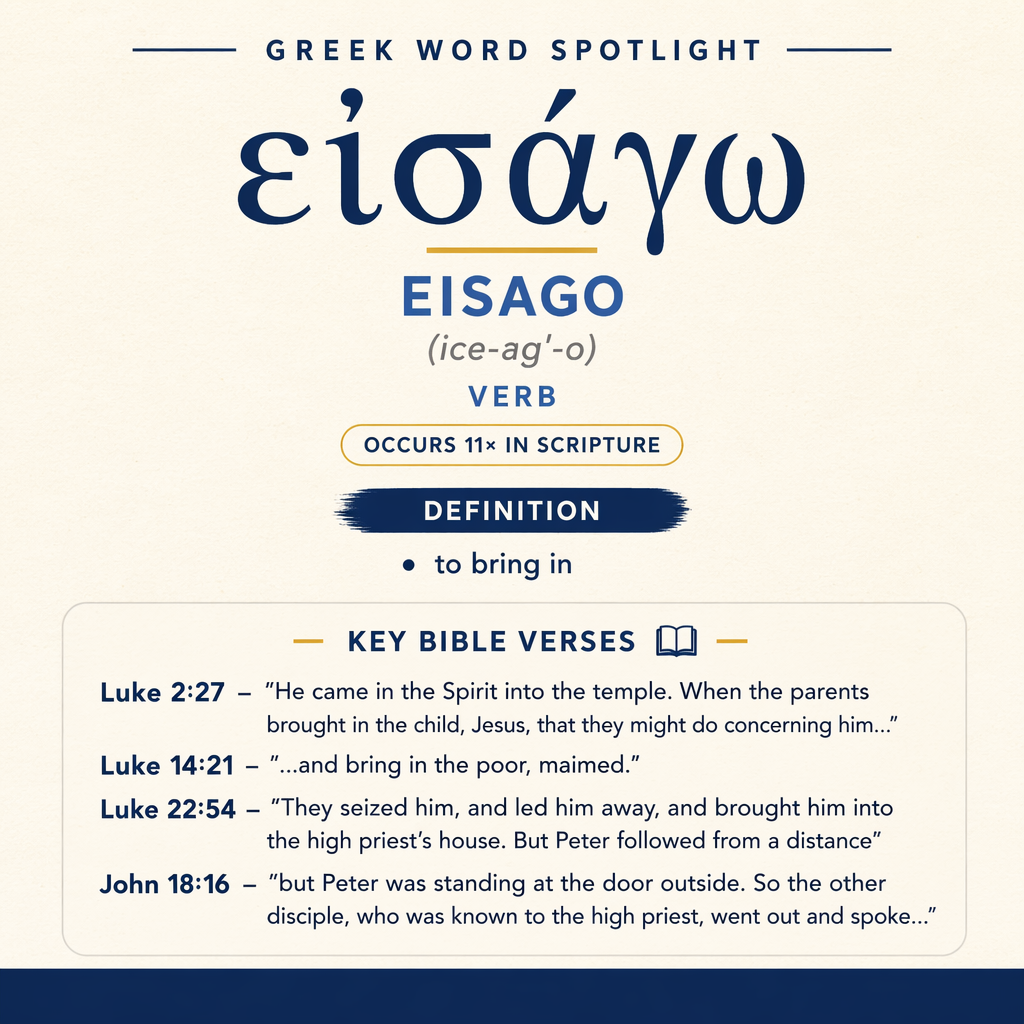
εἰσάγω (Eisago) means “to bring in” and occurs 11 times in Scripture, including Luke, John, and Acts.
Core Meaning
εἰσάγω means “to bring in.” It describes bringing a person into a place, such as a temple or a house.
Learn More →Luke Scenes
In Luke 2:27, the parents brought in the child Jesus into the temple. In Luke 22:54, Jesus was brought into the high priest’s house.
Learn More →Acts Contexts
In Acts 9:8, Saul was led by the hand and brought into Damascus. In Acts 21:29, Paul was supposed to have brought Trophimus into the temple.
Learn More →εἰσάγω expresses the act of bringing someone or something in, with the motion and result of entry into a defined space. In the passages where it appears, the verb repeatedly marks a crossing of boundaries—into a temple, a house, a city, a barracks, or even “the world.”
Occurrences
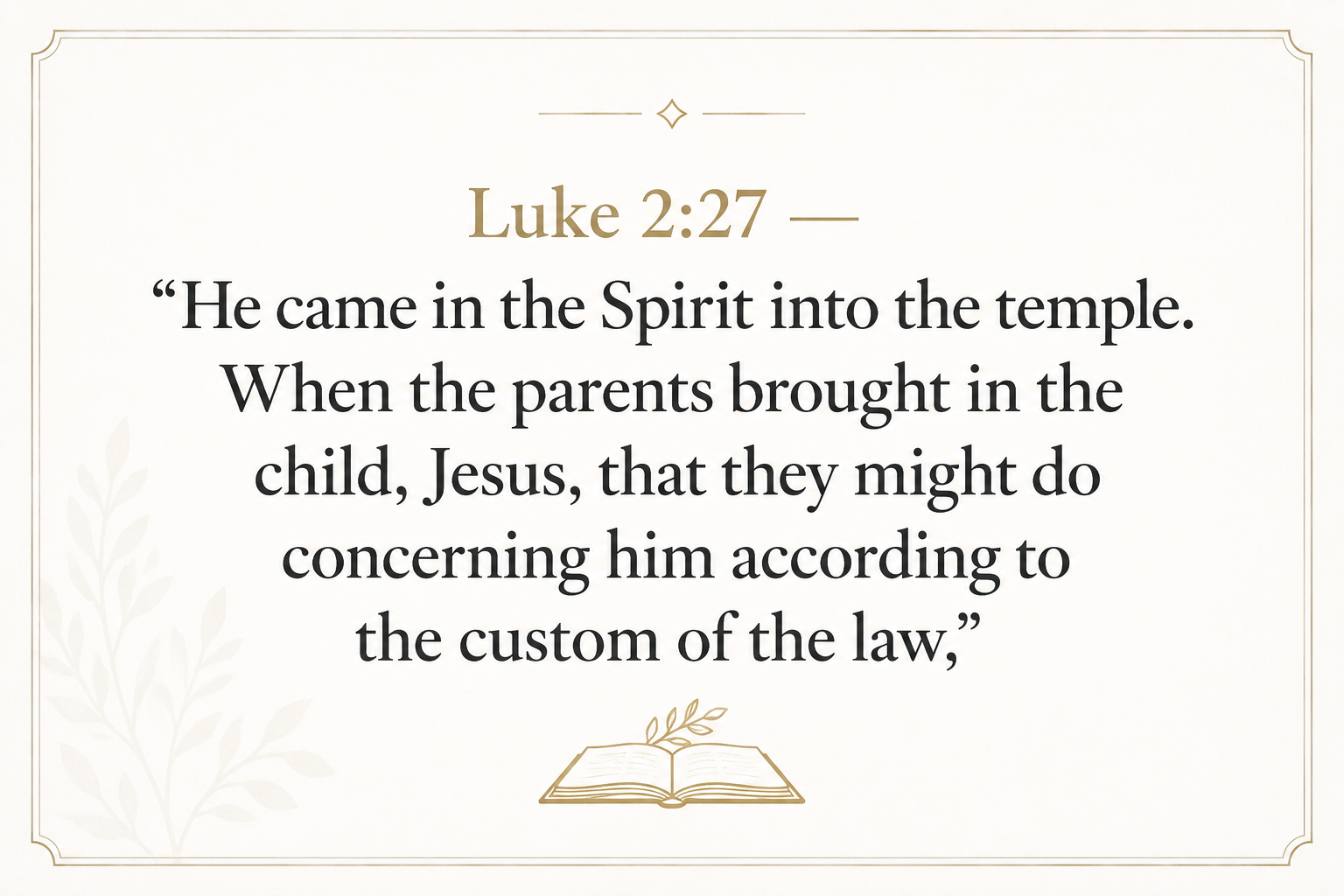
Luke 2:27 — “He came in the Spirit into the temple. When the parents brought in the child, Jesus, that they might do concerning him according to the custom of the law,”
Here εἰσάγω locates the child’s movement into the temple precincts. The parents are the agents of the bringing, and the purpose clause (“that they might do…according to the custom of the law”) frames the entry as ordered and lawful: the verb marks the concrete step that makes the temple encounter possible.
Luke 14:21 — “That servant came, and told his lord these things. Then the master of the house, being angry, said to his servant, ‘Go out quickly into the streets and lanes of the city, and bring in the poor, maimed, blind, and lame.’”
In this household scene, εἰσάγω is the hinge between outside and inside. The servant is told to go out “into the streets and lanes of the city” and then to bring in persons described by their need. The verb therefore carries the force of gathering from public spaces and ushering into the master’s house, changing their location and status relative to the meal.
Luke 22:54 — “They seized him, and led him away, and brought him into the high priest’s house. But Peter followed from a distance.”
εἰσάγω accompanies arrest and custody. The sequence is tight: “seized,” “led…away,” and then “brought…into the high priest’s house.” The verb spotlights the moment Jesus is moved from public space into a controlled, authoritative interior, while Peter’s distant following highlights the contrast between being brought in and remaining outside the center of events.
John 18:16 — “but Peter was standing at the door outside. So the other disciple, who was known to the high priest, went out and spoke to her who kept the door, and brought in Peter.”
Here εἰσάγω resolves a barrier at “the door outside.” Peter’s position is explicitly outside, and entry requires mediation: the known disciple speaks to the gatekeeper and then “brought in Peter.” The verb underscores access granted through relationship and permission, turning a closed threshold into an opened one.
Acts 7:45 — “which also our fathers, in their turn, brought in with Joshua when they entered into the possession of the nations, whom God drove out before the face of our fathers, to the days of David,”
In Stephen’s retelling, εἰσάγω is used for the bringing-in of something by “our fathers…with Joshua” during entry into the land. The verb portrays transport and introduction as part of a larger movement of taking possession, extending beyond a single doorway to the establishment of something within a new territory over a long span (“to the days of David”).
Acts 9:8 — “Saul arose from the ground, and when his eyes were opened, he saw no one. They led him by the hand, and brought him into Damascus.”
εἰσάγω here is paired with Saul’s helplessness: his eyes are open yet he “saw no one,” so others “led him by the hand.” The verb marks his entry into Damascus as an assisted bringing-in, emphasizing dependence and guidance rather than self-directed arrival.
Acts 21:28 — “crying out, ‘Men of Israel, help! This is the man who teaches all men everywhere against the people, and the law, and this place. Moreover, he also brought Greeks into the temple, and has defiled this holy place!’”
In the accusation against Paul, εἰσάγω is loaded with boundary violation. The alleged act is bringing “Greeks into the temple,” and the claim draws its sting from the temple’s sanctity (“this holy place”) and the resulting charge of defilement. The verb pinpoints the decisive action: causing outsiders to cross into a space understood as restricted.
Acts 21:29 — “For they had seen Trophimus, the Ephesian, with him in the city, and they supposed that Paul had brought him into the temple.”
This verse explains how the charge was formed: they saw Trophimus “with him in the city” and from that inferred an entry “into the temple.” εἰσάγω marks the imagined transition from city space to temple space. The verb’s significance lies in the supposed movement across a line that, in their minds, should not be crossed.
Acts 21:37 — “As Paul was about to be brought into the barracks, he asked the commanding officer, ‘May I speak to you?’ He said, ‘Do you know Greek?”
εἰσάγω here depicts Paul under military control, on the verge of being taken “into the barracks.” The impending entry provides the setting for the brief exchange with the commanding officer; the verb frames the moment as a transition into a guarded interior where custody and procedure will intensify.
Acts 22:24 — “the commanding officer commanded him to be brought into the barracks, ordering him to be examined by scourging, that he might know for what crime they shouted against him like that.”
In this continuation, εἰσάγω belongs to official command: the officer orders Paul to be brought inside “into the barracks” for examination. The verb functions as the procedural step that places Paul within the space where interrogation can occur, linking entry with investigative intent (“that he might know for what crime…”).
Hebrews 1:6 — “When he again brings in the firstborn into the world he says, “Let all the angels of God worship him.””
εἰσάγω is used on the largest stage here: bringing “the firstborn into the world.” The verb still retains its directional sense—causing entry—but the destination is “the world” rather than a building. The bringing-in triggers a response: the quoted command for angelic worship, so the verb introduces a scene in which arrival is met with acknowledgment and honor.

Sense and Usage
Across these contexts, εἰσάγω consistently presents entry as something effected by an agent: parents bring in a child; a servant is commanded to bring in guests; captors bring a prisoner into a house; a disciple brings in another disciple; companions bring Saul into a city; authorities arrange for Paul to be brought into military quarters; God brings in the firstborn into the world. The verb’s contribution is not merely motion toward a place, but the completion of movement into an “inside,” whether that inside is architectural (temple, house, barracks), civic (a city), territorial (possession of the nations), or cosmic (“the world”).
The verb is especially vivid where boundaries are foregrounded. John 18:16 places Peter “at the door outside,” then portrays entry as dependent on access granted through a mediator who can speak to the gatekeeper. Luke 14:21 contrasts “streets and lanes” with the implied interior of the master’s house; the command to bring in makes inclusion tangible, relocating those on the margins into a space prepared for them. Acts 21:28–29 highlights how bringing into the temple is perceived as a decisive act with communal implications, because it redefines who is present within a holy boundary. In these scenes, εἰσάγω is the verb of threshold-crossing.
Other occurrences show entry as an aspect of custody and control. Luke 22:54, Acts 21:37, and Acts 22:24 all place the brought-in person under someone else’s power; the subject is moved into a place associated with authority (high priest’s house, barracks). Acts 9:8 adds a different shade: Saul is brought in not as a captive of hostile authorities in that moment, but as a person unable to navigate independently; being led by the hand and brought into Damascus makes his vulnerability concrete. Even when the destination is expansive (Acts 7:45; Hebrews 1:6), the verb still signals introduction into a new sphere—bringing something into a land, bringing the firstborn into the world—so that what was formerly outside becomes present within a defined realm.
Imagery
The repeated pattern of bringing in gives these passages a strong spatial feel: doors, houses, temple courts, city gates, and military quarters all become places where entry is either granted, commanded, alleged, or enforced. εἰσάγω often marks the turning point where circumstances change because someone is now inside—welcomed to a meal, placed under interrogation, included in worship, or drawn into the center of a public dispute.
Sources: Lexical data from Strong’s Exhaustive Concordance and the Translators Brief Lexicon of Extended Strongs for Greek (STEPBible, CC BY). Occurrence data from the Translators Amalgamated Greek New Testament (STEPBible, CC BY). Scripture quotations from the World English Bible (public domain).





