
Exploring the Meaning of Heilikrineia in Greek
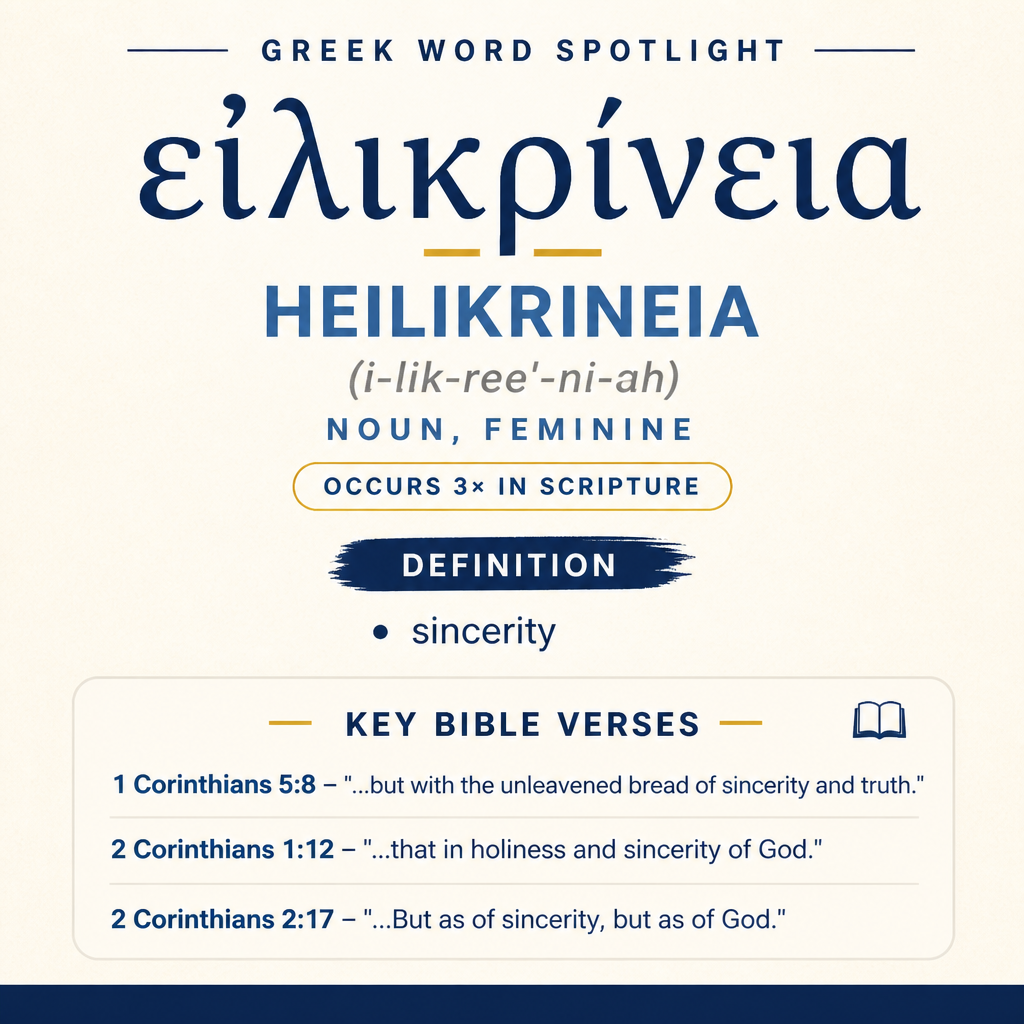
εἰλικρίνεια means “sincerity” and appears three times in Scripture: 1 Corinthians 5:8; 2 Corinthians 1:12; 2 Corinthians 2:17.
Scripture Occurrences
It occurs 3 times in Scripture: 1 Corinthians 5:8; 2 Corinthians 1:12; and 2 Corinthians 2:17.
Learn More →Context Snapshots
In 1 Corinthians 5:8 it contrasts with “old yeast” and “malice and wickedness.” In 2 Corinthians it appears with “holiness,” and in contrast to “peddling the word of God.”
Learn More →εἰλικρίνεια means “sincerity,” and it appears in three Pauline contexts that contrast genuine moral and spiritual integrity with corrupting influences and manipulative speech. In these passages it functions as a quality that marks both communal life and apostolic conduct as transparently aligned with God.
Root and Related Words
εἰλικρίνεια (Heilikrineia) is related to the adjective εἰλικρινής (eilikrines), “pure” (Strong’s G1506). The noun expresses the corresponding quality as an identifiable trait or manner.

Occurrences
“Therefore let’s keep the feast, not with old yeast, neither with the yeast of malice and wickedness, but with the unleavened bread of sincerity and truth.” (1 Corinthians 5:8)
Here εἰλικρίνεια is placed in a vivid contrast framed by food imagery: “old yeast” and “the yeast of malice and wickedness” versus “the unleavened bread of sincerity and truth.” Within the sentence, sincerity is not an isolated virtue but part of what makes the feast fitting to keep; it belongs to what is “unleavened,” a way of life not permeated by the corrupting agents named in the verse. The pairing “sincerity and truth” sets sincerity alongside a second quality, so that the community’s celebration is pictured as constituted by these two ingredients. The verse treats sincerity as something that should characterize the whole communal act (“let’s keep the feast”), not merely private intention.

“For our boasting is this: the testimony of our conscience, that in holiness and sincerity of God, not in fleshly wisdom but in the grace of God we behaved ourselves in the world, and more abundantly toward you.” (2 Corinthians 1:12)
In this defense of conduct, εἰλικρίνεια appears in a cluster of terms that describe the manner of apostolic behavior: “in holiness and sincerity of God,” contrasted with “fleshly wisdom,” and aligned with “the grace of God.” Sincerity is thus presented as an element of moral credibility, something the writers can point to as “the testimony of our conscience.” The phrase “sincerity of God” anchors the quality in relation to God, and the contrast with “fleshly wisdom” implies that sincerity is not a strategic posture. It belongs to how they “behaved ourselves in the world,” and it is intensified relationally—“more abundantly toward you”—so the word carries a social dimension: sincerity is not only inward alignment but also outwardly consistent dealing with others, especially the recipients.
“For we are not as so many, peddling the word of God. But as of sincerity, but as of God, in the sight of God, we speak in Christ.” (2 Corinthians 2:17)
In this statement about speech and motive, εἰλικρίνεια functions as the opposite of “peddling the word of God.” The contrast is sharp: some are characterized by commercialized handling of the message, whereas the speakers present themselves “as of sincerity.” The verse then stacks related phrases—“but as of God, in the sight of God”—so that sincerity is framed as operating under divine reference and divine scrutiny. In this setting, sincerity is not merely personal candor; it is the manner in which one “speak[s] in Christ,” presented as consistent with speaking before God rather than for gain. The repetition of “but as…” gives the line a measured insistence: sincerity is part of the proper stance from which Christian proclamation proceeds.
Sense and Usage
Across these three occurrences, εἰλικρίνεια (“sincerity”) is a quality with public consequences: it is something that can be contrasted, tested, and observed in communal life, personal conduct, and ministerial speech. In 1 Corinthians 5:8, sincerity belongs to the “unleavened bread” that replaces the permeating power of “malice and wickedness.” The word thereby functions as a marker of moral purity in the shared life of the church, fitting the communal “feast” with a corresponding moral reality. Sincerity is pictured as a kind of moral ingredient that cannot coexist with the “yeast” named in the verse, because yeast works through the whole batch; the image implies that sincerity, too, is meant to characterize the whole.
In 2 Corinthians 1:12, sincerity is bound to accountability and self-attestation: it belongs to the “testimony of our conscience.” The term is paired with “holiness” and set against “fleshly wisdom,” which places sincerity in the realm of moral and spiritual authenticity rather than clever self-presentation. The verse also links sincerity with both divine and human arenas—“we behaved ourselves in the world, and more abundantly toward you”—suggesting that sincerity is consistent across contexts: it does not shift with audience, and it does not depend on circumstances. It is a stable manner of life that can be appealed to as a ground of “boasting,” not as self-exaltation in the abstract, but as a defense of integrity.
In 2 Corinthians 2:17, sincerity is specifically the manner of speaking the word of God. Because the verse contrasts it with “peddling,” sincerity is implicitly connected with freedom from manipulative motives. The phrase “in the sight of God” intensifies the setting: sincerity is what remains when speech is carried out as under God’s gaze. It is also placed alongside “as of God” and “we speak in Christ,” giving sincerity a theological orientation: it is the appropriate condition for speech that claims to be from God and in Christ. In this way, sincerity functions as a criterion for faithful ministry, distinguishing proclamation shaped by Godward accountability from proclamation distorted by self-interest.
Taken together, these passages show sincerity as a quality that stands in contrast to corruption (“malice and wickedness”), to self-derived calculation (“fleshly wisdom”), and to exploitation (“peddling”). It is portrayed as compatible with holiness, grace, truth, and Godward accountability. The term therefore carries the sense of genuineness that is not merely internal feeling but is expressed in actions (“we behaved ourselves”) and communication (“we speak”), and it is envisioned as something that can be recognized in the texture of a community’s life and the credibility of its leaders.
Imagery in Context
The strongest concrete picture attached to εἰλικρίνεια is the table image of “unleavened bread” in 1 Corinthians 5:8: sincerity is something a community is to “keep” with, as though it were part of what is set out and shared. In 2 Corinthians, the imagery shifts from the table to the courtroom of conscience and the public square of proclamation: sincerity is what endures when conduct is examined (“the testimony of our conscience”) and when speech is weighed “in the sight of God.”
Sources: Lexical data from Strong’s Exhaustive Concordance and the Translators Brief Lexicon of Extended Strongs for Greek (STEPBible, CC BY). Occurrence data from the Translators Amalgamated Greek New Testament (STEPBible, CC BY). Scripture quotations from the World English Bible (public domain).




