Exploring the Meaning of Eidoleion in Greek
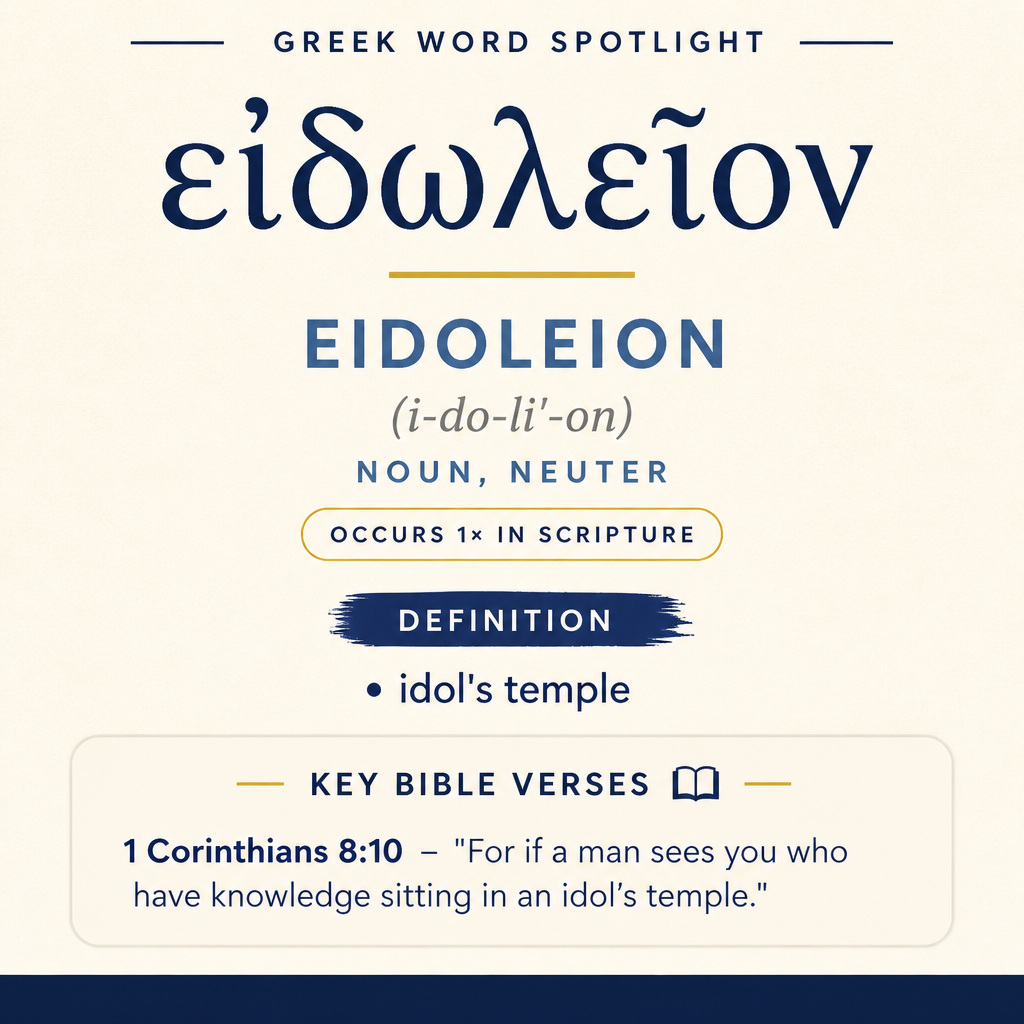
εἰδωλεῖον means “idol’s temple” and appears once in Scripture in 1 Corinthians 8:10.
Verse Context
In 1 Corinthians 8:10, it refers to someone sitting in an idol’s temple, affecting a weak conscience.
Learn More →εἰδωλεῖον means “idol’s temple” and appears in a single New Testament passage addressing the practical pressures surrounding idol-offerings. The word points to a particular setting—an identifiable place—where social participation and religious associations meet.
Root and Related Words
εἰδωλεῖον is derived from eidolon (εἴδωλον), “idol” (Strong’s G1497). The related noun supplies the conceptual center: the place named by εἰδωλεῖον is defined in relation to an idol.

Occurrences
“For if a man sees you who have knowledge sitting in an idol’s temple, won’t his conscience, if he is weak, be emboldened to eat things sacrificed to idols?” (1 Corinthians 8:10)
Here εἰδωλεῖον identifies the location in which the observed behavior occurs: “sitting in an idol’s temple.” The term does more than provide scenery; it marks the act as taking place within a venue publicly linked to idols, a venue that can be entered, occupied, and seen by others. Because the sentence hinges on what “a man sees,” the word carries the force of social visibility: the setting is not private, and the presence of someone “who have knowledge” is open to observation.

The verse’s logic depends on the contrast between the observer’s “weak” conscience and the observed person’s “knowledge.” εἰδωλεῖον functions as the flashpoint where that contrast becomes ethically significant. The man’s conscience is “emboldened” not simply by hearing an argument, but by seeing a concrete example enacted in a charged place. The temple-setting makes the example persuasive; it frames the act of eating as compatible—at least in appearance—with what the temple represents. Thus εἰδωλεῖον contributes an atmosphere of religious association that intensifies imitation: the weak person is moved toward eating “things sacrificed to idols” because the meal is imagined in continuity with the idol-linked environment.
The syntax also shows how the place interacts with the action. The key action is “sitting,” an image of settled participation rather than a brief pass-through. By pairing “sitting” with “in an idol’s temple,” the verse depicts a posture of comfort in that setting—an ease that can be interpreted by a watcher as approval, permission, or harmlessness. εἰδωλεῖον therefore helps explain why the watcher’s conscience responds so strongly: the location is the sort of place where eating idol-sacrificed food would be expected, and the observed person’s presence there can be taken as endorsement.
Sense and Usage
The definition “idol’s temple” is spatial and concrete: it names a physical locus connected with idols. In 1 Corinthians 8:10, that concreteness matters because the argument is built on an everyday scene that could plausibly unfold in community life—someone recognizes a fellow believer (“you who have knowledge”) and observes them seated inside such a place. The word serves to locate the scenario precisely, anchoring the ethical question in a recognizable venue rather than in a vague concept of idolatry.
Because εἰδωλεῖον denotes a temple, it implies a setting with established associations, expectations, and meanings—especially for onlookers. The verse does not describe what the building looks like or how it is used in detail, but it does show what the place does rhetorically: it shapes perception. A weak conscience becomes “emboldened” when it sees conduct enacted within this environment. The place-name helps the reader understand why the same act (eating) could carry different weight depending on where it occurs. In ordinary contexts, eating may appear morally neutral; inside an idol’s temple, eating readily appears to be bound up with the idol framework that the temple evokes.
εἰδωλεῖον also functions as a boundary-marker. The sentence imagines a person crossing into and remaining within an idol-associated space. The moral pressure in the verse is not abstract; it arises because the knowledgeable person’s freedom is exercised in a location that can easily be read as religious participation. In this way, the term highlights how place can communicate meaning apart from spoken explanation. The observed person may have reasons for their behavior, but what the weak person “sees” is a simple picture: someone with recognized “knowledge” is comfortably seated in an idol’s temple. εἰδωλεῖον names the element of the picture that carries the strongest religious signal.
Additionally, εἰδωλεῖον provides the connective tissue between two ideas in the verse: (1) the visible setting (“in an idol’s temple”) and (2) the consequent action (“eat things sacrificed to idols”). The conscience is emboldened toward a specific kind of eating—food tied to idols—and the temple setting helps explain the direction of that emboldening. The scene implies a natural pathway: presence in an idol’s temple normalizes, in the observer’s mind, consuming idol-connected food. The word thus supports the passage’s warning about influence: what is done in a religiously marked place can strengthen another person’s resolve to follow, even if their conscience is “weak.”
Imagery
The imagery of εἰδωλεῖον in 1 Corinthians 8:10 is that of a public interior where one can be seen “sitting” and where the setting itself communicates allegiance or permission. The term evokes the tension between outward participation in a temple space and the inward dynamics of conscience: a single visible scene inside an idol’s temple becomes the catalyst by which a weak conscience is “emboldened” toward eating what has been sacrificed to idols.
Sources: Lexical data from Strong’s Exhaustive Concordance and the Translators Brief Lexicon of Extended Strongs for Greek (STEPBible, CC BY). Occurrence data from the Translators Amalgamated Greek New Testament (STEPBible, CC BY). Scripture quotations from the World English Bible (public domain).