Exploring the Meaning of Eidos in Greek
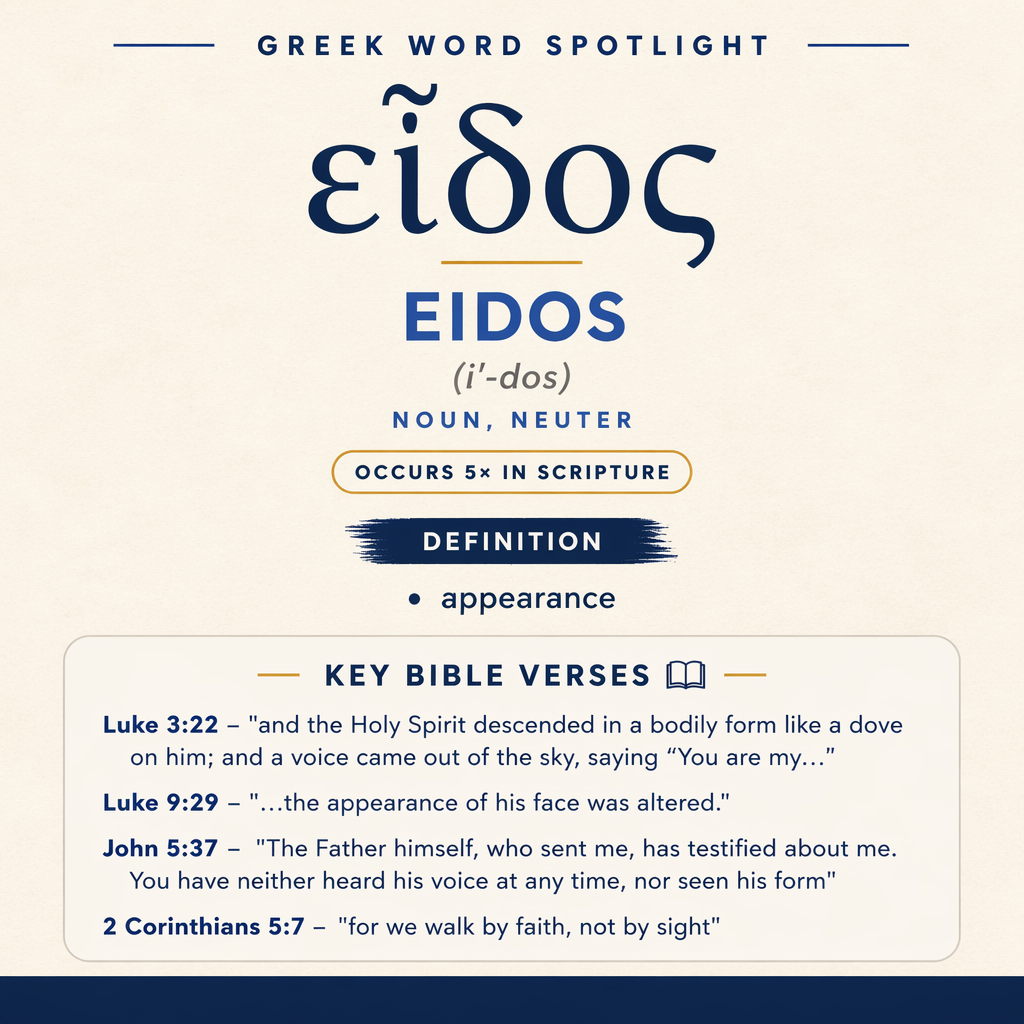
εἶδος (Eidos) means “appearance” and occurs five times in Scripture: Luke 3:22; Luke 9:29; John 5:37; 2 Corinthians 5:7; 1 Thessalonians 5:22.
Core Meaning
εἶδος is defined as “appearance.” It is used for what is seen or presented as a form.
Learn More →Gospel Occurrences
In Luke 3:22 it describes the Spirit’s descent “in a bodily form,” and in Luke 9:29 the altered appearance of Jesus’ face. In John 5:37 it refers to the Father’s “form.”
Learn More →Epistle Usage
In 2 Corinthians 5:7 it appears in the statement, “we walk by faith, not by sight.” In 1 Thessalonians 5:22 it is used in “every form of evil.”
Learn More →εἶδος speaks of “appearance,” a word used in the New Testament for what is presented to perception in a given moment. It appears in scenes ranging from the Spirit’s descent at Jesus’ baptism to moral instruction about avoiding evil in whatever guise it comes.
Root and Related Words
εἶδος is connected with eido (εἴδω), “to perceive: understand” (Strong’s G1492). The link highlights the close relationship between what is perceived and the “appearance” that meets the perceiver.

Occurrences
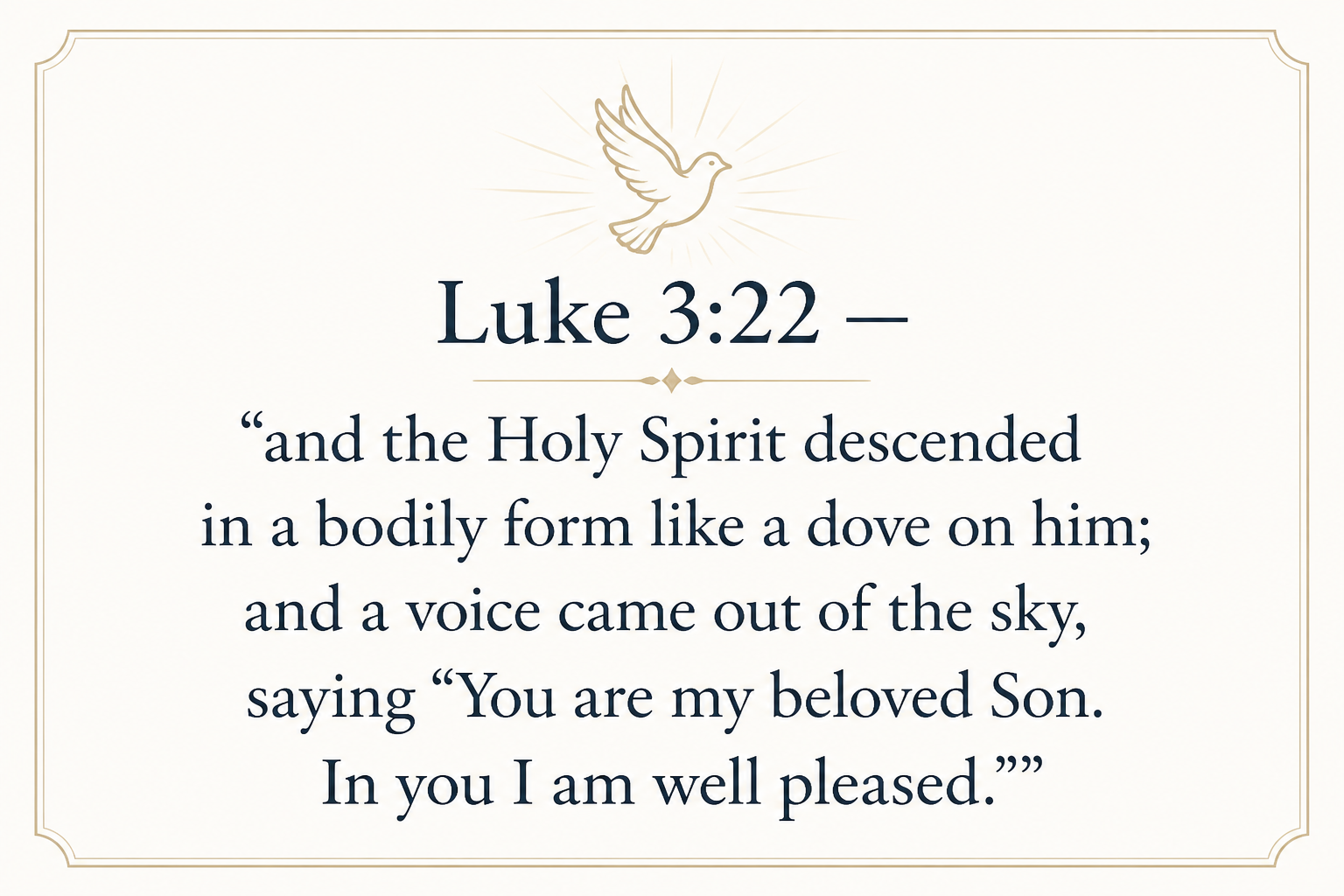
Luke 3:22 — “and the Holy Spirit descended in a bodily form like a dove on him; and a voice came out of the sky, saying “You are my beloved Son. In you I am well pleased.””
Here εἶδος frames the Spirit’s descent as something that can be described in visible terms. The wording ties the event to a “bodily form,” and then qualifies it with a comparison: “like a dove.” The scene is not merely that the Spirit descended, but that the descent had an observable appearance—something presented in a way that could be spoken of with shape-like language (“bodily form”) while still being likened rather than equated (“like a dove”). In the same verse, the voice from the sky addresses Jesus directly; εἶδος belongs to the visual side of the event, set alongside the audible testimony.
Luke 9:29 — “As he was praying, the appearance of his face was altered, and his clothing became white and dazzling.”
In this moment, εἶδος focuses attention on what changes about Jesus that can be seen: “the appearance of his face.” The alteration is presented as an outward transformation, paired with another visible change—his clothing becoming “white and dazzling.” εἶδος thus marks the face as the locus of perceptible change: the narrative does not describe a change of identity or role in abstract terms, but a change that registers on the surface and can be reported as a shift in appearance.
John 5:37 — “The Father himself, who sent me, has testified about me. You have neither heard his voice at any time, nor seen his form.”
In John 5, εἶδος appears in a statement about human limits in encountering the Father. Jesus speaks of the Father’s testimony and then contrasts what the audience has not experienced: “neither heard his voice… nor seen his form.” εἶδος here points to appearance as something that could, in principle, be seen—yet Jesus insists that this has not happened for them. The verse sets “voice” (heard) beside “form” (seen), making εἶδος part of a carefully balanced pair of sensory categories. Appearance, in this line, is not used to describe something present and visible, but to deny that such a visible form has been seen.
2 Corinthians 5:7 — “for we walk by faith, not by sight.”
Although εἶδος is often associated with what can be seen, this verse places Christian conduct (“we walk”) under a contrast between two ways of proceeding: “by faith” and “by sight.” Within that contrast, εἶδος aligns with what belongs to sight—what is apprehended through visible appearance. The short sentence uses a familiar image (“walk”) for ongoing life-direction, and the negative clause “not by sight” makes appearance-based perception an insufficient guide for that walk. The contribution of εἶδος is to anchor “sight” in the realm of what is outwardly presented.
1 Thessalonians 5:22 — “Abstain from every form of evil.”
In this instruction, εἶδος extends beyond describing a single visible manifestation and becomes a way to speak about the range in which something can present itself. The command is comprehensive: “Abstain from every form of evil.” The force of “every” joined to εἶδος suggests that evil may come in various appearances, and the community is to keep away from it regardless of the particular form it takes. The verse uses εἶδος to press the ethical demand beyond a narrow set of obvious cases, aiming at any appearance in which evil is encountered.
Sense and Usage
Across these passages, “appearance” functions as a flexible term for what is presented to perception, whether the emphasis falls on visibility, describability, or the scope of possible manifestations. In Luke 3:22, εἶδος supports the claim that the Spirit’s descent was not only real but also presented in a describable way—“in a bodily form like a dove.” The comparison language matters: the appearance is rendered in terms that can be pictured, yet the verse signals likeness rather than a simple identification.
Luke 9:29 shows εἶδος used for a change that is located in what observers could notice. The verse pairs “the appearance of his face was altered” with clothing that “became white and dazzling,” keeping the whole description within the sphere of outward, reportable transformation. εἶδος, in this setting, allows the account to speak precisely about what was altered: not merely what Jesus did, but how he appeared while praying.
John 5:37 uses εἶδος in a negative assertion: the audience has not “seen his form.” This usage still depends on the ordinary idea of appearance—something that could be seen—but deploys it to underline distance rather than immediacy. The parallel with “heard his voice” strengthens the point: just as voice is a perceivable auditory feature, so form is a perceivable visual presentation; neither has been experienced by them. εἶδος thereby participates in John’s argument by drawing a boundary around what has (and has not) been available to direct perception.
In 2 Corinthians 5:7, appearance is implicit in the contrast between faith and sight. The verse does not spell out what sight sees, but the logic depends on the reader knowing that sight takes its cues from visible presentation. εἶδος belongs to that realm: it represents the kind of information available in appearances, and the sentence states that Christian “walking” does not proceed on that basis. The term thus becomes part of a larger contrast between what is seen and what is trusted.
Finally, in 1 Thessalonians 5:22, “appearance” is used to cover a breadth of expressions: “every form of evil.” Here εἶδος is not restricted to one visual shape; it functions as a category for the varied ways something may present itself to recognition. The instruction assumes that evil is encountered under different appearances, and it calls for abstention across that whole field. Taken together, these uses show εἶδος ranging from concrete, scene-setting description (bodily form; altered face) to a conceptual boundary (unseen form) to a practical contrast and warning (not by sight; every form of evil). In each case, the word keeps its focus on appearance as the interface between reality and perception.
Imagery
The imagery connected to εἶδος in these verses is strongly sensory: a descent “in a bodily form like a dove” (Luke 3:22), a face whose appearance changes and clothing that becomes “white and dazzling” (Luke 9:29), and the stark claim that the Father’s form has not been seen (John 5:37). Against those vivid scenes, the ethical and pastoral lines sharpen: life is not directed “by sight” (2 Corinthians 5:7), and vigilance is required toward “every form of evil” (1 Thessalonians 5:22). Appearance can be the vehicle for revelation, the marker of transformation, the boundary of human experience, and the domain in which moral discernment must operate.
Sources: Lexical data from Strong’s Exhaustive Concordance and the Translators Brief Lexicon of Extended Strongs for Greek (STEPBible, CC BY). Occurrence data from the Translators Amalgamated Greek New Testament (STEPBible, CC BY). Scripture quotations from the World English Bible (public domain).