
Understanding the Meaning of Egguos in Greek
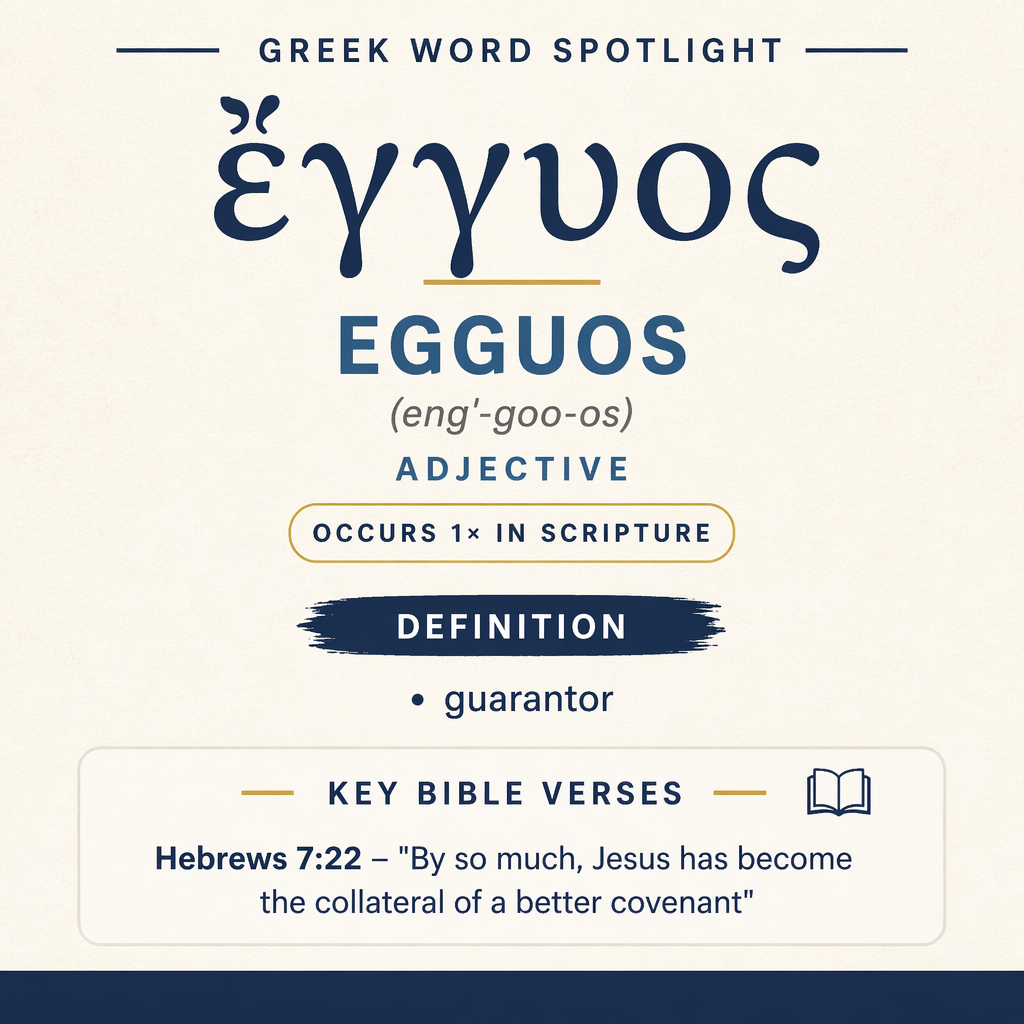
ἔγγυος means “guarantor” and appears once in Scripture, in Hebrews 7:22.
Scripture Occurrence
It occurs 1 time in Scripture. The occurrence is in Hebrews 7:22.
Learn More →Hebrews 7:22
Hebrews 7:22 says, “By so much, Jesus has become the collateral of a better covenant.” This verse uses ἔγγυος.
Learn More →ἔγγυος means “guarantor” and appears once in the New Testament, in Hebrews 7:22, where it is applied to Jesus in connection with a “better covenant.” In that verse, the term frames Jesus’ role using a concrete, legal-financial way of speaking.
Root and Related Words
ἔγγυος is linked with the preposition ἐν (en), “in/on/among” (Strong’s G1722), as a related word noted in the lexical tradition behind Strong’s.

Occurrences
“By so much, Jesus has become the collateral of a better covenant.” (Hebrews 7:22)
In Hebrews 7:22, ἔγγυος is the predicate describing what Jesus “has become,” and the sentence ties that status directly to the superiority of what follows: “a better covenant.” The verse does not present the term as a general quality or an abstract label; it presents it as a role Jesus enters into—something he “has become”—with a clear object in view, the covenant described as “better.”
The Berean Standard Bible wording given here uses the phrase “the collateral,” which pictures a pledge put forward to secure a binding arrangement. Within that picture, ἔγγυος casts Jesus as the one who stands in a securing position with respect to the covenant: his person is spoken of as what anchors confidence in the covenant’s reliability. The compact phrasing “By so much” places the statement in a comparative frame—this role belongs to Jesus as part of an argument that the covenant in view is not merely different, but “better,” and that the better covenant comes with an accompanying improvement in what secures it.
The verse’s grammar also keeps the focus on Jesus as the single, sufficient guarantor: “Jesus has become” is singular and direct, and “a better covenant” is likewise singular, presented as one defined arrangement. The adjective ἔγγυος, attached to Jesus, therefore functions to connect the covenant’s “better” quality with the personal standing of Jesus as the one who secures it.
Sense and Usage
As “guarantor,” ἔγγυος speaks in the register of assurance and security: it marks a person who stands good for something. In Hebrews 7:22, the term is not used to name the covenant itself, nor to describe its clauses, but to describe the person who stands in relation to it. The result is that the covenant’s “better” character is not presented as an impersonal improvement; it is bound to a personal guarantor.
The verse’s metaphor (“collateral”) gives the sense of guarantor a tangible edge. Collateral is what is put forward to secure an obligation; it is not merely a promise, but something that carries weight for the fulfillment of what has been established. Read within the sentence, ἔγγυος points to Jesus as the securing reality attached to the covenant. The word thus operates as a bridge between the covenant language (which can sound institutional) and a personal figure (Jesus), who is portrayed as the covenant’s assurance in himself.
The brevity of the statement also shapes how the word functions. Hebrews 7:22 does not elaborate with additional images or qualifications in the immediate line quoted; instead, it places the whole weight of “guarantor/collateral” on Jesus and moves on. That rhetorical economy makes the term carry concentrated force: a single descriptor is made to do the work of anchoring the reader’s confidence in the covenant’s “better” status by pointing to who secures it.
Because ἔγγυος occurs here in relation to “a better covenant,” its usage is directional and covenant-focused: the guarantor is identified precisely as guarantor of this covenant. The term therefore functions relationally in the verse. It is not primarily about Jesus’ inner character as such, but about his standing in the covenant arrangement being described—his role as the one in whom the covenant is secured.
Imagery
Hebrews 7:22’s wording invites the reader to picture the covenant as something established and dependable because a guarantor stands behind it. The imagery of “collateral” evokes a pledge set in place to secure an agreement; within that picture, Jesus is presented as the pledged security of “a better covenant,” giving a concrete shape to the idea of covenant assurance.
Sources: Lexical data from Strong’s Exhaustive Concordance and the Translators Brief Lexicon of Extended Strongs for Greek (STEPBible, CC BY). Occurrence data from the Translators Amalgamated Greek New Testament (STEPBible, CC BY). Scripture quotations from the World English Bible (public domain).




