Understanding the Meaning of Douleia in Greek
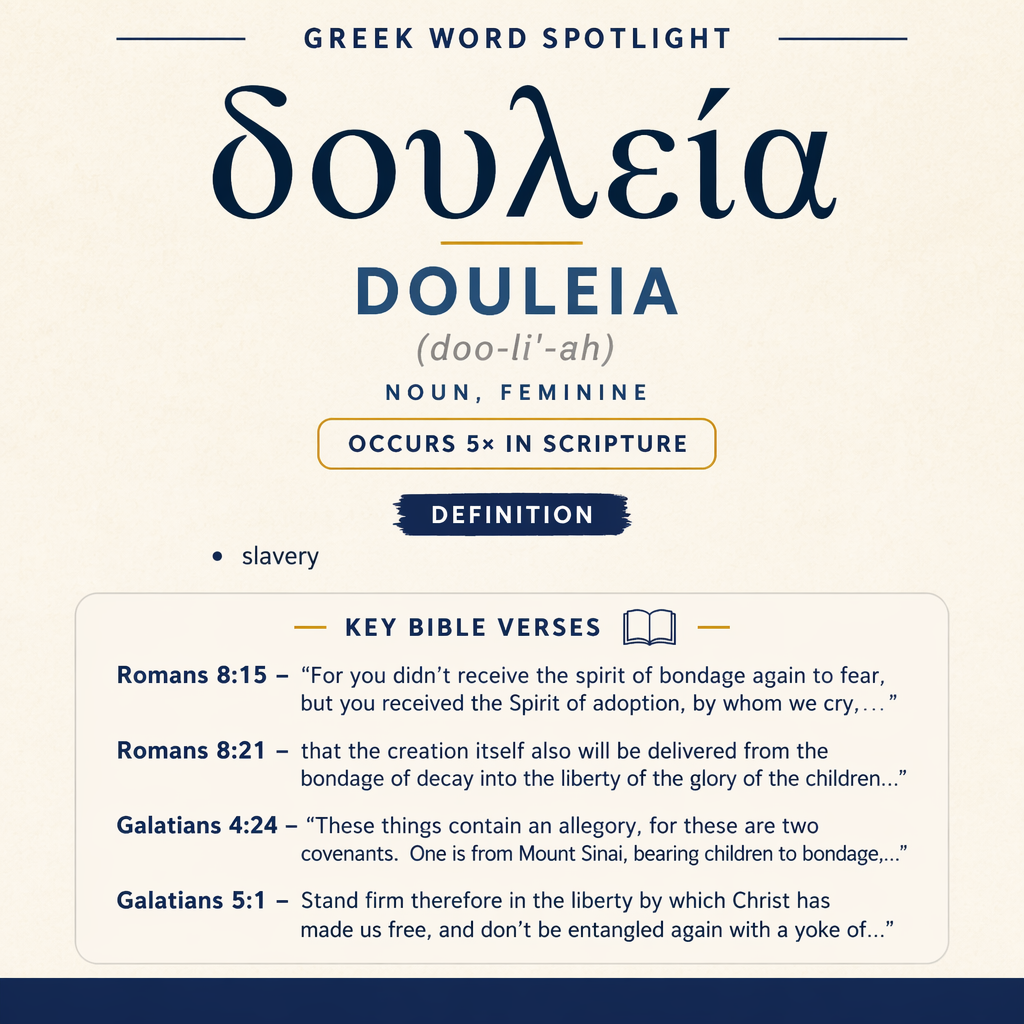
δουλεία means “slavery” and appears five times in Scripture: Romans 8:15, Romans 8:21, Galatians 4:24, Galatians 5:1, and Hebrews 2:15.
Core Meaning
δουλεία is defined as “slavery.” It is used as “bondage” in the cited verses.
Learn More →Where It Appears
This word occurs 5 times in Scripture. The references are Romans 8:15; Romans 8:21; Galatians 4:24; Galatians 5:1; Hebrews 2:15.
Learn More →Verse Contexts
It describes bondage connected with fear (Romans 8:15; Hebrews 2:15) and bondage tied to decay (Romans 8:21). It also appears with covenant imagery and a warning against returning to bondage (Galatians 4:24; Galatians 5:1).
Learn More →δουλεία names “slavery” and appears in Paul’s letters and in Hebrews as a way to describe an enslaving condition from which deliverance is needed. In these passages it is paired with fear, decay, and a binding yoke, and it is set in contrast with adoption and liberty.
Root and Related Words
The related verb δουλεύω (douleuo), “be a slave” (Strong’s G1398), stands behind δουλεία as the corresponding action-word: it expresses being in the state that δουλεία describes.

Occurrences
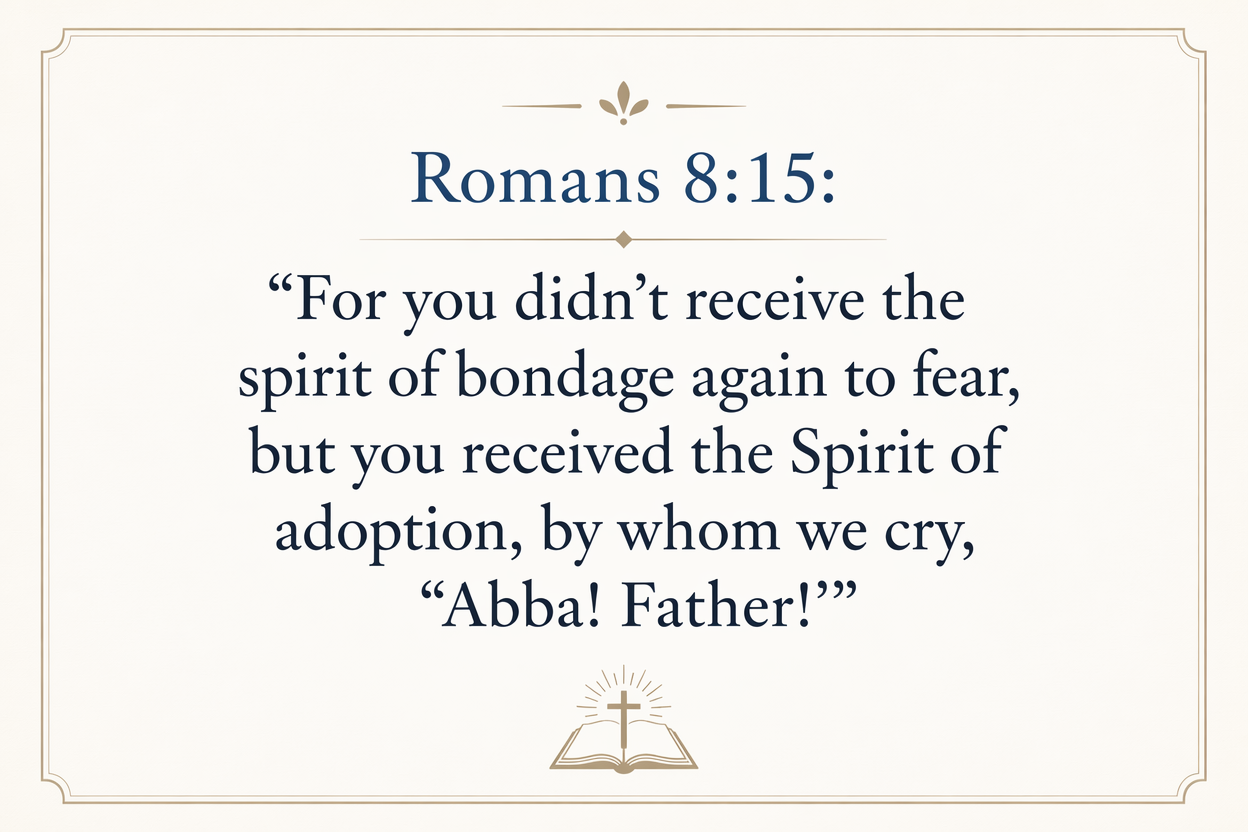
Romans 8:15: “For you didn’t receive the spirit of bondage again to fear, but you received the Spirit of adoption, by whom we cry, “Abba! Father!””
Here δουλεία is presented as a “spirit of bondage” that produces fear and belongs to an “again” of returning—language that paints slavery as a lived atmosphere that shapes a person’s posture before God. The contrast is sharply relational: bondage is set over against “the Spirit of adoption,” and fear is set over against the cry “Abba! Father!” In this scene, δουλεία is not described with external chains but with an inner condition that drives fear rather than filial confidence.
Romans 8:21: “that the creation itself also will be delivered from the bondage of decay into the liberty of the glory of the children of God.”
In Romans 8:21, δουλεία is broadened beyond individual experience to encompass “the creation itself.” Slavery is linked with “decay,” giving the bondage a realm and texture: it is a captivity characterized by deterioration. The verse also frames slavery as a situation from which rescue is possible—“will be delivered”—and sets it opposite “liberty,” specifically “the liberty of the glory of the children of God.” δουλεία therefore functions here as the name for an oppressive condition holding creation in a process of corruption, contrasted with a freedom associated with the status and glory of God’s children.
Galatians 4:24: “These things contain an allegory, for these are two covenants. One is from Mount Sinai, bearing children to bondage, which is Hagar.”
In Galatians 4:24, δουλεία belongs to an argument framed as “an allegory” involving “two covenants.” Slavery is the result of one covenantal line: it is “from Mount Sinai” and it is said to be “bearing children to bondage.” In this usage, δουλεία is tied to a kind of lineage or birth—an inherited condition conveyed through a covenantal relationship—rather than merely an individual predicament. The identification “which is Hagar” locates bondage within a specific side of the allegory, making δουλεία a key marker for the covenant characterized by enslaved offspring.
Galatians 5:1: “Stand firm therefore in the liberty by which Christ has made us free, and don’t be entangled again with a yoke of bondage.”
In Galatians 5:1, δουλεία is pictured with the concrete image of a “yoke,” something laid on an animal’s neck to control movement and labor. The command “Stand firm therefore” presumes pressure toward surrender, and the warning “don’t be entangled again” portrays bondage as something that can re-capture and immobilize those who have been freed. Here slavery is not simply the opposite of liberty in the abstract; it is a yoke that entangles, over against the liberty “by which Christ has made us free.” The verse gives δουλεία a physical metaphor that underscores constraint and compelled service.
Hebrews 2:15: “and might deliver all of them who through fear of death were all their lifetime subject to bondage.”
Hebrews 2:15 connects δουλεία directly to “fear of death,” and it describes slavery as lifelong: “all their lifetime subject to bondage.” The verse emphasizes both duration and domination—bondage is a condition under which people are “subject,” and its mechanism is fear. The action of deliverance is foregrounded (“might deliver”), making slavery the state from which rescue is needed. In this scene, δουλεία is the long-term captivity created and maintained by fear, especially fear focused on death.
Sense and Usage
Across these five contexts, δουλεία consistently marks slavery as a constraining condition that governs life and shapes experience. It can be described in personal terms (“the spirit of bondage again to fear”) and in cosmic terms (“the creation itself also will be delivered from the bondage of decay”). The word readily takes defining genitives that specify the character of the slavery: in Romans it is “bondage” associated with “fear” and with “decay,” and in Hebrews it is bondage maintained by “fear of death.” These pairings show how the writers speak of slavery not merely as a social status but as a condition with identifiable effects and pressures.
In the Pauline passages, δουλεία is repeatedly contrasted with positive counterparts that are themselves named and concretely expressed. Romans 8:15 opposes bondage to “the Spirit of adoption,” with the audible cry “Abba! Father!” as the sign of the new relation; the contrast highlights slavery as the condition incompatible with adopted sonship. Romans 8:21 opposes “bondage of decay” to “the liberty of the glory of the children of God,” placing slavery on the side of corruption and freedom on the side of glorious belonging. Galatians 5:1 opposes the “yoke of bondage” to the liberty given by Christ, framing slavery as a re-entangling power that threatens firmness.
Galatians 4:24 uses δουλεία in a distinctive way: slavery is not presented primarily as an emotion or a physical restraint but as the outcome of a covenantal line, “bearing children to bondage.” In that argument, δουλεία functions as a category by which one covenant is characterized, and it is tied to origin (“from Mount Sinai”) and identity (“which is Hagar”). This usage shows that the term can describe slavery as a defining status attached to a particular relationship, not only as an internal experience of fear or an external yoke.
Hebrews 2:15 draws together several threads found elsewhere: slavery is lifelong, it is sustained by fear, and it stands in need of deliverance. In that setting, δουλεία names the state of being held—subjected—by fear, rather than simply feeling fear. The word thus helps articulate how fear can function as a master, keeping people in an enslaved posture for a lifetime.
Imagery and Contrast
These passages give δουλεία a set of strong contrasts and images that clarify its force. It can be a “spirit of bondage” that renews fear (Romans 8:15), a decaying captivity from which even creation must be delivered (Romans 8:21), a birth-producing covenantal condition (Galatians 4:24), and a “yoke” that entangles again (Galatians 5:1). Hebrews intensifies the picture by making slavery lifelong and tying it to fear of death (Hebrews 2:15). In each case, the word serves to name a condition of constraint that stands opposite liberty, adoption, and deliverance.
Sources: Lexical data from Strong’s Exhaustive Concordance and the Translators Brief Lexicon of Extended Strongs for Greek (STEPBible, CC BY). Occurrence data from the Translators Amalgamated Greek New Testament (STEPBible, CC BY). Scripture quotations from the World English Bible (public domain).