Exploring the Meaning of Dikaioma in Greek
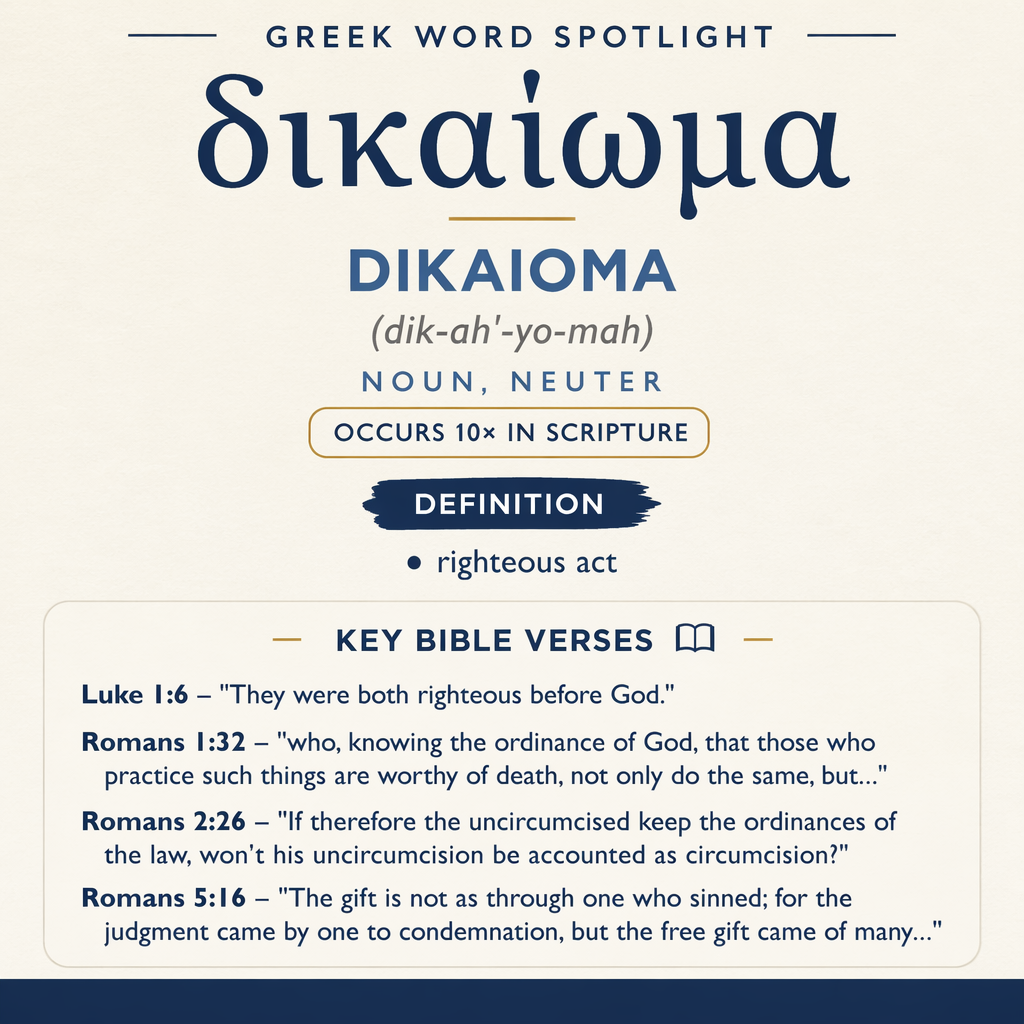
δικαίωμα means “righteous act” and appears 10 times in Scripture, including Luke 1:6, Romans, and Hebrews 9.
Core Meaning
δικαίωμα is defined as “righteous act.” In several verses it is rendered as “ordinance.”
Learn More →Gospel Contexts
Romans uses δικαίωμα in contexts such as God’s ordinance (Romans 1:32) and “one act of righteousness” (Romans 5:18). It also appears in Romans 2:26, 5:16, and 8:4.
Learn More →Covenant Ordinances
Hebrews applies δικαίωμα to the first covenant’s “ordinances” (Hebrews 9:1). It also speaks of “fleshly ordinances” (Hebrews 9:10).
Learn More →δικαίωμα refers to a righteous act. In the passages where it appears, it can describe what God requires, what the law sets out, and what is celebrated when righteousness is publicly displayed.
Occurrences
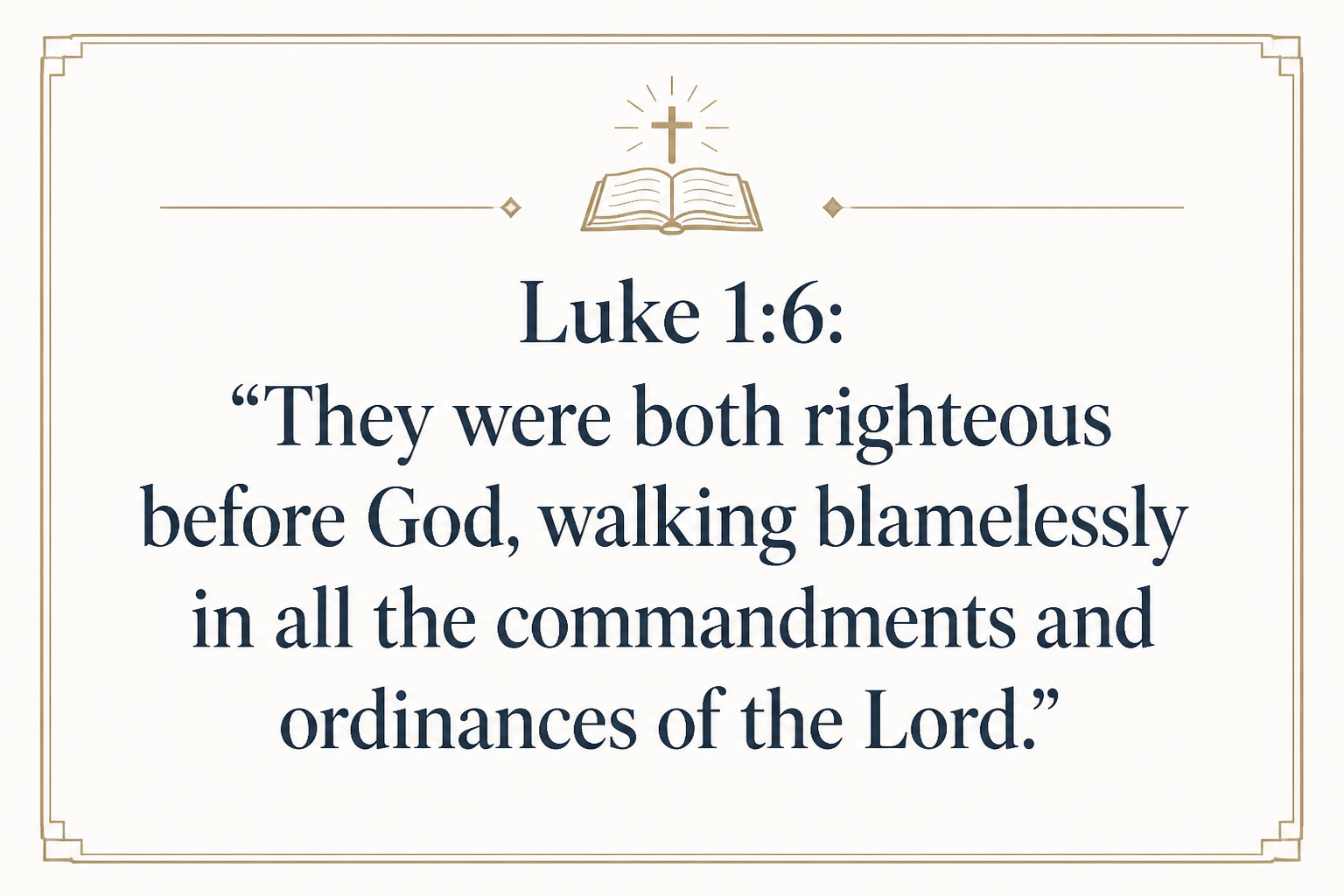
Luke 1:6: “They were both righteous before God, walking blamelessly in all the commandments and ordinances of the Lord.”
Here δικαίωμα is rendered “ordinances” alongside “commandments,” framing the couple’s life as ordered by what the Lord has set out. Within the sentence, the word supports the description “walking blamelessly,” giving concrete content to their “walking”: it is shaped by definite, recognized standards of conduct.
Romans 1:32: “who, knowing the ordinance of God, that those who practice such things are worthy of death, not only do the same, but also approve of those who practice them.”
In this indictment, δικαίωμα is “the ordinance of God” that is “known,” and the content of that knowledge is expressed as a moral judgment: certain practices are “worthy of death.” The word anchors the charge by pointing to a recognized divine standard that condemns, making the problem not ignorance but culpable defiance and even endorsement of wrongdoing.
Romans 2:26: “If therefore the uncircumcised keep the ordinances of the law, won’t his uncircumcision be accounted as circumcision?”
Here δικαίωμα is plural (“ordinances”) and belongs to “the law.” The verse uses it to probe the relationship between outward status and lived obedience: keeping the ordinances becomes the decisive consideration in the argument, raising the possibility that obedience can overturn expected social-religious categories (“uncircumcision” / “circumcision”).
Romans 5:16: “The gift is not as through one who sinned; for the judgment came by one to condemnation, but the free gift came of many trespasses to justification.”
In this comparison, δικαίωμα is rendered “justification” and set in contrast to “condemnation.” The word contributes to the portrayal of a decisive outcome: where “judgment” results in condemnation, the “free gift” results in δικαίωμα, an opposite verdict-like reality. The emphasis falls on the direction of the result (“to justification”) and the striking backdrop of “many trespasses.”
Romans 5:18: “So then as through one trespass, all men were condemned; even so through one act of righteousness, all men were justified to life.”
Here δικαίωμα is translated explicitly as “one act of righteousness,” matching the definition in a focused way. The verse sets this single righteous act against “one trespass,” and assigns to it a far-reaching effect (“all men were justified to life”). In the logic of the sentence, δικαίωμα is not a general virtue but a particular act that functions as the pivot from condemnation to life.
Romans 8:4: “that the ordinance of the law might be fulfilled in us, who walk not after the flesh, but after the Spirit.”
In this purpose clause, δικαίωμα is “the ordinance of the law” that can be “fulfilled in us.” The word helps express that the law’s requirement is not merely announced but completed in the sphere of lived conduct, and the verse immediately characterizes that conduct as a manner of “walk” defined by “the Spirit” rather than “the flesh.”
Hebrews 9:1: “Now indeed even the first covenant had ordinances of divine service and an earthly sanctuary.”
Here δικαίωμα is plural and tied to covenantal worship: “ordinances of divine service” set within “the first covenant,” alongside “an earthly sanctuary.” The word contributes a sense of arranged, recognized acts connected to service, fitting the verse’s catalog of concrete features belonging to that covenantal order.
Hebrews 9:10: “being only (with meats and drinks and various washings) fleshly ordinances, imposed until a time of reformation.”
In this description, δικαίωμα again appears in the plural as “ordinances,” now qualified as “fleshly” and illustrated with tangible practices: “meats and drinks and various washings.” The word gathers these practices into a category of regulated acts, and the clause “imposed until a time of reformation” highlights their provisional, time-bounded character in the passage’s argument.
Revelation 15:4: “Who wouldn’t fear you, Lord, and glorify your name? For you only are holy. For all the nations will come and worship before you. For your righteous acts have been revealed.”
Here δικαίωμα is “righteous acts” attributed to the Lord and described as having been “revealed.” The word functions as a reason for universal worship: the nations come because God’s righteous acts are publicly disclosed and displayed, fitting the verse’s movement from God’s holiness to worldwide acknowledgement.
Revelation 19:8: “It was given to her that she would array herself in bright, pure, fine linen: for the fine linen is the righteous acts of the saints.”
Here δικαίωμα is again “righteous acts,” now belonging to “the saints,” and it is linked to visible imagery: “bright, pure, fine linen.” The verse uses the word to interpret the symbol—linen corresponds to righteous acts—so δικαίωμα supplies the moral substance represented by the garment that is “given to her” and worn as public array.

Sense and Usage
Across these passages, δικαίωμα consistently names righteousness in the form of action—either as a righteous act itself or as an ordinance that defines what right action looks like within a given order. In Luke and in several places in Romans and Hebrews, the word is rendered “ordinance(s),” which situates righteous action within an established pattern: commandments and ordinances form the concrete framework for a “walk,” and “the ordinance of God” is something that can be “known,” violated, and even perversely applauded (Romans 1:32). This usage naturally supports moral accountability, because an ordinance is not a vague ideal; it is a recognized standard that can be kept, broken, or fulfilled.
Romans places particular weight on the way righteous action and legal requirement intersect with larger outcomes. Romans 2:26 presses the argument that keeping “the ordinances of the law” matters profoundly even when conventional boundary markers seem to point the other way. Romans 8:4 speaks of “the ordinance of the law” being “fulfilled in us,” connecting righteous requirement to an embodied way of life described as walking “after the Spirit.” In these statements, δικαίωμα helps express righteousness as something that takes shape in lived conduct, not merely in asserted identity.
Romans 5 then concentrates the idea into a single decisive moment: δικαίωμα appears as “justification” (Romans 5:16) and as “one act of righteousness” (Romans 5:18). The passages place δικαίωμα over against condemnation and trespass, so the word carries the sense of righteousness as effectual action—action that does something in the narrative logic of the sentences, moving from condemnation toward life. Even when translated as an outcome (“justification”), the term is still tethered in the immediate context to actions and their consequences (“one who sinned,” “one trespass,” “one act of righteousness”).
Hebrews uses δικαίωμα within the domain of worship and covenant order. “Ordinances of divine service” coordinate with “an earthly sanctuary” (Hebrews 9:1), and “fleshly ordinances” are exemplified by food, drink, and washings (Hebrews 9:10). Here righteous action is depicted as regulated practice—specified acts performed within a structured system—while the passage’s own qualifiers distinguish different kinds of ordinances and their place in time (“imposed until a time of reformation”).
Revelation shifts the focus from requirement and regulation to disclosure and display. God’s δικαιώματα are “revealed” as the grounds for fear, glorifying, and worldwide worship (Revelation 15:4). Then δικαιώματα become the interpretive key for the bride’s clothing: “the fine linen is the righteous acts of the saints” (Revelation 19:8). In both scenes, righteous acts are not hidden; they are made manifest, either as divine deeds that summon the nations or as saintly deeds portrayed as visible splendor.
Imagery
The word’s movement from ordinances to clothing creates a striking arc within these texts. What begins as the steady, blameless “walking” shaped by “commandments and ordinances” (Luke 1:6) culminates in an image where righteous acts can be spoken of as “bright, pure, fine linen” (Revelation 19:8). Along the way, δικαίωμα can confront human rebellion as a known divine ordinance (Romans 1:32), articulate the law’s requirement as something fulfilled in a Spirit-shaped walk (Romans 8:4), and point to righteous acts—God’s and the saints’—as realities fit to be revealed before the nations (Revelation 15:4).
Sources: Lexical data from Strong’s Exhaustive Concordance and the Translators Brief Lexicon of Extended Strongs for Greek (STEPBible, CC BY). Occurrence data from the Translators Amalgamated Greek New Testament (STEPBible, CC BY). Scripture quotations from the World English Bible (public domain).