
Exploring the Meaning of Dusnoetos in Greek
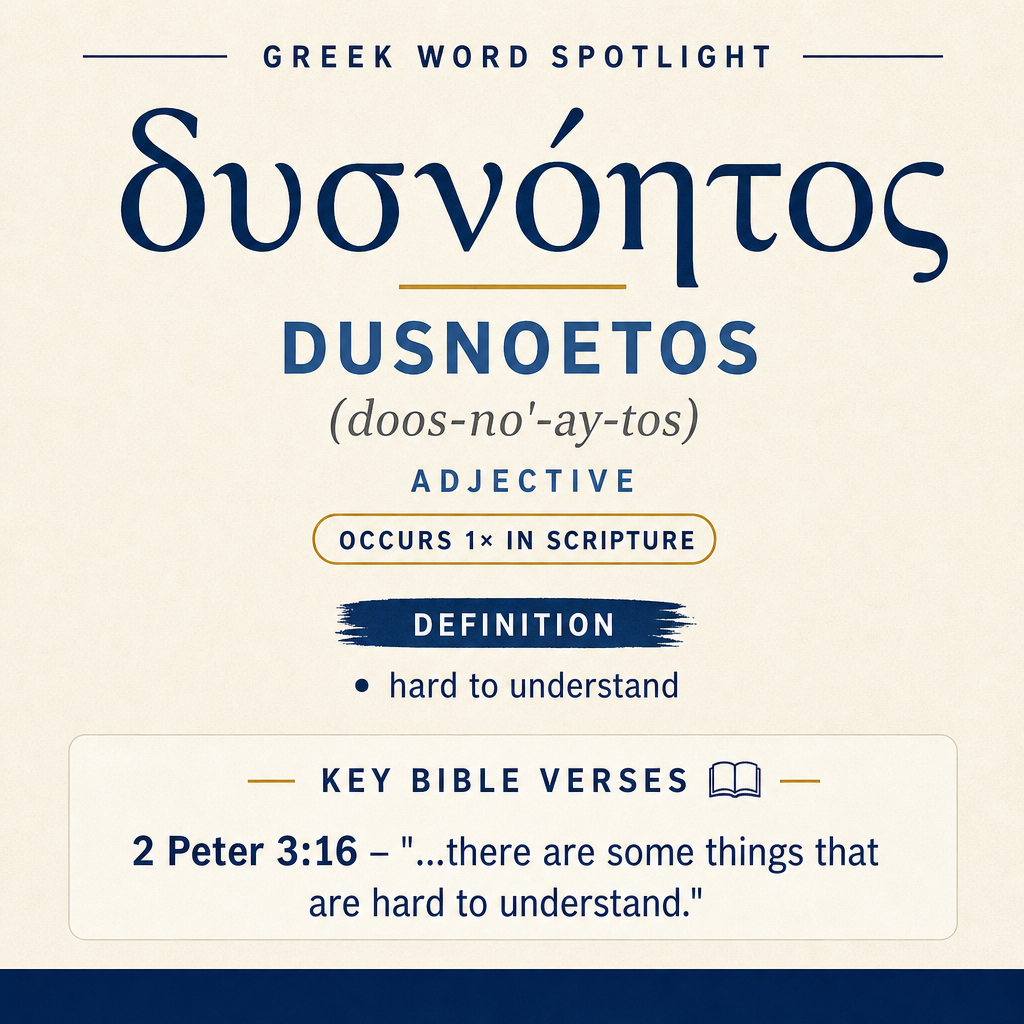
δυσνόητος means “hard to understand” and appears once in Scripture, in 2 Peter 3:16.
Scripture Occurrence
It occurs 1 time in Scripture. The occurrence is in 2 Peter 3:16.
Learn More →Verse Context
In 2 Peter 3:16, it describes “some things” in the letters as hard to understand.
Learn More →Dusnoetos describes something that is “hard to understand” and is used of certain matters found within the apostolic letters. Its single New Testament occurrence highlights how difficulty in understanding can become a setting for misuse of Scripture.
Root and Related Words
Dusnoetos is built from δυσ- (dys-), “hard” (Strong’s G1418), and νοέω (noieo), “to understand” (Strong’s G3539). The compound shape naturally frames the term as a descriptor applied to a subject in view, marking it as difficult for understanding to grasp.

Occurrences
“as also in all of his letters, speaking in them of these things. In those, there are some things that are hard to understand, which the ignorant and unsettled twist, as they also do to the other Scriptures, to their own destruction.” (2 Peter 3:16)
Here dusnoetos characterizes “some things” found within “all of his letters.” The author does not treat the letters as uniformly opaque; rather, within the wider body of teaching “speaking in them of these things,” particular points rise to the surface as difficult for understanding. The word functions as a candid acknowledgment: certain content demands more from the reader than quick grasping or casual listening.
In the same sentence, the description “hard to understand” is immediately placed next to moral and spiritual instability: “the ignorant and unsettled twist” these difficult matters. The adjective therefore does more than label complexity; it sets the stage for a contrast between two responses to challenging teaching. One response is implied restraint and care—an approach that recognizes difficulty and therefore proceeds attentively. The other response is explicit: twisting the teaching. By attaching dusnoetos to the items that are being distorted, the text shows how difficulty can become an occasion for misreading when joined to ignorance and instability.

The author further widens the frame: those who twist these difficult things behave the same way toward “the other Scriptures.” In this scene, dusnoetos helps explain a pattern of abuse. The problem is not limited to one letter or a single topic; the same people distort other scriptural writings as well. The adjective thus contributes a sober realism about reading: where understanding is strained, the temptation to manipulate the text—rather than be corrected by it—can intensify.
The sentence ends with the result: such twisting is “to their own destruction.” Within this warning, “hard to understand” is not an excuse that softens accountability. Instead, it is part of the warning’s logic: when the content is difficult, the stakes of mishandling it are not lower but higher. Dusnoetos participates in a chain of thought that moves from difficult material, to distortion by unfit readers, to disastrous consequences.
Sense and Usage
The definition “hard to understand” plays out in 2 Peter 3:16 as a realistic descriptor of certain theological or instructional statements (“some things”) within apostolic correspondence. The word’s force lies in its plainness: it labels a real barrier to understanding without turning that barrier into a virtue or a defect in the writings themselves. The letters are presented as coherent teaching “speaking…of these things,” and yet within that coherent teaching there are statements that press the limits of comprehension for some readers.
Because the word is applied to “things” rather than to people, it marks the difficulty as located in the content being considered—its depth, its tight reasoning, or the way it connects themes—without redefining the readers as inherently incapable. At the same time, the verse does identify a group whose handling of such content is especially dangerous: “the ignorant and unsettled.” In the sentence’s structure, dusnoetos does not stand alone; it is paired with a diagnosis of the readers’ posture. The difficulty of the material becomes hazardous when met by ignorance and instability, producing the action described as “twist.”
The word also helps clarify a practical distinction between difficulty and distortion. “Hard to understand” describes the legitimate challenge posed by certain statements. “Twist” describes an active interference with meaning. The verse places them side by side, showing that the second can be a corrupt reaction to the first. In this usage, dusnoetos does not suggest that the challenging parts are optional or dismissible; they belong within “all of his letters,” and the warning assumes that the church will continue to read and receive them. The proper response is not to avoid difficult teaching but to resist the impulse to reshape it.
Finally, the adjective’s placement within a warning about “the other Scriptures” gives it a broad interpretive horizon. The same kind of hard-to-understand material exists within apostolic letters, and the same kind of twisting occurs in other scriptural writings. Dusnoetos therefore sits within a larger concern for responsible reading. It signals that interpretive difficulty is a normal feature of Scripture’s communication, and that the reader’s character and stability matter when approaching what is difficult.
Imagery
In 2 Peter 3:16, dusnoetos carries the imagery of a written message whose meaning can be handled in two ways: carefully received or forcibly reshaped. The verse pictures difficult passages as something that can be “twist[ed],” as if the text were treated like a material that can be bent away from its intended form, with “destruction” marking the end of that path.
Sources: Lexical data from Strong’s Exhaustive Concordance and the Translators Brief Lexicon of Extended Strongs for Greek (STEPBible, CC BY). Occurrence data from the Translators Amalgamated Greek New Testament (STEPBible, CC BY). Scripture quotations from the World English Bible (public domain).





