Understanding the Meaning of Duskolos in Greek
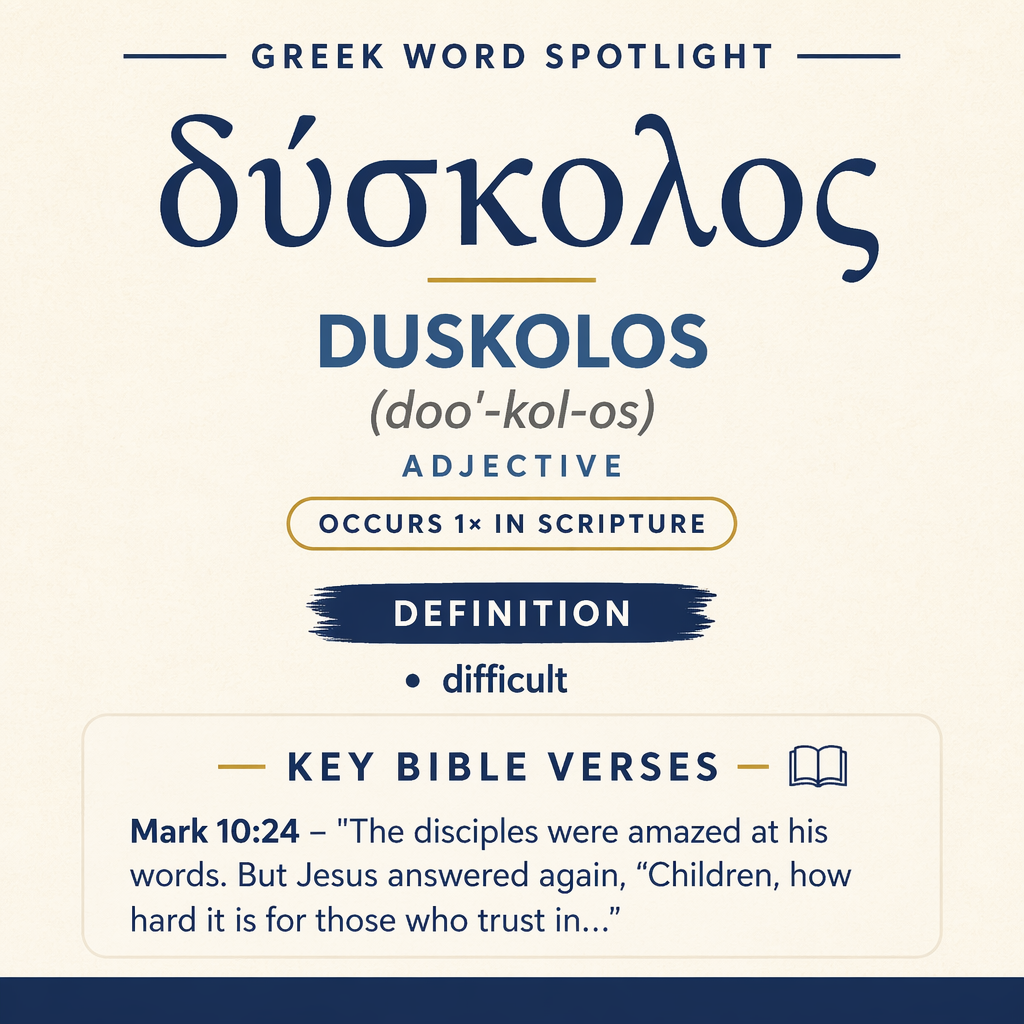
δύσκολος means “difficult” and appears once in Scripture, in Mark 10:24.
Context in Mark
In Mark 10:24, Jesus says how hard it is for those who trust in riches.
Learn More →δύσκολος means “difficult,” and it appears in the teaching moment in Mark 10:24 where Jesus addresses the disciples about entering God’s Kingdom.
Root and Related Words
δύσκολος is built with the element δυσ- (dys-), “hard” (Strong’s G1418).

Occurrences
“The disciples were amazed at his words. But Jesus answered again, “Children, how hard it is for those who trust in riches to enter into God’s Kingdom!” (Mark 10:24)
In Mark 10:24, the adjective frames Jesus’ statement as an assessment of difficulty: “how hard it is … to enter into God’s Kingdom!” The sentence places that difficulty alongside a specific description of the people in view—“those who trust in riches.” Within the flow of the verse, the disciples’ reaction (“were amazed at his words”) sets a tone of surprise or shock, and Jesus’ direct address (“Children”) introduces his reply with pastoral plainness while still sharpening the point. The word contributes the blunt force of the claim: entry into God’s Kingdom is characterized here as difficult for a particular kind of reliance, namely trusting in riches. It functions not as a detached description of a task in general, but as a targeted characterization of the obstacle faced by that group.
The structure of the saying also shows what the adjective is doing rhetorically. Jesus does not simply state that entering is hard; he exclaims “how hard it is,” which intensifies the evaluation. The difficulty is then tied to an infinitive-like idea expressed in English as “to enter,” so the adjective bears on the action of entry itself—entry is the point at which the difficulty is felt. The verse, as quoted, places the word inside a relational claim about people (“those who trust in riches”) and a destination (“God’s Kingdom”), making “difficult” a bridge-word: it links a kind of trust to the challenge associated with reaching that goal.
Sense and Usage
“Difficult” in this passage is not an abstract label for something merely complicated; it is a concrete evaluation of a real outcome—“to enter into God’s Kingdom.” The verse anchors the sense of difficulty in a lived posture: “trust in riches.” The adjective therefore works as an interpretive lens for the situation Jesus is describing. It signals that the issue is not presented as neutral or effortless; the path of “entering” is portrayed as marked by hardship when a person’s confidence is placed in wealth.
Because the word appears in a spoken saying introduced by “Jesus answered again,” its force is conversational and corrective. The disciples are “amazed,” and Jesus responds not by softening the reaction but by clarifying the nature of what has astonished them. The adjective “hard” (as the English renders it here) gives the disciples a category for what they are encountering in his teaching: the challenge is not merely surprising; it is genuinely difficult. In context, the word pushes the listener to recognize that “trust in riches” stands in tension with “enter[ing] into God’s Kingdom,” and that this tension manifests as real difficulty at the point of entry.
Even within the single verse, the adjective carries a comparative implication: it distinguishes this case (“for those who trust in riches”) from other cases not described here, making the difficulty specific rather than universalizing in the wording as quoted. The term thus functions as a qualifier—difficulty is attached to a defined group—while still keeping the focus on the main outcome of the statement: entry into God’s Kingdom.
Imagery
The verse’s imagery is spatial and directional: people are pictured as seeking “to enter into God’s Kingdom,” with “how hard it is” casting that entrance as a constricted or resisted movement. Without adding details beyond the line itself, the word “difficult” makes the entrance feel like a threshold that does not yield easily when the entrant is marked by “trust in riches.”
Sources: Lexical data from Strong’s Exhaustive Concordance and the Translators Brief Lexicon of Extended Strongs for Greek (STEPBible, CC BY). Occurrence data from the Translators Amalgamated Greek New Testament (STEPBible, CC BY). Scripture quotations from the World English Bible (public domain).