
Understanding the Significance of Dunamoo in Greek
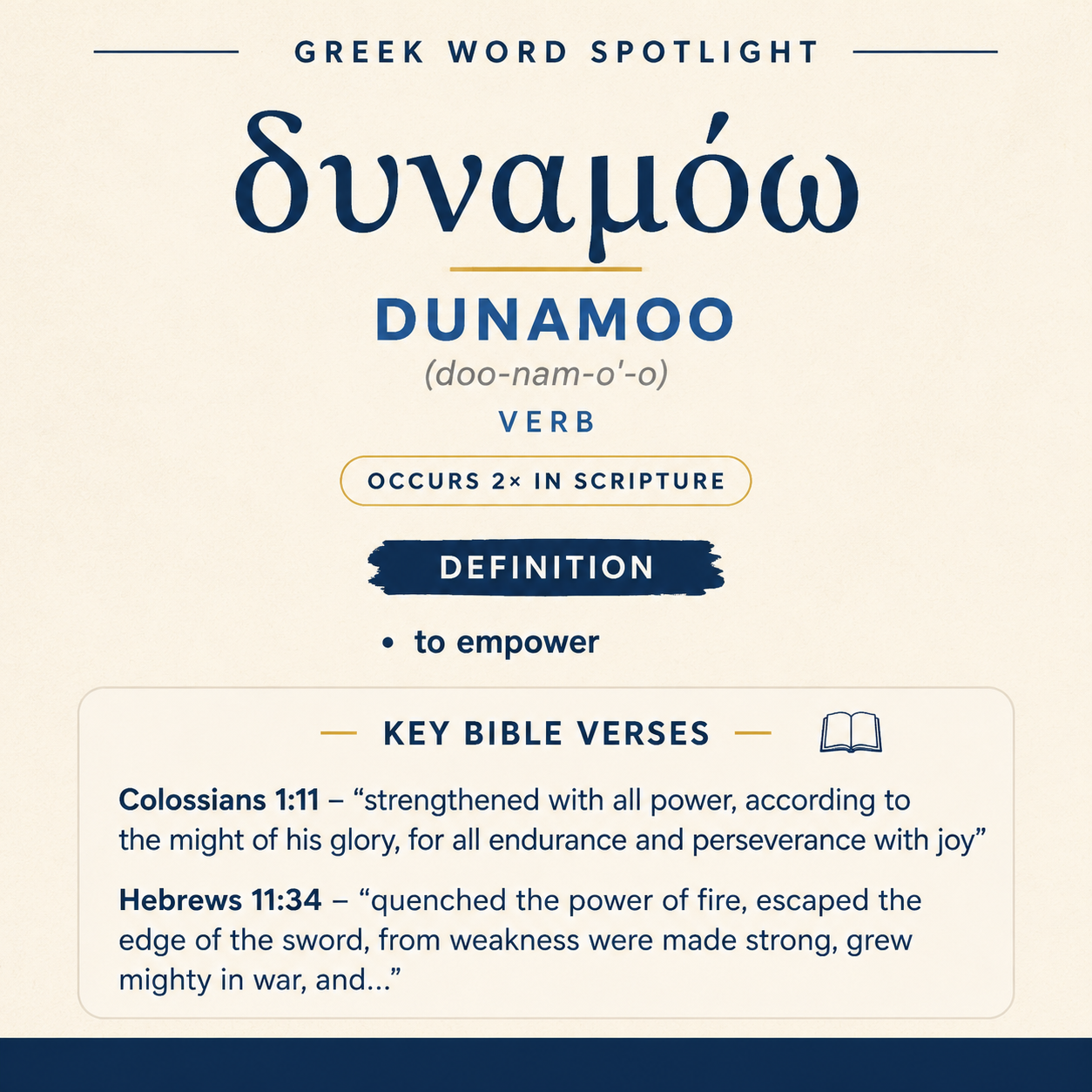
δυναμόω means “to empower” and occurs twice in Scripture: Colossians 1:11 and Hebrews 11:34.
Scripture Occurrences
This verb appears 2 times in Scripture. Its occurrences are Colossians 1:11 and Hebrews 11:34.
Learn More →Verse Context
In Colossians 1:11 it is translated “strengthened with all power.” In Hebrews 11:34 it appears in the wording “from weakness were made strong.”
Learn More →δυναμόω means “to empower.” It appears in prayerful language about inner strengthening and in a catalogue of deeds that display strength in the face of danger.
Root and Related Words
δυναμόω is related to dynamis (δύναμις), “power” (Strong’s G1411).
Occurrences
“strengthened with all power, according to the might of his glory, for all endurance and perseverance with joy,” (Colossians 1:11)
In this line the word sits inside a dense cluster of strength-language: “strengthened,” “all power,” and “the might of his glory.” The empowering described here is not an end in itself; it is directed “for all endurance and perseverance with joy.” The verse frames empowerment as something that supplies capacity over time—an enabling that sustains “endurance” and “perseverance,” and that does so without severing the experience of hardship from “joy.” The strengthening is also measured and sourced: it is “with all power” and “according to the might of his glory,” language that places the empowering action on a scale set by divine “might” and “glory,” rather than by human circumstance.
The surrounding wording also highlights that this empowering is comprehensive and goal-oriented. “With all power” conveys a breadth, while “according to the might of his glory” describes a standard or proportion that governs the strengthening. The result is a picture of empowerment that is not merely momentary intensity, but a fitted provision that equips the recipient for the long work of steadfastness—endurance in pressure, perseverance in continuing, and the particular disposition of “joy” alongside them.
“quenched the power of fire, escaped the edge of the sword, from weakness were made strong, grew mighty in war, and caused foreign armies to flee.” (Hebrews 11:34)
Here the word belongs to a rapid sequence of concrete outcomes. The line moves from peril (“fire,” “the edge of the sword”) to reversal (“from weakness were made strong”), then to public effectiveness (“grew mighty in war”), and finally to decisive impact (“caused foreign armies to flee”). Empowering in this setting is portrayed as a transition: weakness is not simply endured; it becomes the point from which strength emerges. The empowering is thus expressed as an enabling that changes what is possible in situations of threat and conflict.
The verse also links empowerment with both resistance and action. “Quenched the power of fire” depicts the neutralizing of destructive force; “escaped the edge of the sword” depicts deliverance from lethal danger. Then the focus shifts from survival to capability: being “made strong” and “grew mighty in war” portrays empowerment as operative strength that can be exercised. The final clause, “caused foreign armies to flee,” presents empowerment in terms of its effect on others and on outcomes—an ability that turns the tide so that opposing forces retreat.
Sense and Usage
Across these two contexts, “to empower” is shown as an active strengthening that equips for particular ends. In Colossians 1:11, empowerment is inwardly directed and ethically framed: it produces “endurance and perseverance with joy.” The verse does not present strength as self-display, but as capacity for sustained faithfulness and a resilient posture. The wording “strengthened with all power” and “according to the might of his glory” places the empowering action under a divine measure, suggesting a strengthening that corresponds to a glorious source and therefore is sufficient for the demanded perseverance.
In Hebrews 11:34, empowerment is narrated through observable changes in circumstances and capability. The movement “from weakness were made strong” is the hinge of the line: empowerment is the agent of reversal, taking what is fragile and rendering it effective. The surrounding clauses situate this empowerment in high-stakes settings—danger, warfare, and confrontation—where strength is not theoretical but tested. Empowerment there is not described primarily as a feeling, but as an enabling that results in concrete deliverance and decisive action.
Together these uses show that empowering can be spoken of both as sustaining strength for ongoing perseverance and as strengthening that produces striking feats. The first emphasizes duration (“endurance and perseverance”) and disposition (“with joy”); the second emphasizes transformation (“from weakness were made strong”) and impact (“caused foreign armies to flee”). In both, empowerment is not detached from purpose: it is strength with direction—either toward steadfast continuance or toward effective action amid threat.
Imagery
The passages pair empowerment with vivid language of force and resistance. Colossians 1:11 gathers “power,” “might,” and “glory” to portray a strengthening that can carry joy through strain. Hebrews 11:34 sets empowerment against fire and sword, then depicts it as the turning point from weakness to strength and from danger to victory, where hostile forces are driven back and flee.
Sources: Lexical data from Strong’s Exhaustive Concordance and the Translators Brief Lexicon of Extended Strongs for Greek (STEPBible, CC BY). Occurrence data from the Translators Amalgamated Greek New Testament (STEPBible, CC BY). Scripture quotations from the World English Bible (public domain).





