Understanding the Significance of Dikaios in Greek
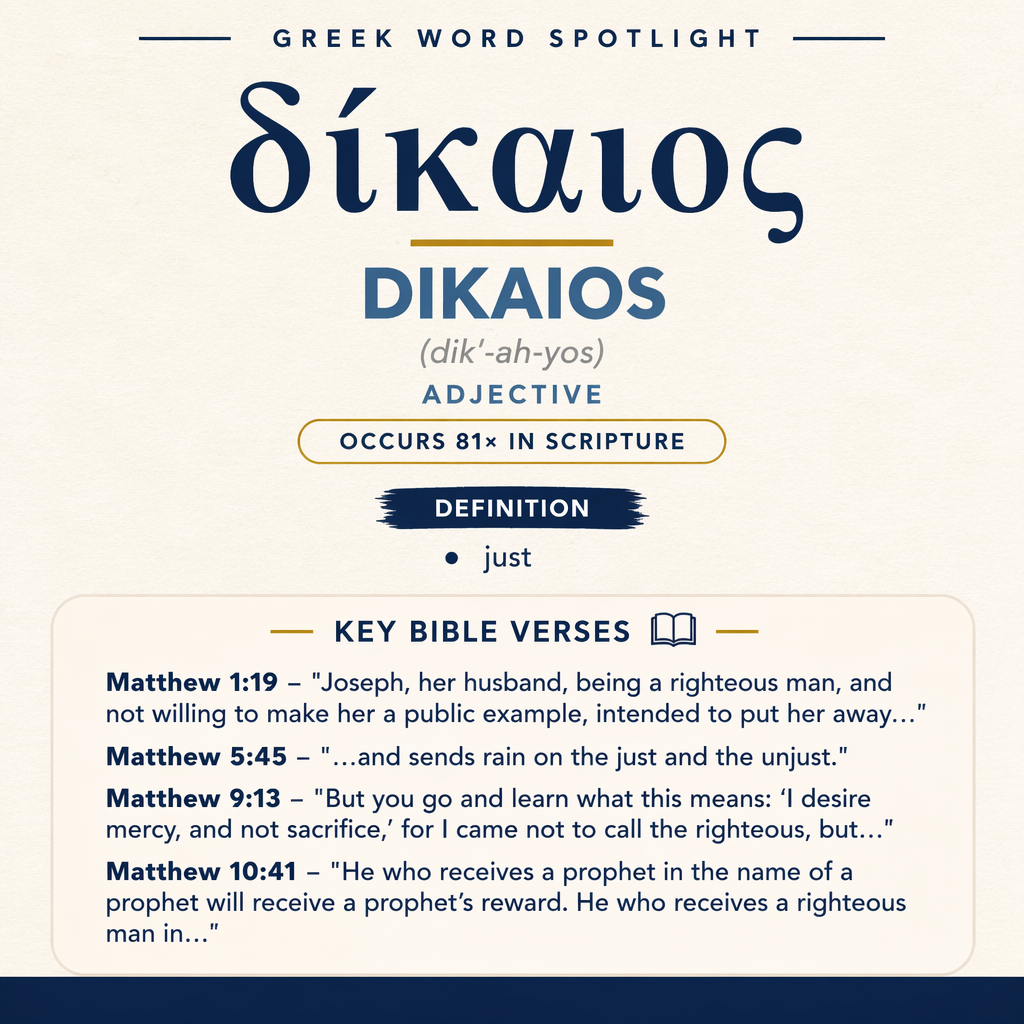
δίκαιος (Dikaios) means “just” and appears 81 times in Scripture, including in Matthew 1:19; 5:45; 9:13; 10:41; 13:17, 43, 49; 20:4.
Core Meaning
δίκαιος means “just.” In Matthew it describes people as “righteous” and actions as “right.”
Learn More →Matthew Examples
Joseph is called “a righteous man” (Matthew 1:19), and Jesus contrasts “the righteous” with “sinners” (Matthew 9:13). It also appears in kingdom teaching, where “the righteous will shine like the sun” (Matthew 13:43).
Learn More →Occurrences
δίκαιος occurs 81 times in Scripture. The references listed include multiple uses across Matthew 1, 5, 9, 10, 13, and 20.
Learn More →δίκαιος describes someone or something as “just,” a quality applied both to people and to what is judged to be right in action or outcome. In the cited passages it marks persons (such as Joseph, prophets, and “the righteous”) and also characterizes what is “right” in promised payment.
Root and Related Words
δίκαιος is related to dike (δίκη), “condemnation” (Strong’s G1349).

Occurrences
Matthew 1:19 — “Joseph, her husband, being a righteous man, and not willing to make her a public example, intended to put her away secretly.”
Here δίκαιος qualifies Joseph’s character as he faces a hard, public situation. The verse connects his being “righteous” with a restrained course of action: he refuses to “make her a public example” and chooses a private resolution (“put her away secretly”). The word frames his intention as consistent with an upright standard expressed through discretion and unwillingness to shame.
Matthew 5:45 — “that you may be children of your Father who is in heaven. For he makes his sun to rise on the evil and the good, and sends rain on the just and the unjust.”
δίκαιος appears in a paired contrast: “the just and the unjust.” The verse uses ordinary, shared blessings—sunrise and rain—to show that God’s providential giving is not limited to those who meet the standard named by δίκαιος. The word functions as one side of a moral division, but the point is that both sides receive the same outward gifts from heaven.
Matthew 9:13 — “But you go and learn what this means: ‘I desire mercy, and not sacrifice,’ for I came not to call the righteous, but sinners to repentance.”
δίκαιος marks a class of people contrasted with “sinners.” In this saying, “the righteous” are not the target of the call described (“to repentance”); the mission described is directed toward those identified as sinners. The word therefore serves to set a boundary between groups and to clarify whom the call is aimed at within the stated purpose.
Matthew 10:41 — “He who receives a prophet in the name of a prophet will receive a prophet’s reward. He who receives a righteous man in the name of a righteous man will receive a righteous man’s reward.”
δίκαιος identifies a “righteous man” as a recognizable kind of person—one whose reception can be motivated “in the name of” what he is. The verse places the “righteous man” alongside a prophet as someone whose identity carries significance, and it links honoring that identity to receiving a corresponding reward. The adjective helps define the basis on which hospitality and recognition are evaluated.
Matthew 13:17 — “For most certainly I tell you that many prophets and righteous men desired to see the things which you see, and didn’t see them; and to hear the things which you hear, and didn’t hear them.”
δίκαιος again labels a group (“righteous men”), paired with prophets, who longed for privileged sight and hearing but did not attain it. The verse uses their righteousness not to claim they automatically possess insight, but to heighten the weight of their desire: even such people “desired to see” and “to hear” what the listeners now experience. The word contributes to the sense of revered predecessors and intensifies the privilege being described.
Matthew 13:43 — “Then the righteous will shine like the sun in the Kingdom of their Father. He who has ears to hear, let him hear.”
δίκαιος marks those who, in the future scene described, are the subjects of a striking image: “will shine like the sun.” Their destiny is located “in the Kingdom of their Father,” and the adjective distinguishes who participates in that radiance. The word thus identifies the beneficiaries of the promised transformation and sets them apart as a defined community within the kingdom setting.
Matthew 13:49 — “So will it be in the end of the world. The angels will come and separate the wicked from among the righteous,”
δίκαιος stands as the category from which others are removed: angels “separate the wicked from among the righteous.” The word therefore functions as a boundary marker in an eschatological sorting. “Among the righteous” suggests an identified company; the act of separation clarifies that δίκαιος is not merely a private quality but a designation with public consequences in the described end-time judgment scene.
Matthew 20:4 — “He said to them, ‘You also go into the vineyard, and whatever is right I will give you.’ So they went their way.”
δίκαιος here shifts from describing persons to describing what is “right” in compensation. The vineyard owner promises an outcome measured by a standard of rightness rather than by an explicit wage. The word contributes a sense of assured fairness in the agreement: those sent into the vineyard can proceed on the owner’s pledge that the payment will match what is right.
Matthew 20:7 — ““They said to him, ‘Because no one has hired us.’ “He said to them, ‘You also go into the vineyard, and you will receive whatever is right.’”
δίκαιος repeats the promise to late-hired workers who explain their idleness: “Because no one has hired us.” The owner’s response again rests on the standard of “whatever is right,” extending the same assurance to those engaged later in the day. In this scene, the word stabilizes the relationship between master and laborers by making rightness—not timing, bargaining, or visibility—the stated basis of their expected receipt.
Matthew 23:28 — “Even so you also outwardly appear righteous to men, but inwardly you are full of hypocrisy and iniquity.”
δίκαιος is used for an appearance that can be projected “to men.” The contrast is sharp: outwardly “appear righteous,” inwardly “full of hypocrisy and iniquity.” The word here exposes the difference between reputation and reality; it can name a status that observers might grant based on external presentation, yet the verse insists that true assessment must take account of what is inside.
Matthew 23:29 — ““Woe to you, scribes and Pharisees, hypocrites! For you build the tombs of the prophets, and decorate the tombs of the righteous,”
δίκαιος characterizes those whose tombs are honored: “the tombs of the righteous.” The verse portrays religious leaders actively beautifying memorials, implying public respect for the righteous of earlier times. The word helps define whose memory is being curated; it labels the dead as people recognized for justice, even as the surrounding denunciation (“Woe… hypocrites!”) suggests that honoring their tombs can coexist with moral failure in the present.
Matthew 23:35 — “that on you may come all the righteous blood shed on the earth, from the blood of righteous Abel to the blood of Zachariah son of Barachiah, whom you killed between the sanctuary and the altar.”
δίκαιος intensifies the gravity of “blood shed on the earth” by specifying it as “righteous blood.” The word is then attached to individuals named as examples (“righteous Abel,” “Zachariah son of Barachiah”), tying the adjective to victims whose death is presented as morally weighty. Within the verse’s accusation, δίκαιος sharpens culpability: the violence described is not random loss but the shedding of blood belonging to those marked as righteous.
Sense and Usage
Across these passages, “just” functions in two main ways: as a descriptor of persons and as a measure of what is right in action or outcome. Applied to persons, δίκαιος can describe a single individual’s character as it shows itself in choices (Joseph’s refusal to expose Mary publicly), identify a recognized kind of person who can be received and rewarded (“a righteous man”), and name a broader company (“the righteous”) contrasted with “the unjust,” “sinners,” or “the wicked.” In such contrasts, δίκαιος does not float as an abstract label; it draws lines between groups and clarifies who is being addressed, called, separated, or vindicated in the scenes described.
At the same time, δίκαιος can characterize what is “right” in the practical sphere of remuneration (the vineyard owner’s promise). In that setting, the word does not name who the laborers are but what the giver commits himself to do. The repeated phrase “whatever is right” places the burden of defining and delivering rightness on the owner, presenting rightness as a reliable standard guiding his payment.
The passages also show that δίκαιος can be claimed or displayed in a way that falls short of internal reality. “Outwardly appear righteous to men” shows that righteousness can be socially legible—something others can think they see—yet the word’s force is undermined when hypocrisy and iniquity fill the inner life. Likewise, honoring “the tombs of the righteous” shows that righteousness can be publicly praised in memorial form even while the living stand under accusation for actions that align them with the shedding of “righteous blood.” In these ways, δίκαιος carries both the weight of moral evaluation and the exposure of false moral performance.
Imagery
Two images give δίκαιος particular vividness here. One is cosmic and bright: “the righteous will shine like the sun in the Kingdom of their Father” (Matthew 13:43), where justice is pictured as radiance and visibility. The other is judicial and separating: “The angels will come and separate the wicked from among the righteous” (Matthew 13:49), where righteousness marks a community from which evil is removed. Together these scenes present δίκαιος as a designation that endures beyond present appearances and reaches into final outcomes.
Sources: Lexical data from Strong’s Exhaustive Concordance and the Translators Brief Lexicon of Extended Strongs for Greek (STEPBible, CC BY). Occurrence data from the Translators Amalgamated Greek New Testament (STEPBible, CC BY). Scripture quotations from the World English Bible (public domain).