
Understanding the Significance of Diaphulasso in Greek
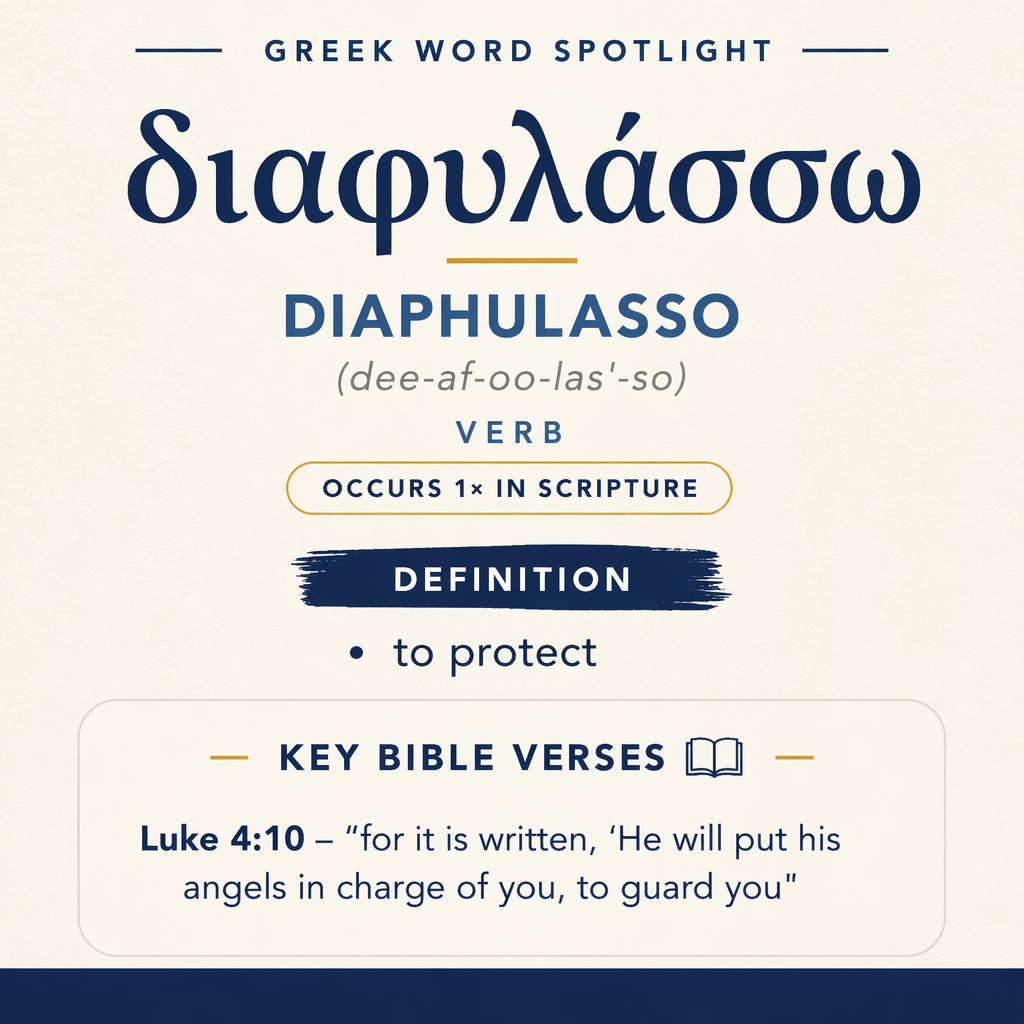
διαφυλάσσω means “to protect” and appears once in Scripture, in Luke 4:10.
Verse Context
In Luke 4:10, it occurs in the line: “He will put his angels in charge of you, to guard you;”.
Learn More →διαφυλάσσω means “to protect” and is attested in the Greek Scriptures in Luke 4:10. In that setting it appears in a citation about angelic care, presenting protection as an active, watchful guardianship over a person.
Root and Related Words
διαφυλάσσω (Diaphulasso) is formed with διά (dia), “through/because of,” joined to φυλάσσω (phylasso), “to keep/guard: observe.” The combined form expresses guarding in a strengthened way, with διά adding force to the action of φυλάσσω.

Occurrences
“for it is written, ‘He will put his angels in charge of you, to guard you;’” (Luke 4:10)
In Luke 4:10 the verb stands inside a written citation: “He will put his angels in charge of you, to guard you.” The scene is framed as an appeal to what “is written,” so the protection described is presented as a settled, scriptural assurance rather than a spontaneous promise invented in the moment. The content of the citation assigns agents—“his angels”—and gives them a directed task: they are “in charge of you,” and their charge is “to guard you.” In this line, διαφυλάσσω contributes the idea of protection as vigilant oversight, not merely a general wish for safety.
The wording also makes the protection personal and specific. The object is “you,” and the angels are “in charge of you,” so the guarding is not abstract or distant; it is directed toward an individual and attaches to that person’s circumstances. The verb’s placement after the appointment of angels emphasizes protection carried out by assigned guardians, as though the guarding is the practical execution of being “in charge.” In this way the action described is both purposeful and continuous in feel: a guarding that attends someone rather than a single intervention described with other language.
Sense and Usage
With the simple definition “to protect,” διαφυλάσσω in Luke 4:10 shows protection as something done by watchful guardians who are commissioned for the task. The line does not describe protection as a mere condition (“being safe”) but as an activity (“to guard you”) performed by agents placed over someone. Protection here has an ordered character: there is an authority who “will put” angels “in charge,” and there are guardians who carry out the protection that charge requires.
The verse’s phrasing also ties protection to accountability and responsibility. To be “in charge of you” implies that the guardians have a defined duty toward the person guarded. Thus the protection conveyed by διαφυλάσσω is not depicted as accidental or occasional; it is connected to a role. Even without adding details beyond the verse, the sentence itself portrays protection as a deliberate arrangement: protection is enacted through appointed guardianship.
Finally, because the verb occurs within “for it is written,” the protection is framed as something anchored in Scripture language. That rhetorical frame does not add a new meaning to the verb, but it affects how the protection is heard: it is invoked as a weight-bearing statement meant to be trusted. The result is that διαφυλάσσω, in its single attestation, carries the sense of protection that is both active (“to guard”) and structured (“put … in charge”).
Imagery
The verse supplies a concrete picture: angels set “in charge” of a person, guarding that person closely. The imagery is not of a wall or weapon named in the text, but of watchful custodianship—heavenly attendants assigned to protect someone under their care.
Sources: Lexical data from Strong’s Exhaustive Concordance and the Translators Brief Lexicon of Extended Strongs for Greek (STEPBible, CC BY). Occurrence data from the Translators Amalgamated Greek New Testament (STEPBible, CC BY). Scripture quotations from the World English Bible (public domain).





