Exploring the Meaning of Diaphero in Greek
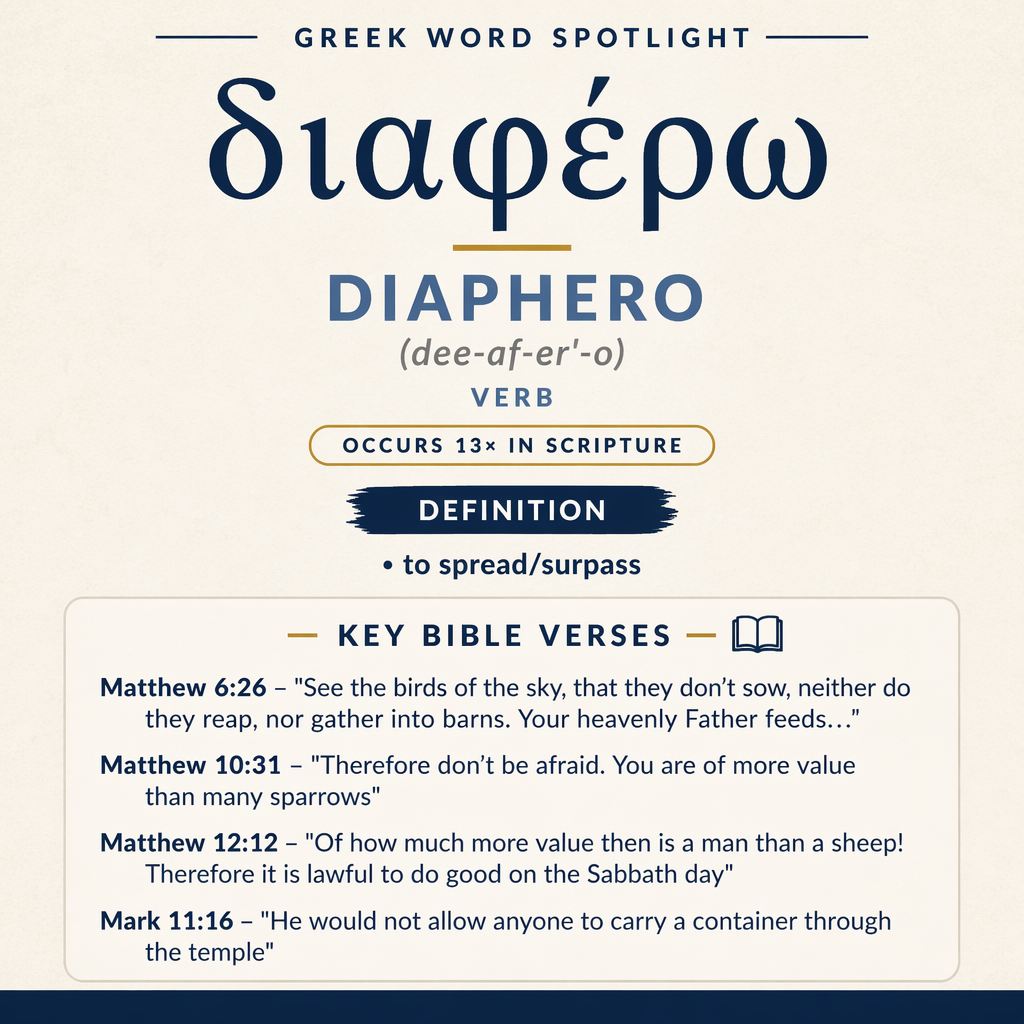
διαφέρω means “to spread/surpass” and occurs 13 times in Scripture, including in Matthew, Mark, Luke, and Acts.
Gospel Contexts
In Matthew 6:26; 10:31; 12:12 and Luke 12:7; 12:24, it appears in statements about being “of more value.”
Learn More →Acts Usage
In Acts 13:49, “The Lord’s word was spread abroad throughout all the region.” It also appears in Acts 27:27.
Learn More →διαφέρω expresses a twofold idea: it can describe something being spread, and it can describe something surpassing another in value or distinction. In the New Testament it appears in sayings about comparative worth, in a report of the word’s wider reach, and in scenes that highlight difference (or the lack of it).
Occurrences
Matthew 6:26 — “See the birds of the sky, that they don’t sow, neither do they reap, nor gather into barns. Your heavenly Father feeds them. Aren’t you of much more value than they?”
Here διαφέρω frames a comparison of worth. The verse sets birds and humans side by side: birds lack farming and storage, yet are fed; the point lands with “more value,” where διαφέρω marks surpassing in value within a simple, everyday observation.

Matthew 10:31 — “Therefore don’t be afraid. You are of more value than many sparrows.”
In this reassurance, διαφέρω again carries the force of surpassing value, but now with a sharpened comparison (“many sparrows”). The verb’s contribution is to place the hearers on the higher side of the scale and to connect that valuation to the command, “don’t be afraid.”
Matthew 12:12 — “Of how much more value then is a man than a sheep! Therefore it is lawful to do good on the Sabbath day.”
διαφέρω underwrites an argument: because a man surpasses a sheep in value, a conclusion about permitted action follows (“it is lawful to do good”). The comparison is not merely rhetorical flourish; the verb supports a moral inference drawn from relative worth.
Mark 11:16 — “He would not allow anyone to carry a container through the temple.”
This line presents a concrete action involving movement through a sacred space. In this setting, διαφέρω contributes the idea of carrying something through—an act of conveying—so that the prohibition concerns not only presence in the temple but the transporting of an item “through” it.
Luke 12:7 — “But the very hairs of your head are all counted. Therefore don’t be afraid. You are of more value than many sparrows.”
Luke pairs the surpassing-value comparison with a detail of exhaustive care (“the very hairs… are all counted”). διαφέρω functions in the closing assurance, reinforcing that the counted life is also the life that exceeds sparrows in value, and so fear is addressed directly.
Luke 12:24 — “Consider the ravens: they don’t sow, they don’t reap, they have no warehouse or barn, and God feeds them. How much more valuable are you than birds!”
The scene mirrors the earlier birds comparison, but expands the description (“no warehouse or barn”). διαφέρω again marks surpassing value, now set against the ravens’ lack of human provisioning; the hearers’ greater value is placed in the foreground by the question’s emphasis.
Acts 13:49 — “The Lord’s word was spread abroad throughout all the region.”
Here διαφέρω moves from valuation to dissemination. The verb depicts the Lord’s word as extending outward across geographical space (“throughout all the region”), emphasizing breadth of reach rather than comparison.
Acts 27:27 — “But when the fourteenth night had come, as we were driven back and forth in the Adriatic Sea, about midnight the sailors surmised that they were drawing near to some land.”
In the voyage narrative, the surrounding clauses evoke being carried along (“driven back and forth”). Within that motion, διαφέρω fits the scene of being borne or conveyed at sea, contributing to the picture of a vessel and its passengers moved by forces beyond their control as land is suspected nearby.
Romans 2:18 — “know his will, and approve the things that are excellent, being instructed out of the law,”
In this statement about moral discernment, διαφέρω stands behind “approve the things that are excellent.” The verb’s role is to express a selection that recognizes what surpasses—an approving judgment oriented toward what stands out in value or quality, grounded in instruction “out of the law.”
1 Corinthians 15:41 — “There is one glory of the sun, another glory of the moon, and another glory of the stars; for one star differs from another star in glory.”
διαφέρω serves the language of distinction. The verse arranges lights in an ordered comparison, and then narrows to the stars: “one star differs from another star in glory.” The verb marks surpassing or differing within a shared category, highlighting gradation rather than sameness.
Galatians 2:6 — “But from those who were reputed to be important—whatever they were, it makes no difference to me; God doesn’t show partiality to man—they, I say, who were respected imparted nothing to me,”
In Paul’s comment on reputed importance, διαφέρω appears as “it makes no difference to me.” The verb contributes the idea that the alleged distinction of status does not create a meaningful separation in Paul’s assessment, especially as the sentence continues to deny partiality and to state that nothing was added to him.
Galatians 4:1 — “But I say that so long as the heir is a child, he is no different from a bondservant, though he is lord of all,”
Here διαφέρω expresses the absence of effective distinction. The heir’s legal standing (“lord of all”) is set against lived condition (“so long as… a child”), and the verb states that, in that stage, there is no practical surpassing over a bondservant.

Sense and Usage
Across these passages διαφέρω oscillates between two concrete patterns that match its definition. In the “surpass” line of meaning, it most often appears in explicit comparisons: humans versus birds (Matthew 6:26; Matthew 10:31; Luke 12:7; Luke 12:24), man versus sheep (Matthew 12:12), and star versus star in glory (1 Corinthians 15:41). In each case the comparison is not left abstract; it is tethered to the scene’s point. Where fear is addressed, surpassing value supports reassurance (“Therefore don’t be afraid” in Matthew 10:31 and Luke 12:7). Where a dispute over lawful action is in view, surpassing value becomes a premise for doing good (Matthew 12:12). Where creation’s varied “glory” is described, surpassing/differing maps the observable variety within the heavens (1 Corinthians 15:41).
The same surpassing idea can also be negated to deny the force of a supposed distinction. Galatians 2:6 uses the verb to say that the reputedly important do not create a difference that binds Paul’s conscience or message; the status claim fails to produce a real separating effect. Galatians 4:1 similarly denies practical distinction between heir and bondservant at a particular stage of life, even while acknowledging an underlying title (“lord of all”). In Romans 2:18, the surpassing sense takes the form of discerning approval: to “approve the things that are excellent” is to recognize and affirm what surpasses alternatives, an evaluative act grounded in instruction.
Alongside surpassing, διαφέρω also carries the “spread” idea in ways that are vividly physical. Acts 13:49 portrays the Lord’s word as spreading outward through a region, a movement across space that results in wider presence. Mark 11:16 depicts a different kind of movement: carrying a container through the temple, an act of conveyance that is halted. Acts 27:27 fits the same broad field of being carried or borne along, with the voyage described as being driven back and forth in the sea; within that setting, the verb belongs to the narrative’s emphasis on motion and conveyance until land is near. These uses share the thread of transfer—something borne, carried, or extended from one place toward others.
Taken together, the passages show that διαφέρω can mark the spread of something across distance, or the surpassing (and therefore the difference) between items being compared. The contexts determine whether the verb points to outward movement (word through a region; a container through a precinct; a ship driven across waters) or to evaluative distinction (value, glory, excellence, status, and practical standing).
Imagery
The word’s scenes move between the ordinary and the expansive: birds and sparrows that are fed, a sheep set beside a man, and the counted hairs on a head; then a region in which a message travels, a temple corridor where carrying is stopped, and a ship on a dark sea edging toward land. Even the cosmic comparison—sun, moon, and stars—uses visible differences to make “differing” and “surpassing” feel tangible rather than theoretical.
Sources: Lexical data from Strong’s Exhaustive Concordance and the Translators Brief Lexicon of Extended Strongs for Greek (STEPBible, CC BY). Occurrence data from the Translators Amalgamated Greek New Testament (STEPBible, CC BY). Scripture quotations from the World English Bible (public domain).