Exploring the Meaning of Diateleo in Greek
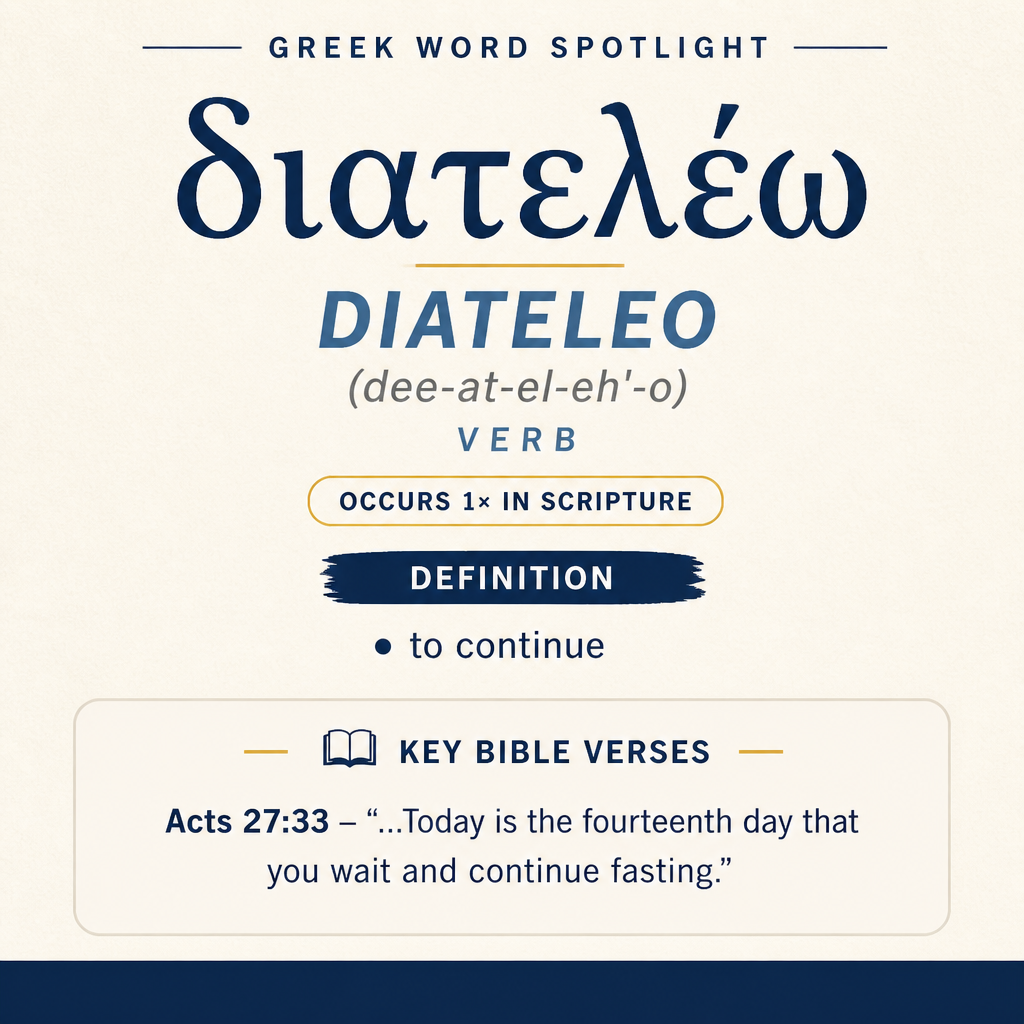
διατελέω means “to continue” and appears once in Scripture, in Acts 27:33.
Scripture Occurrence
This verb occurs 1 time in Scripture. Its single occurrence is in Acts 27:33.
Learn More →Context Snapshot
In Acts 27:33, Paul speaks of “the fourteenth day” that they wait, using διατελέω.
Learn More →διατελέω means “to continue” and appears in the narrative of Paul’s sea voyage to Rome, in a moment when a long, dangerous delay has pushed the crew and passengers to exhaustion. In its sole New Testament occurrence, the word helps Paul name an ongoing condition—one that has stretched across many days and now requires a decisive change.
Root and Related Words
διατελέω is connected with dia (διά), “through/because of,” and teleo (τελέω), “to finish.” These components frame the verb’s force in context: a state or activity is carried on through a span of time, with an eye toward its endpoint.

Occurrences
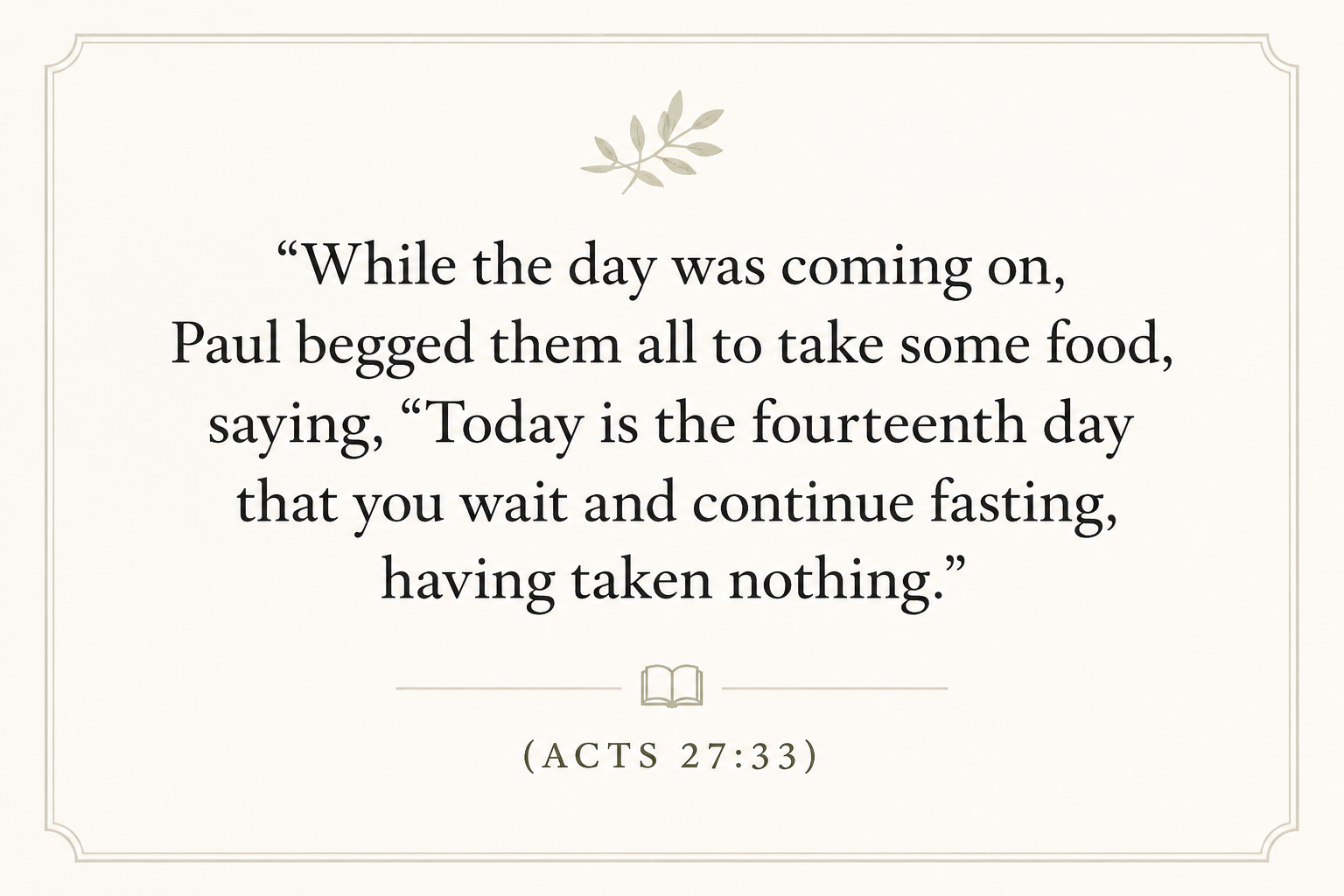
“While the day was coming on, Paul begged them all to take some food, saying, “Today is the fourteenth day that you wait and continue fasting, having taken nothing.” (Acts 27:33)
In Acts 27:33, διατελέω sits inside Paul’s direct speech and forms part of a carefully structured appeal. The setting is transitional—“While the day was coming on”—as if the approach of daylight marks a narrow window for action. Paul “begged them all to take some food,” and his argument is anchored in time: “Today is the fourteenth day.” By coupling the count of days with the description of their behavior (“you wait and continue fasting”), Paul depicts a pattern that has not merely happened once but has persisted.
The verb therefore does more than label fasting as an isolated choice; it presents fasting as an ongoing condition maintained across a defined stretch of time. The following phrase, “having taken nothing,” reinforces the practical consequence of that continued state: a prolonged absence of food intake. In the scene, the continuation is not described neutrally; it is invoked as the reason Paul’s request is urgent and reasonable. Paul is not speaking about a future plan to fast, nor about a single missed meal, but about an extended period that has now reached “the fourteenth day.” The word helps carry the weight of that duration, tying a present moment (“Today…”) to an unbroken thread of prior days.
The placement of διατελέω alongside “you wait” also matters for how the situation is portrayed. The waiting indicates enforced delay, uncertainty, or inability to act; the continuing fasting shows what has filled that delay physically. Together, they sketch a community stuck in suspense and progressively weakened. In that rhetorical pairing, the verb supports Paul’s pastoral strategy: he names their experience accurately, quantifies its length, and uses it to persuade them toward eating as daylight arrives.
Sense and Usage
The single attestation of διατελέω in Acts 27:33 displays “to continue” as persistence across an extended period, not merely momentary endurance. The context supplies a clear temporal boundary—“the fourteenth day”—which makes the continuation measurable and emphasizes accumulation: many prior days are gathered into one present moment. The verb thus serves as a bridge between past and present, enabling Paul to speak as if the ongoing pattern is still in effect and must now be interrupted for the sake of survival.
Because the continuation is attached to “fasting,” the word naturally takes on an embodied, practical feel in the narrative. It is not presented as an abstract continuation of ideas or plans, but continuation expressed in bodily deprivation: they have “taken nothing.” That concreteness helps explain why the verb is so persuasive within Paul’s appeal; continued fasting is not simply a spiritual posture here but a dangerous physical deficit. The scene gives the sense of continuation a pressing edge: the longer the behavior continues, the more it threatens their strength at the very time they need it.
διατελέω also functions as a spotlight on a group condition. Paul addresses “them all,” and the wording “you wait and continue fasting” paints the fasting as shared, communal experience rather than a private discipline. The verb supports that collective portrait by implying that the group as a whole has been carried along in the same sustained pattern. The continuation is therefore not merely individual habit but a shipboard reality affecting everyone—exactly the kind of reality that a leader must name plainly when calling for a change.
Finally, the timing marker “While the day was coming on” frames the continuation as belonging to the night and the long stretch before daybreak. Even without describing each intervening hour, the verse lets the reader feel the drawn-out passage: many days of waiting, a night giving way to morning, and a continued fasting that has extended into this new day. In that way, “to continue” becomes a narrative hinge: it describes what has been happening up to this moment, and it sets up the action Paul urges next—taking food—as the necessary breaking of that continuation.
Imagery
In Acts 27:33, διατελέω carries the imagery of time that will not release its grip: day after day of waiting, and hunger that has been allowed to run on without relief. Paul’s words place the continuation at the turning of the day, as though morning light exposes how long the pattern has lasted and presses the ship’s company toward a concrete act that ends the streak of deprivation.
Sources: Lexical data from Strong’s Exhaustive Concordance and the Translators Brief Lexicon of Extended Strongs for Greek (STEPBible, CC BY). Occurrence data from the Translators Amalgamated Greek New Testament (STEPBible, CC BY). Scripture quotations from the World English Bible (public domain).