Exploring the Meaning of Desmotes in Greek
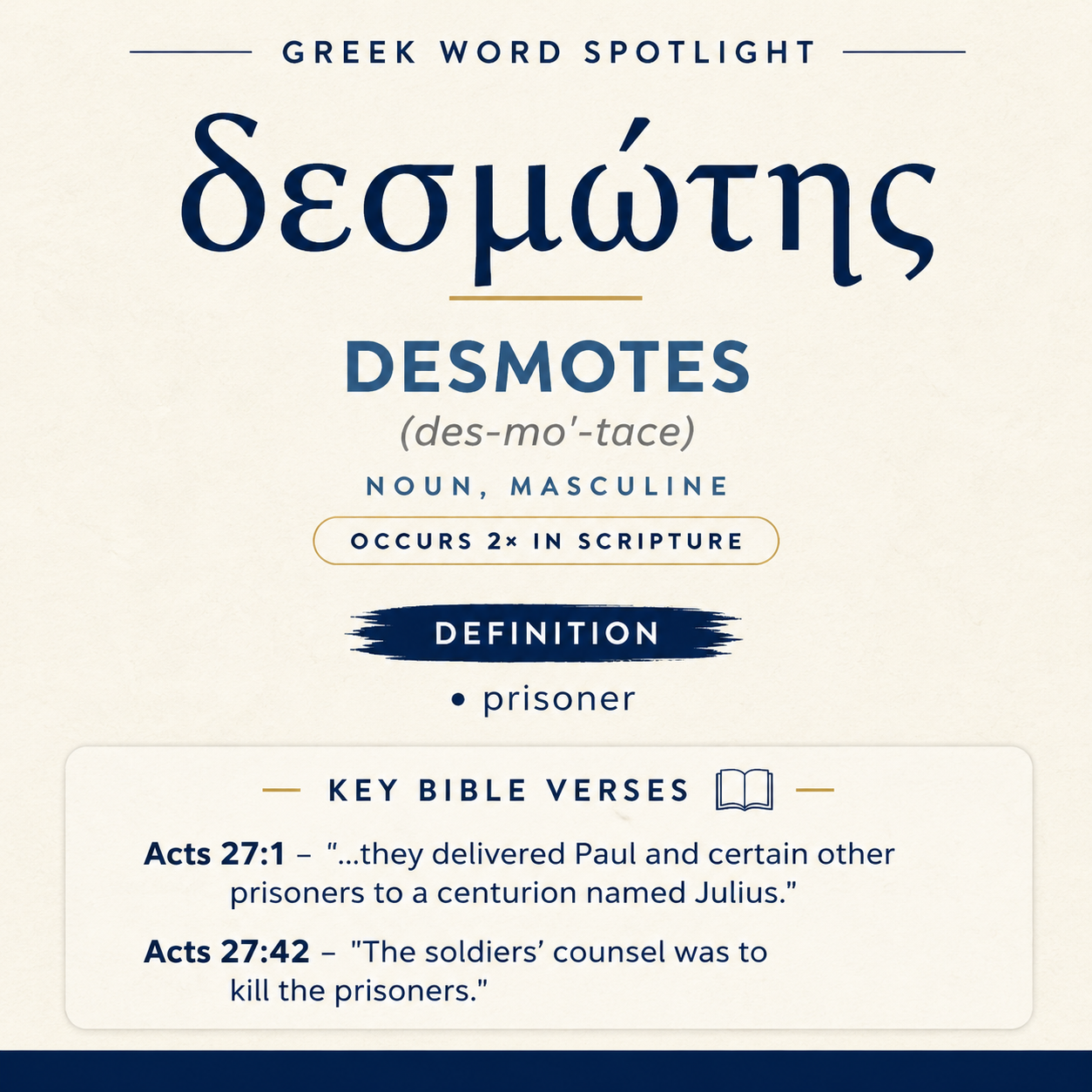
δεσμώτης (Desmotes) means “prisoner” and appears twice in Scripture, both in Acts 27:1 and Acts 27:42.
Acts 27 Context
In Acts 27:1, Paul and certain other prisoners are delivered to a centurion for a voyage to Italy. In Acts 27:42, soldiers plan to kill the prisoners to prevent escape.
Learn More →Where It Appears
This word occurs only in Acts 27:1 and Acts 27:42. It appears two times in Scripture.
Learn More →δεσμώτης means “prisoner” and appears in Acts 27 within the account of Paul’s voyage toward Italy. In both uses it names people under guard whose fate is being decided by others.
Root and Related Words
δεσμώτης is related to desmoterion (δεσμωτήριον), “prison” (Strong’s G1201), described as the word from which δεσμώτης derives.

Occurrences
“When it was determined that we should sail for Italy, they delivered Paul and certain other prisoners to a centurion named Julius, of the Augustan band.” (Acts 27:1)
Here δεσμώτης identifies a group traveling under custody as the journey begins. The verb “delivered” places the prisoners in a chain of responsibility: they are handed over to “a centurion named Julius,” and the centurion is explicitly connected with an identifiable military unit (“of the Augustan band”). In this setting, “prisoners” is not merely a description of location; it is a legal and social status that explains why these travelers are subject to escort and transfer rather than acting by their own initiative. The mention of “Paul and certain other prisoners” also shows that δεσμώτης can be used collectively for multiple individuals in the same situation, grouping Paul with others who share this constrained condition even if their stories and charges differ. The word therefore contributes to the narrative by setting the terms of movement: the voyage is not simply a trip but a conveyance of detainees under official oversight.
“The soldiers’ counsel was to kill the prisoners, so that none of them would swim out and escape.” (Acts 27:42)
In this later scene, δεσμώτης again marks the same kind of person, but now under crisis conditions where survival, security, and accountability collide. “The soldiers’ counsel” frames a deliberation among those tasked with control; their proposed action is extreme (“to kill the prisoners”), and the reason given is narrowly practical: “so that none of them would swim out and escape.” The word “prisoners” thus functions as the pivot of the soldiers’ logic. These are the people whose potential to “escape” creates a perceived risk serious enough to motivate lethal measures. At the same time, the verse presumes a chaotic environment in which “swim out” is a realistic option; the prisoners are near open water and have physical opportunity to flee, making their status as detainees newly difficult to enforce. δεσμώτης, in this context, highlights vulnerability: the prisoners are endangered not because of what they do in the verse, but because others judge them by their custodial category and act preemptively to prevent flight.
Sense and Usage
Across these two occurrences, δεσμώτης consistently denotes a person held in custody, but the word’s narrative weight shifts with the circumstances. In Acts 27:1 it is administrative and procedural: prisoners are “delivered” to an officer for transport, and the term naturally belongs to a system of custody, transfer, and supervision. The word gathers individuals into a class whose movement is controlled; their travel occurs by decision (“When it was determined…”) and by handover (“they delivered…”), and δεσμώτης gives a simple label to those who are moved under that arrangement.
By Acts 27:42, the same status becomes a matter of urgent security. The soldiers’ proposal assumes that prisoners have both motive and opportunity to flee, and the clause “so that none of them would swim out and escape” treats escape as the decisive danger. δεσμώτης therefore carries the implication, within this verse, that these people are not free agents whose choices can be negotiated with; they are persons whose custody must be maintained, even at a terrible cost, because their release would be construed as failure of control. The noun remains straightforward, yet it brings with it a whole set of relational roles that appear in the text: prisoners are those delivered to a centurion, guarded by soldiers, and evaluated in terms of potential escape.
Taken together, the usages show δεσμώτης operating at two levels. On the surface it simply identifies who these people are in the social order of the story. More subtly, it clarifies power dynamics: decisions are made about them (“determined,” “delivered,” “counsel”), and the term helps explain why those decisions have such force. The prisoners are present on the voyage not as passengers with ordinary rights of travel but as persons constrained by custody, liable to transfer, and subject to armed control. In a narrative driven by movement toward Italy, δεσμώτης marks a kind of movement that is compelled rather than chosen.
Imagery
In Acts 27, δεσμώτης evokes the picture of custody carried onto the sea: detainees transferred to an officer for transport, then threatened with death in a moment where water itself could become a path of escape. The word ties confinement to motion—people counted, handed over, watched, and feared as possible fugitives even amid the wider danger pressing on everyone aboard.
Sources: Lexical data from Strong’s Exhaustive Concordance and the Translators Brief Lexicon of Extended Strongs for Greek (STEPBible, CC BY). Occurrence data from the Translators Amalgamated Greek New Testament (STEPBible, CC BY). Scripture quotations from the World English Bible (public domain).