
Exploring the Meaning of Desmon in Greek
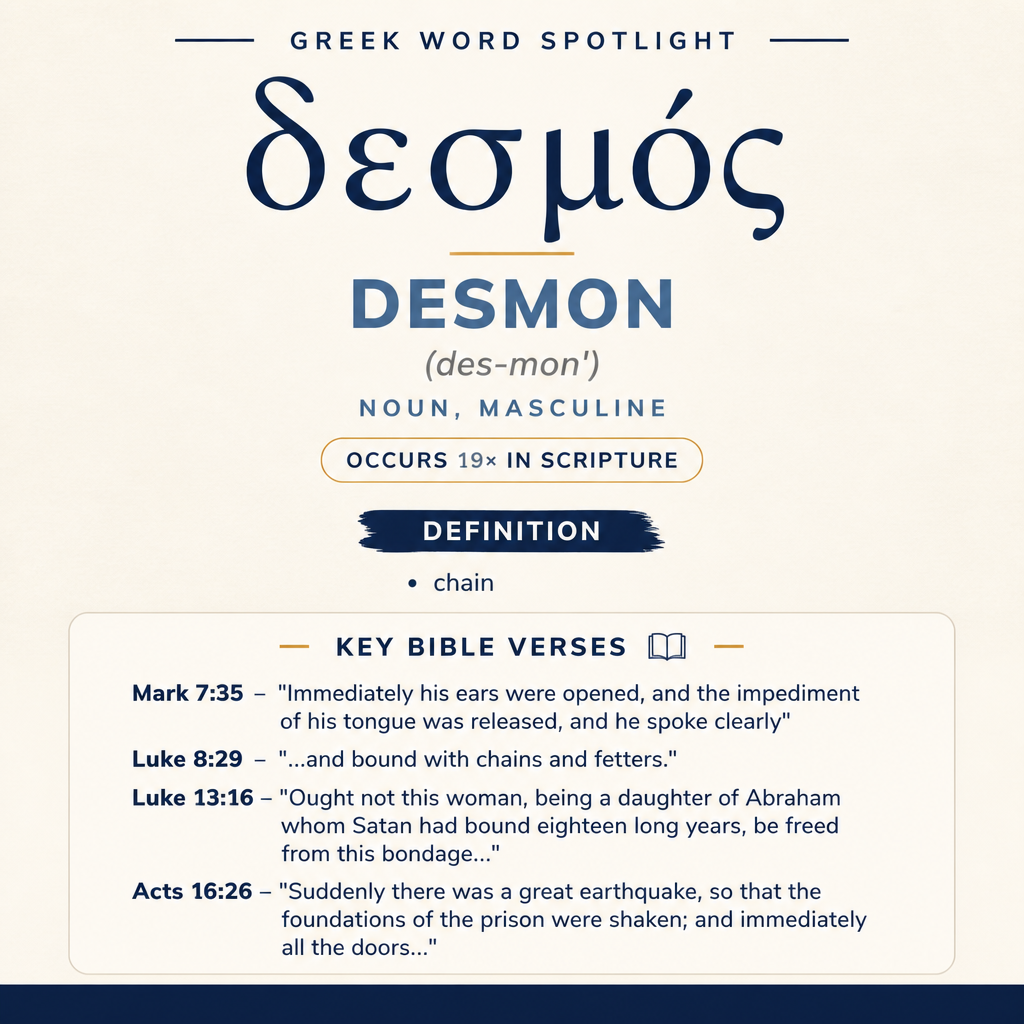
δεσμός means “chain” and occurs 19 times in Scripture, including Mark 7:35; Luke 8:29; Luke 13:16; and Acts.
Scripture Footprint
This word occurs 19 times in Scripture. References provided include Mark 7:35; Luke 8:29; Luke 13:16; Acts 16:26; Acts 20:23; Acts 22:30; Acts 23:29; and Acts 26:29.
Learn More →Acts Contexts
In Acts 20:23, Paul speaks of “bonds and afflictions” awaiting him. In Acts 22:30, someone is freed from “the bonds.”
Learn More →δεσμός refers to a “chain,” a concrete restraint that can also frame a person’s condition as one of confinement or limitation. In the passages where it appears, it is used in scenes of release, restraint, legal custody, and apostolic suffering.
Occurrences
“Immediately his ears were opened, and the impediment of his tongue was released, and he spoke clearly.” (Mark 7:35)
In this healing scene, δεσμός contributes the picture of something that holds fast and must be loosened. The verse pairs opening (“his ears were opened”) with release (“the impediment of his tongue was released”), presenting the condition as a restraint that yields immediately. The word’s force lies in the sudden transition from restriction to unhindered speech.

“For Jesus was commanding the unclean spirit to come out of the man. For the unclean spirit had often seized the man. He was kept under guard, and bound with chains and fetters. Breaking the bonds apart, he was driven by the demon into the desert.” (Luke 8:29)
Here δεσμός stands in a vivid account of physical containment used against violent spiritual oppression. The man is “kept under guard” and “bound with chains and fetters,” yet he is also described as “Breaking the bonds apart,” showing that the restraints are real and external but repeatedly defeated. The word underscores the severity of the confinement attempt and the destructive power that shatters it, heightening the contrast with Jesus’ commanding authority in the same verse.
“Ought not this woman, being a daughter of Abraham whom Satan had bound eighteen long years, be freed from this bondage on the Sabbath day?” (Luke 13:16)
δεσμός frames the woman’s long affliction as binding. The verb “had bound” and the question about being “freed” portray her condition as if fastened like a chain, and the duration (“eighteen long years”) makes the restraint feel weighty and prolonged. In the argument of the sentence, the word reinforces the moral clarity of release: bondage is treated as something improper to leave in place when liberation is possible.
“Suddenly there was a great earthquake, so that the foundations of the prison were shaken; and immediately all the doors were opened, and everyone’s bonds were loosened.” (Acts 16:26)
In the prison earthquake, δεσμός is part of a cascading picture of restraint being undone. The text moves from structural stability (“foundations”) to access (“doors”) to bodily confinement (“everyone’s bonds”), and the loosening of chains matches the opening of doors. The word’s contribution is the tactile detail that makes the liberation complete: not only barriers in the building but restraints on people are released “immediately.”
“except that the Holy Spirit testifies in every city, saying that bonds and afflictions wait for me.” (Acts 20:23)
Here δεσμός is projected into the future as an awaiting reality. Coupled with “afflictions,” the chain becomes a way to speak about anticipated confinement as part of the apostle’s path. The phrase “wait for me” gives the word a looming presence: chains are not merely an event that happens but a condition that stands ready in multiple places (“in every city”).
“But on the next day, desiring to know the truth about why he was accused by the Jews, he freed him from the bonds, and commanded the chief priests and all the council to come together, and brought Paul down and set him before them.” (Acts 22:30)
In this procedural setting, δεσμός marks custody that can be adjusted for inquiry. The official “freed him from the bonds” in order to conduct a hearing before “the chief priests and all the council,” so the chain functions as a practical instrument of detention rather than punishment in itself. The word makes Paul’s status visible: even when brought to speak, he is ordinarily held in chains, and their temporary removal signals controlled movement within legal authority.
“I found him to be accused about questions of their law, but not to be charged with anything worthy of death or of imprisonment.” (Acts 23:29)
δεσμός appears within a judgment about proportionality of restraint. The charge is evaluated as “questions of their law,” and the conclusion denies that it merits “death or of imprisonment.” In this context, chains represent the kind of penal outcome being weighed and rejected as unwarranted; the word helps define the stakes of the legal assessment.
“Paul said, “I pray to God, that whether with little or with much, not only you, but also all that hear me today, might become such as I am, except for these bonds.”” (Acts 26:29)
Paul’s statement uses δεσμός as the one element of his present condition he does not wish to transfer to others. The word is concrete (“these bonds”), pointing to visible chains that accompany his testimony before an audience. The contrast is rhetorically sharp: he desires the hearers to share his state in one sense, but not to share the physical confinement signified by the chain.
“When they had withdrawn, they spoke to one another, saying, “This man does nothing worthy of death or of bonds.”” (Acts 26:31)
Again δεσμός functions in a formal evaluation of guilt and punishment. The verdict among the listeners is that he deserves neither “death” nor “bonds,” pairing the most severe penalty with the restraint of imprisonment. The word’s effect is to frame chains as a punitive measure that requires justification—justification they explicitly deny.
“It is even right for me to think this way on behalf of all of you, because I have you in my heart, because both in my bonds and in the defense and confirmation of the Good News, you all are partakers with me of grace.” (Philippians 1:7)
In this pastoral context, δεσμός names the apostle’s confinement as a setting in which fellowship is experienced. “Both in my bonds and in the defense and confirmation of the Good News” places chains alongside active testimony, not as a cessation of mission but as the circumstance within which it continues. The word anchors the letter’s relational language: the community shares with him “in my bonds” as well as in proclamation and argument.
“so that it became evident to the whole palace guard, and to all the rest, that my bonds are in Christ,” (Philippians 1:13)
Here δεσμός is tied to public recognition. The chains are not private; they are known “to the whole palace guard, and to all the rest.” The phrase “my bonds are in Christ” links the visible reality of confinement with the identity and cause that explain it, so the chain becomes a sign interpreted by observers, spreading awareness beyond the immediate setting.
“and that most of the brothers in the Lord, being confident through my bonds, are more abundantly bold to speak the word of God without fear.” (Philippians 1:14)
In this verse δεσμός is portrayed as indirectly strengthening others. The chains are the means through which “most of the brothers” become “confident,” resulting in increased boldness “to speak the word of God without fear.” The word contributes a paradoxical emphasis: a physical restraint on one person becomes a catalyst for freer speech among many.

Sense and Usage
Across these occurrences, δεσμός consistently evokes restraint that can be tightened, borne, evaluated, and loosened. In healing narratives (Mark 7:35; Luke 13:16), it portrays a disabling condition as if it were a binding that rightly gives way to release. In scenes involving spiritual oppression (Luke 8:29), chains are literal instruments of control that fail under violent force, sharpening the need for a different kind of deliverance than mere containment.
In Acts, δεσμός moves into the sphere of custody and public adjudication. It appears as something removed for a hearing (Acts 22:30), discussed as a potential penalty (Acts 23:29; 26:31), and contrasted with innocence (“does nothing worthy of death or of bonds,” Acts 26:31). The word thus serves as a concrete marker of imprisonment while also functioning as shorthand for the legal consequences that imprisonment represents.
In Philippians, δεσμός becomes part of the apostle’s communicative world: chains are not only endured but interpreted (“evident…that my bonds are in Christ,” Phil 1:13) and socially productive (“being confident through my bonds,” Phil 1:14). Even here the word keeps its tangible character (“my bonds,” “these bonds”); its rhetorical strength depends on the audience imagining the actual chain and then tracking what that restraint signifies in public perception, communal participation, and courageous speech.
Imagery
The imagery of δεσμός in these passages oscillates between binding and loosening. Acts 16:26 presents the most kinetic picture—shaken foundations, opened doors, and loosened bonds—while Acts 26:29–31 holds chains in a courtroom-like setting where their justice is debated. In Philippians 1, the chain is visible enough to reach “the whole palace guard,” yet its presence does not silence speech; instead it becomes the backdrop against which the message advances “without fear.”
Sources: Lexical data from Strong’s Exhaustive Concordance and the Translators Brief Lexicon of Extended Strongs for Greek (STEPBible, CC BY). Occurrence data from the Translators Amalgamated Greek New Testament (STEPBible, CC BY). Scripture quotations from the World English Bible (public domain).




